Mars from Orbit (from July 2009)
|
|
|
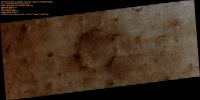
Utopia_Planitia-PIA13263.jpgDust Devil Tracks in Utopia Planitia (Natural Colors; credits for the additional process. and color.: Dr Paolo C. Fienga - Lunexit Team)66 visitenessun commentoMareKromium
|
|
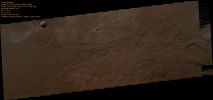
Utopia_Planitia-PIA13350.jpgUtopian Landscape (Natural Colors; credits for the additional process. and color.: Dr Paolo C. Fienga - Lunexit Team)97 visitenessun commentoMareKromium
|
|
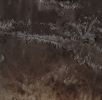
Valles_Marineris-01-PCF-LXTT.jpgThe "Valles Marineris Canyon System" (Absolute Natural Colors; credits for the additional process. and color.: Dr Paolo C. Fienga - Lunexit Team) 86 visitenessun commentoMareKromium
|
|
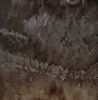
Valles_Marineris-02-PCF-LXTT.jpgThe "Valles Marineris Canyon System" (Absolute Natural Colors; credits for the additional process. and color.: Dr Paolo C. Fienga - Lunexit Team) 85 visitenessun commentoMareKromium
|
|
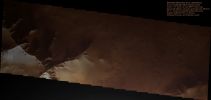
Valles_Marineris-20071228a-PCF-LXTT.jpgBetween Marineris and Labyrinthus... (Darkened Natural Colors; credits for the additional process. and color.: Dr Paolo C. Fienga - Lunexit Team)65 visiteDa ammirare, a nostro avviso, la "resa visiva" del contrasto fra zone esposte alla luce diretta del Sole, le zone in penombra e le zone in ombra (come quelle alle spalle della montagna che domina la porzione Sx del frame).
Ricordate, poi, che la Regola Aurea della fotografia spaziale recita quanto segue: "Quanto più il contrasto fra zone in luce e zone in ombra è netto, tanto minore è l'influenza dell'Atmosfera su quanto ripreso".
In questo frame, come in molti altri, il "contrasto" c'è, ma NON così netto come si vorrebbe (questa, almeno, è la nostra opinione).MareKromium
|
|

Valles_Marineris-MOD-PCF-LXTT.jpgFeatures of Valles Marineris (Absolute Natural Colors; credits for the additional process. and color.: Dr Paolo C. Fienga - Lunar Explorer Italia) 138 visitenessun commentoMareKromium
|
|
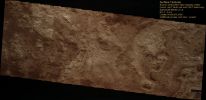
Vastitas_Borealis-20080624a-PCF-LXTT.jpgSurface Textures of the Northern Plains (Absolute Natural Colors; credits for the additional process. and color.: Dr Paolo C. Fienga - Lunexit Team)64 visiteCaption NASA:"Though the Northern Plains of Mars have little topographic variation, the surfaces textures very greatly from one Region to the next.
The cause of such variation is unknown".MareKromium
|
|
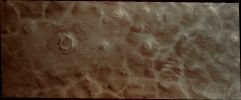
Vastitas_Borealis-NP-MO-20090219a.jpgVastitas' Texture (Natural Colors; credits for the additional process. and color.: Dr Paolo C. Finega - Lunar Explorer Italia)65 visiteCaption NASA:"The Northern Plains of Mars contain an abundance of different textures and appearances. This Region contains mounds separated by channels with an unusual floor pattern. Just how this texture formed is unknown".
Coord.: 70,0° North Lat. and 55,9° East Long.MareKromium
|
|

Volcanic_Features-Apollinaris_Caldera-20070914a-PCF-LXTT.jpgApollinaris Caldera (Natural Colors; credits for the additional process. and color.: Dr Paolo C. Fienga - Lunexit Team)290 visitenessun commentoMareKromium
|
|
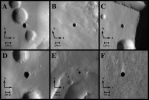
Volcanic_Features-Caverns-PIA09929-00.jpgOn the Northern Slope of Arsia Mons: candidates Cavern Entrance (1)83 visiteCaption NASA:"Seven very dark holes on the North Slope of Arsia Mons (about 9° South Lat. and 239° East Long.) have been proposed as possible cave skylights, based on day-night temperature patterns suggesting they are openings to subsurface spaces. These 6 excerpts of images taken in visible-wavelength light by the Thermal Emission Imaging System (THEMIS) camera on NASA's Mars Odyssey orbiter show the 7 openings.
Solar illumination comes from the left in each frame.
The features have been given informal names to aid comparative discussion. They range in diameter from about 100 meters (328 feet) to about 225 meters (738 feet).
The candidate cave skylights are (A) "Dena", (B) "Chloe", (C) "Wendy", (D) "Annie", (E) "Abby" (left) and "Nikki", and (F) "Jeanne."
Arrows signify North and the Direction of Illumination".MareKromium
|
|
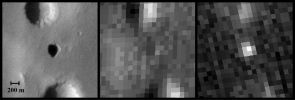
Volcanic_Features-Caverns-PIA09929-01.jpgOn the Northern Slope of Arsia Mons: candidate Cavern Entrance (Annie)65 visiteCaption NASA:"Each of the 3 images in this set covers the same patch of Martian Ground, centered on a possible cave skylight informally called "Annie" which has a diameter about double the length of a football field. The THEMIS camera on NASA's Mars Odyssey orbiter took all 3, gathering information that the hole is cooler than surrounding surface in the afternoon and warmer than the surrounding surface at night. This is thermal behavior that would be expected from an opening into an underground space.
The left image was taken in visible-wavelength light (fig. 1). The other 2 were taken in Thermal Infrared Wavelengths, indicating the relative temperatures of features in the image. The center image is from mid-afternoon. The hole is warmer than the shadows of nearby pits to the North and South, while cooler than sunlit surfaces. The thermal image at right was taken in the pre-dawn morning, about 4 M.L.T. .
At that hour, the hole is warmer than all nearby surfaces".
Nota Lunexit: ovviamente non era necessario nè uno scienziato nè un veggente per anticipare le mosse (di buon senso) della NASA, ma il fatto che i Tecnici di Pasadena abbiano effettivamente operato non solo delle riprese notturne di questa interessante Surface Feature, ma anche dei rilievi IR - come da noi suggerito ed anticipato, sebbene a proposito di un'altra (e forse più famosa) Candidate Cavern Entrance - ci ha dato, onestamente, una notevole soddisfazione!MareKromium
|
|
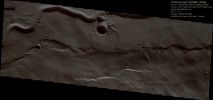
Volcanic_Features-Channels-HT-MO-PCF-LXTT.jpgChannels near Hecates Tholus (Absolute Natural Colors; credits for the additional process. and color.: Dr Paolo C. Fienga - Lunexit Team)113 visitenessun commentoMareKromium
|
|
| 1004 immagini su 84 pagina(e) |
 |
|
|
|
|
72 | |
|
|
|
|








