Mars from Orbit (from July 2009)
|
|
|
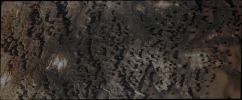
North_Polar_Regions-Olympia_Undae-PIA16320-PCF-LXTT-IPF.jpgFeatures of Olympia Undae (Absolute Natural Colors; credits for the additional process. and color.: Dr Paolo C. Fienga/Lunar Explorer Italia/Italian Planetary Foundation)97 visiteThis NASA - Mars Odyssey Orbiter "VIS" image shows a portion of Olympia Undae, the largest Dunefield near the North Polar Cap. In this Region, the Dunes are spaced far enough apart so to allow us to see the details of the Surface that they are moving across.
Orbit Number: 47095
Latitude: 79,6934° North
Longitude: 149,575° East
Instrument: VIS
Captured: July, 26, 2012MareKromium
|
|

North_Polar_Regions-The_Erg-PIA18233-PCF-LXTT-IPF.jpgFeatures of the North Polar Erg (Absolute Natural Colors; credits for the additional process. and color.: Dr Paolo C. Fienga/Lunar Explorer Italia/Italian Planetary Foundation)74 visiteIn this VIS image, taken by the NASA - Mars Odyssey Orbiter on February, 26th, 2014, and during its 54.141st orbit around the Red Planet, we can see a small area of the North Polar Erg (---> Sea of Dunes). As the season changes from Spring to Summer, the Dunes surrounding the North Polar Cap, as you can see here, become darker and darker.
Only the round and bright Feature located on the left (Sx) margin of the frame (that we have already noticed in the past, when other pictures of this very same area were taken even by other Orbiters), seems to remain - basically - unchanged during the entire Martian Year. Unfortunately, we do not know what that Feature actually is, but our educated guess is that it could reasonably be a (relatively large) patch of Permanent Ice and Frost, thick and compacted enough to resist to the Winds' Action and then make it through the whole Martian Summer, when the temperature considerably raises, without sublimating or melting.
Latitude (centered): 79,7727° North
Longitude (centered): 198,7900° East
Instrument: VIS
This image (which is an Original Mars Odyssey Orbiter b/w and Map-Projected frame published on the NASA - Planetary Photojournal with the ID n. PIA 18233) has been additionally processed, magnified to aid the visibility of the details, contrast enhanced, Gamma corrected and then colorized in Absolute Natural Colors (such as the colors that a human eye would actually perceive if someone were onboard the NASA - Mars Odyssey Orbiter and then looked down, towards the Surface of Mars), by using an original technique created - and, in time, dramatically improved - by the Lunar Explorer Italia Team.
MareKromium
|
|

Northern_regions-Dunes_and_Clouds-PIA07289-PCF-LXTT.jpgNorthern Clouds and Dunes (Absolute Natural Colors; credits for the additional process. and color.: Dr Paolo C. Fienga - Lunexit Team)119 visitenessun commentoMareKromium
|
|

Oenotria_Scapuli-PIA14567-PCF-LXTT.jpgFeatures of Oenotria Scapuli (Absolute Natural Colors; credits for the additional process. and color: Dr Paolo C. Fienga - Lunexit Team)203 visiteOrbit Number: 42604
Latitude: 5,8920° South
Longitude: 68,8747° East
Instrument: VIS
Captured: July, 23rd, 2011
Mars Local Time (M.L.T.): 06:03 (Early Morning Hours)
MareKromium
|
|

Ophir_Chasma-IR-20071219a.jpgLandslide in Ophir Chasma (IR) - coloring: Lunexit71 visiteCaption NASA: “The large landslide that can be seen on the right side (Dx) of this InfraRed (IR) image is located in Ophir Chasma. Although the resolution is less than the one that can be obtained from an image taken in Visible Light (VL), the large size of the feature is more completely covered by the wider frame size of the THEMIS infrared camera”.
Nota Lunexit: un esempio concreto di caption NASA "non sense".
Perchè vengono scattate le fotografie in IR? Beh – e questo lo sanno anche i bambini e gli “Scienziati da Salotto”… – non certo per avere una "qualità visiva migliore" (in senso stretto) del frame, né per "coprire meglio la superficie ripresa" (in termini di area inquadrabile).
A tal ultimo proposito Vi rammentiamo che il quantum di superficie inquadrabile dipende, in buona sostanza, non solo e non tanto dall'estensione del rilievo che interessa riprendere (attenzione: per questo tipo di frames si parla di rilievi aventi dimensioni comprese fra i 4 ed gli 8 Km di estensione in lunghezza ed i 2/3 Km di estensione in larghezza, e NON di rilievi grandi quanto possono esserlo dei continenti...), né dal tipo di "imaging strip" che la camera dell'Orbiter può ottenere.
Il quantum di cui sopra dipende, essenzialmente, DALL'ALTEZZA da cui la ripresa viene effettuata e dalla capacità di magnificazione della camera che riprende (ed ecco la semplicissima regola generale: per coprire una maggiore superficie con un singolo scatto, occorre aumentare l'altezza dell'Orbiter rispetto al suolo e ridurre la capacità di magnificazione della camera che riprende).
Tutto ciò premesso, e quindi tornando al quesito originale, Vi ricordiamo che le riprese orbitali in IR si fanno, di regola, di notte (o, comunque, in ore nelle quali la luminosità della superficie e bassissima e/o tendente a zero) e per verificare se un certo rilievo EMETTE o RITIENE (e, se SI, QUANTO) CALORE.
La spiegazione NASA, nei termini in cui viene esposta nella riportata caption, quindi – a nostro umile parere –, è totalmente priva di significato.
Anzi, peggio: è fuorviante.
Ed ora provate a rileggerla...
MareKromium
|
|
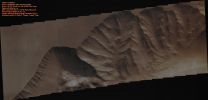
Ophir_Chasma-PIA14469-PCF-LXTT.jpgFeatures of Ophir Chasma (Absolute Natural Colors; credits for the additional process. and color: Dr Paolo C. Fienga - Lunexit Team)133 visitenessun commentoMareKromium
|
|
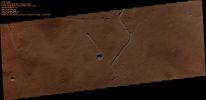
Pits_and_Channels-Ituxi_Valles-PIA13252.jpgPits and Channels in Ituxi Vallis (Natural Colors; credits for the additional process. and color.: Dr Paolo C. Fienga - Lunexit Team)89 visitenessun commentoMareKromium
|
|
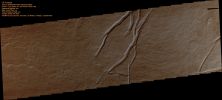
Pits_and_Channels-Oti_Fossae-PIA13253.jpgPits and Channels in Oti Fossae (Natural Colors; credits for the additional process. and color.: Dr Paolo C. Fienga - Lunexit Team)69 visitenessun commentoMareKromium
|
|
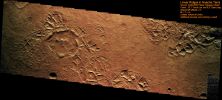
Polygonal_Ridges-NoachisTerra-20080401a-PCF-LXTT.jpgPolygonal and Linear Ridges in Noachis Terra (Extremely Enhanced Natural Colors; credits for the additional process. and color.: Dr Paolo C. Fienga - Lunexit Team)205 visitenessun commentoMareKromium
|
|
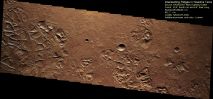
Polygonal_Ridges-NoachisTerra-20080502a-PCF-LXTT.jpgPolygonal and Linear Ridges in Noachis Terra (Enhanced Natural Colors; credits for the additional process. and color.: Dr Paolo C. Fienga - Lunexit Team)225 visitenessun commentoMareKromium
|
|
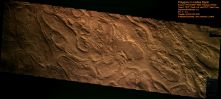
Polygons-Hellas_Basin-20080328a.jpgPolygons in Hellas Basin (Enhanced Natural Colors; credits for the additional process. and color.: Dr Paolo C. Fienga - Lunexit Team)66 visiteCaption NASA:"This interesting image shows a small portion of the Western Floor of Hellas Basin. The curved, broad ridges are separated by lower elevations filled with smaller, linear ridges". MareKromium
|
|

Ridges-Northern_Meridiani_Planum-PIA13830-PCF-LXTT.jpgRidges (Natural Colors; credits for the additional process. and color.: Dr Paolo C. Fienga - Lunexit Team)248 visitenessun commentoMareKromium
|
|
| 1004 immagini su 84 pagina(e) |
 |
|
|
|
|
66 | |
|
|
|
|








