Mars from Orbit (from July 2009)
|
|
|

North_Polar_Region-The_Erg-PIA07820-00.jpgFeatures of the North Polar Erg (Original NASA/JPL/ASU b/w Frame)77 visiteCaption NASA:"Sand Seas on Earth are often called "Ergs", an Arabic name for Dunefield, but a Sand Sea DIFFERS from a Dunefield in - at least - two ways:
1) a Sand Sea has a LARGE regional extent and
2) the individual Dunes forming the Sand Sea are LARGE in size and complex in form.
This VIS image was taken at 82° North Latitude during Northern Spring. The Dunes are still partially frost covered. This Region is part of the North Polar Sand Sea: so note the complexity and regional coverage of the Dunes".
Image information: VIS instrument;
Latitude: 81,2° North;
Longitude: 118,2° East (such as 241,8° West);
Resolution: 19 meter/pixel.
|
|

North_Polar_Region-The_Erg-PIA07820-01.jpgFeatures of the North Polar Erg (Absolute Natural Colors; credits for the additional process. and color.: Dr Paolo C. Fienga - Lunexit Team) 162 visiteCaption NASA:"Sand Seas on Earth are often called "Ergs", an Arabic name for Dunefield, but a Sand Sea DIFFERS from a Dunefield in - at least - two ways:
1) a Sand Sea has a LARGE regional extent and
2) the individual Dunes forming the Sand Sea are LARGE in size and complex in form.
This VIS image was taken at 82° North Latitude during Northern Spring. The Dunes are still partially frost covered. This Region is part of the North Polar Sand Sea: so note the complexity and regional coverage of the Dunes".
Image information: VIS instrument;
Latitude: 81,2° North;
Longitude: 118,2° East (such as 241,8° West);
Resolution: 19 meter/pixel.MareKromium
|
|

North_Polar_Regions-Aspledon_Undae-PIA18237-PCF-LXTT-IPF.jpgAspledon Undae (Absolute Natural Colors; credits for the additional process. and color.: Dr Paolo C. Fienga/Lunar Explorer Italia/Italian Planetary Foundation)124 visiteIn this VIS image, taken by the NASA - Mars Odyssey Orbiter on February, 27th, 2014, and during its 54.150th orbit around the Red Planet, we can see a small portion of a Martian Region known as Aspledon Undae: one of the several large Dunefields located near the North Pole of Mars. The term Undae, as you can easily understand, comes from the Latin word "Unda" (---> Wave; plural Undae ---> Waves) and, in this specific case, as the image suggests quite clearly, means Dunes (better yet: Wave-shaped Dunes).
Latitude (centered): 72,4562° North
Longitude (centered): 307,9130° East
Instrument: VIS
This image (which is a crop taken from an Original Mars Odyssey Orbiter b/w and Map-Projected frame published on the NASA - Planetary Photojournal with the ID n. PIA 18237) has been additionally processed, magnified to aid the visibility of the details, contrast enhanced, Gamma corrected and then colorized in Absolute Natural Colors (such as the colors that a human eye would actually perceive if someone were onboard the NASA - Mars Odyssey Orbiter and then looked down, towards the Surface of Mars), by using an original technique created - and, in time, dramatically improved - by the Lunar Explorer Italia Team.MareKromium
|
|
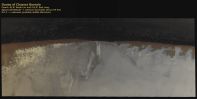
North_Polar_Regions-Chasma_Boreale-PCF-LXTT.jpgChasma Boreale (Absolute Natural Colors; credits for the additional process. and color.: Dr Paolo C. Fienga - Lunexit Team)68 visitenessun commentoMareKromium
|
|
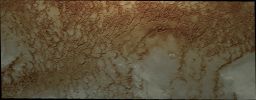
North_Polar_Regions-North_Polar_Erg-PCF-LXTT.jpgNorthern Dunes (Natural Colors; credits for the additional process. and color.: Dr Paolo C. Fienga - Lunexit Team)65 visiteCaption NASA:"This region of North Polar Dunes has less dune materials than other portions of the North Polar Erg. This allows the base (assumption) that the dunes are moving across to be observed".MareKromium
|
|

North_Polar_Regions-North_Polar_Erg-PIA13313.jpgNorth Polar Erg (Natural Colors; credits for the additional process. and color.: Dr Paolo C. Fienga - Lunexit Team)76 visiteRegions of densely coalesced dunes are common around the North Polar cap of Mars.
Orbit Number: 37730
Latitude: 80,146° North
Longitude: 274,555° East
Instrument: VIS
Captured: 2010, June, 17thMareKromium
|
|

North_Polar_Regions-North_Polar_Erg-PIA13661.jpgNorth Polar Erg (Absolute Natural Colors; credits for the additional process. and color.: Dr Paolo C. Fienga - Lunexit Team:)116 visitenessun commentoMareKromium
|
|

North_Polar_Regions-North_Polar_Erg-PIA15943-PCF-LXTT-IPF.jpgFeatures of the North Polar Erg (Absolute Natural Colors; credits for the additional process. and color.: Dr Paolo C. Fienga/Lunar Explorer Italia/Italian Planetary Foundation)79 visiteThe highly suggestive Dunefield visible in this VIS image taken by the NASA - Mars Odyssey Orbiter during its 46719th orbit around the Red Planet is just a small portion of the gigantic Dunefield (or "Erg" ---> Sea of Sand) that encircles most part of the North Pole of Mars. The bright round spot visible on the lower left (Sx) side of the frame should be just a patch of permanent ice which is located (and therefore, somehow, protected) inside a relatively shallow depression of the Surface - possibly (but we have no way to be sure), an almost rimless and very old Impact Crater.
Latitude (centered): 80,0896° North
Longitude (centered): 194,1910° East
Instrument: VIS
Captured: June, 26th, 2012
This frame (which is an Original Mars Odyssey Orbiter b/w frame published on the NASA - Planetary Photojournal with the ID n. PIA 15943) has been additionally processed and then colorized in Absolute Natural Colors (such as the colors that a human eye would actually perceive if someone were onboard the NASA - Mars Odyssey Orbiter and then looked down, towards the Surface of Mars), by using an original technique created - and, in time, dramatically improved - by the Lunar Explorer Italia Team.MareKromium
|
|

North_Polar_Regions-North_Polar_Erg-PIA17865-PCF-LXTT-IPF.jpgSpring over the North Polar Erg (Absolute Natural Colors; credits for the additional process. and color.: Dr Paolo C. Fienga - Lunar Explorer Italia/Italian Planetary Foundation)91 visiteIn this VIS image, taken by the NASA - Mars Odyssey Orbiter on December, 1st, 2013, and during its 53.076th orbit around the Red Planet, we can see the Erg (---> Sea/Ocean of Dunes) that surrounds the North Polar Cap of Mars. It is Springtime, now, at the North Pole (---> in the Northern Hemisphere of Mars) and the Dunes are starting to lose their Frost cover. As the season continues towards Summer, the Dunes will appear darker and darker, as the Frost sublimates.
The bright (and round, as we have found out using other frames) spot visible on the upper side of the picture should be just a patch of Permanent Ice which is located (and therefore, somehow, protected) inside a relatively shallow Depression of the Surface - possibly (but we have no way to be sure), an almost rimless and very old Impact Crater. You can take a look, if you wish to get a few more visual information about this area, at the APOD of April, 1st, 2013.
Latitude (centered): 80,267° North
Longitude (centered): 157,439° East
Instrument: VIS
This image (which is an Original Mars Odyssey Orbiter b/w and Map-Projected frame published on the NASA - Planetary Photojournal with the ID n. PIA 17865) has been additionally processed, magnified, contrast enhanced, Gamma corrected and then colorized in Absolute Natural Colors (such as the colors that a human eye would actually perceive if someone were onboard the NASA - Mars Odyssey Orbiter and then looked down, towards the Surface of Mars), by using an original technique created - and, in time, dramatically improved - by the Lunar Explorer Italia Team.MareKromium
|
|

North_Polar_Regions-North_Polar_Erg-PIA17866-PCF-LXTT-IPF-1.jpgSpring over the North Polar Erg (Absolute Natural Colors; credits for the additional process. and color.: Dr Paolo C. Fienga - Lunar Explorer Italia/Italian Planetary Foundation)86 visiteIn this VIS image, taken by the NASA - Mars Odyssey Orbiter on December, 1st, 2013, and during its 53.077th orbit around the Red Planet, we can see, once again, the Erg (---> Sea/Ocean of Dunes) that surrounds the North Polar Cap of Mars. It is Springtime, now, at the North Pole (---> in the Northern Hemisphere of Mars) and the Dunes are starting to lose their Frost cover. As the season continues towards Summer, the Dunes will appear darker and darker, as the Frost sublimates.
Specifically, throughout the accurate observation (and, even more, after the colorization) of the landscape that is shown here, we are able to easily notice that, in this portion of the North Polar Erg (a portion that is positioned a little more towards the South of the Northern Hemisphere - as compared to the Latitude of the Region observed during the 53.076th orbit of the NASA - Mars Odyssey Orbiter), there has been more Frost lost from the Dunes, and this circumstance caused them to appear darker than the Dunes that were shown in yesterday's APOD.
Latitude (centered): 79,990° North
Longitude (centered): 128,365° East
Instrument: VIS
This image (which is an Original Mars Odyssey Orbiter b/w and Map-Projected frame published on the NASA - Planetary Photojournal with the ID n. PIA 17866) has been additionally processed, magnified, contrast enhanced, Gamma corrected and then colorized in Absolute Natural Colors (such as the colors that a human eye would actually perceive if someone were onboard the NASA - Mars Odyssey Orbiter and then looked down, towards the Surface of Mars), by using an original technique created - and, in time, dramatically improved - by the Lunar Explorer Italia Team.MareKromium
|
|
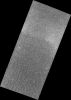
North_Polar_Regions-Olympia_Undae-PIA06848-00.jpgNorth Polar Erg: Olympia Undae (Original NASA/JPL/ASU b/w Frame)96 visiteImage information: VIS instrument;
Latitude: 81,4° North;
Longitude: 180,6° East (such as 179,4° West);
Resolution: 19 meter/pixel.
|
|
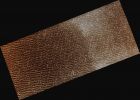
North_Polar_Regions-Olympia_Undae-PIA06848-01.jpgNorth Polar Erg: Olympia Undae (Absolute Natural Colors; credits for the additional process. and color.: Dr Paolo C. Fienga - Lunexit Team)183 visiteImage information: VIS instrument;
Latitude: 81,4° North;
Longitude: 180,6° East (such as 179,4° West);
Resolution: 19 meter/pixel.
MareKromium
|
|
| 1004 immagini su 84 pagina(e) |
 |
|
|
|
|
65 | |
|
|
|
|








