Mars from Orbit (from July 2009)
|
|
|
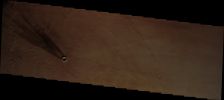
Aeolian_Features-Windstreaks-Pavonis_Mons-20090306a.jpgBeautiful Windstreak, East of Pavonis Mons (Enhanced and Darkened Natural Colors; credits for the additional process. and color.: Dr Paolo C. Fienga - Lunar Explorer Italia)64 visiteCaption NASA:"This Windstreak is located on the Volcanic Flows located East of Pavonis Mons. The multiple tail ends indicate the direction of the wind has changed over time. The darkest tail is the most recent".
Coord.: 0,8° South Lat. and 256,5° East Long.MareKromium
|
|

Aeolian_Features-Windstreaks-SMP-PIA15210-PCF-LXTT.jpgWindstreak in Syrtis Major Planum (Absolute Natural Colors; credits for the additional process. and color.: Dr Paolo C. Fienga - Lunexit Team)265 visiteOrbit Number: 44101
Latitude: 4,105° North
Longitude: 67,941° East
Instrument: VIS
Captured: November, 23rd, 2011
Mars Local Time (M.L.T.): 13:51 (Early Afternoon)
MareKromium
|
|

Aeolian_Features-Windstreaks-SMP-PIA17683-PCF-LXTT-IPF.jpgWindstreaks in Syrtis Major Planum (EDM - Absolute Natural Colors; credits for the additional process. and color.: Dr Paolo C. Fienga/Lunar Explorer Italia/Italian Planetary Foundation)89 visiteIn this VIS image, taken by the NASA - Mars Odyssey Orbiter on September, 24th, 2013, and during its 52.254th orbit around the Red Planet, we can see (an count) a series of at least 8 (eight) Windstreaks (probably the most common Aeolian - meaning Wind-caused/related - Surface Feature found on Mars), which are located in the (VERY dark, as far as its Albedo - Reflectivity - is concerned) Region known as Syrtis Major Planum.
Syrtis Major Planum - when observed through a telescope - looks like a "Dark Spot" (---> Albedo Feature) located at the Boundary between the Northern Lowlands and Southern Highlands of Mars, just West of the large Impact Basin known as Isidis Planitia. In fact, Syrtis Major Planum was discovered, on the base of data collected by the NASA - Mars Global Surveyor Orbiter, to be a low-relief Shield Volcano, when it was formerly believed to be just a Plain (and it was then known as Syrtis Major Planitia). The very dark color of its Surface comes - most likely - from the Basaltic Volcanic Rocks that form (---> are found all over) the Region and a corresponding (and relative) relative lack of the Red/Orange Dust that covers most of the Red Planet.
Latitude (centered): 5,90248° North
Longitude (centered): 69,73730° East
Instrument: VIS
This image (which is an Original Mars Odyssey Orbiter b/w and Map-Projected frame published on the NASA - Planetary Photojournal with the ID n. PIA 17683) has been additionally processed, magnified, contrast enhanced, Gamma corrected and then colorized in Absolute Natural Colors (such as the colors that a human eye would actually perceive if someone were onboard the NASA - Mars Odyssey Orbiter and then looked down, towards the Surface of Mars), by using an original technique created - and, in time, dramatically improved - by the Lunar Explorer Italia Team.MareKromium
|
|
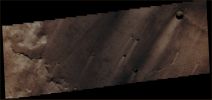
Aeolian_Features-Windstreaks-Syrtis_Major_Planum-PIA14991-PCF-LXTT.jpgWindstreaks in Syrtis Major Planum (Enhanced Absolute Natural Colors; credits for the additional process. and color.: Dr Paolo C. Fienga - Lunexit Team) 191 visiteOrbit Number: 43303
Latitude: 0,5713° South
Longitude: 68,6023° East
Instrument: VIS
Captured: September, 18th, 2011
Mars Local Time (M.L.T.): 19:33 (Early Evening)
MareKromium
|
|

Aeolian_Features-Windstreaks-Terra_Sabaea-PIA14182-PCF-LXTT.jpgWindstreaks in Terra Sabaea (Natural Colors; credits for the additional process. and color.: Dr Paolo C. Fienga - Lunexit Team)285 visiteOrbit Number: 41717
Latitude: 0,444208° South
Longitude: 68,7349° East
Instrument: VIS
Captured: May, 11th, 2011MareKromium
|
|
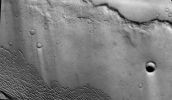
Aeolian_Features-Windstreaks_and_Meroe_Dunes-PIA08597-1.jpgWindstreaks (Original NASA/2001 Mars Odyssey Orbiter b/w Frame)63 visiteImage information: VIS instrument;
Latitude: 6,3° North;
Longitude: 68,3° East;
Resolution: 18 meter/pixel
|
|

Aeolian_Features-Windstreaks_and_Meroe_Dunes-PIA08597-PCF-LXTT.jpgWindstreaks (Absolute Natural Colors; credits for the additional process. and color.: Dr Paolo C. Fienga - Lunar Explorer Italia)65 visiteImage information: VIS instrument;
Latitude: 6,3° North;
Longitude: 68,3° East;
Resolution: 18 meter/pixel
MareKromium
|
|

Aeolian_Features-Yardangs-20080104a-PCF-LXTT.jpgPeri-Equatorial Yardangs (MULTISPECTRUM; credits: Lunexit)63 visiteCaption NASA:"The power of the wind to reshape the surface is readily exposed in the Equatorial Region of Mars, South and East of Olympus Mons. The materials here have been sculpted and resculpted by thousands, if not hundreds of thousand, years of exposure to the wind". MareKromium
|
|

Aeolian_Features-Yardangs-20080111a.jpgAshes and Sulphur all over Apollinaris Patera (Extremely Enhanced Natural Colors; credits for the additional process. and color.: Dr Paolo C. Fienga - Lunexit Team) 171 visiteSe, per questo frame, la NASA sottolinea, per altro giustamente, l'aspetto legato ai "segni del vento" lasciati nei pressi dell'antico vulcano noto come Apollinaris Patera, noi preferiamo enfatizzare il "senso" di questa colorizzazione (forse un pò psichedelica, ma non fantasiosa).
Ricordate le istantanee Apollo 17 che ritraevano, nei pressi del Cratere noto come "Shorty", delle sabbie e detriti arancio/rossastri e che tanto stupirono la Comunità Scientifica? Ebbene, quel "bizzarro" colore della superficie lunare era solo l'evidenza di una remota attività vulcanica o di un, forse più recente, outgassing. Qualunque fosse l'origine del fenomeno, tuttavia, la sua causa venne chiarita attraverso l'analisi dei campioni riportati a Terra.
Per ricordare:"...On Earth, orange or rust-colored rocks and soil around volcanic vents are often the result of literal rusting of iron by volcanic water vapor. If this was the cause of the orange soil at Shorty then, small amounts of volcanic gasses might still be present (on the Moon)...".
Ed anche su Marte, ovviamente. Le "parole magiche", poi (e soprattutto per Marte), sono "ruggine causata da vapore acqueo". Ora la domanda è ovvia: perchè continuare a soffermarsi sulla tracce di "Aeolian Activities" quando c'è qualcosa - a nostro parere - di molto più intrigante da indagare?
Qualcosa che se, sulla Luna, poteva avere senso solo se riferita ad un remoto passato, su Marte potrebbe significare moltissimo in proiezione attuale e futura? Pensateci bene: il fenomeno del "rusting" (e quindi dei colori rosso/arancio accesi, sia sulla Luna, sia sulla Terra e sia su Marte o altrove nel Sistema Solare) si risolve nell'ossidazione di elementi ferrosi (iron-based and iron-rich elements) a causa della presenza di acqua (in qualche forma).
Perchè quindi ignorare il vapore acqueo (con la possibile "cappa di umidità" in perenne sospensione, come sostiene l'Amico Matteo Fagone) e parlare solo di "venti", di "yardangs", di "layers" e di tante altre cose certamente importanti e meravigliose, ma mai tanto importanti e meravigliose quanto l'eventuale - ed attuale - presenza di acqua sul Pianeta "Arrugginito"?
Ecco: alla fine, ben più di Cydonia e dei possibili "Artifacts Marziani", è questo il VERO "mistero"...MareKromium
|
|

Aeolian_Features-Yardangs-Apollinaris_PateraPIA08729.jpgYardangs in Apollinaris Patera (Original NASA/MGS/MSSS b/w Frame)73 visiteCaption NASA originale:"Only a portion of the ejecta remains around this Unnamed Crater. Wind action is creating Yardangs and stripping off the Surface Materials in this Region".
Image information: VIS instrument;
Latitude: 7,0° South;
Longitude: 173,8° East;
Resolution: 18 meter/pixel.
|
|

Aeolian_Features-Yardangs-Elysium-PIA03283-1.jpgYardangs in Elysium Planitia (Original NASA/JPL/ASU b/w Frame)79 visiteCaption NASA:"The multiple trends of Yardangs in this image indicate that the (Dominant) Winds in the Elysium Region have changed direction several times".
Image information: VIS instrument;
Latitude: 2,6° North Lat. and 151,2 East Long;
Resolution: 18 meter/pixel.
|
|

Aeolian_Features-Yardangs-Elysium-PIA03283-2.jpgYardangs in Elysium Planitia (Original NASA/JPL/ASU b/w Frame)62 visitenessun commento
|
|
| 1004 immagini su 84 pagina(e) |
 |
|
4 | |
|
|
|
|
|
|
|








