Mars from Orbit (from July 2009)
|
|
|
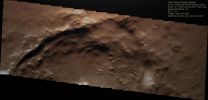
Craters-Unnamed_Crater-20080214a-PCF-LXTT.jpgDark Seeps within an Unnamed highly degraded Northern Crater (EDM - Enhanced Absolute Natural Colors; credits for the additional process. and color.: Dr Paolo C. Fienga - Lunexit Team)87 visitenessun commentoMareKromium
|
|
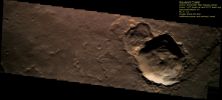
Craters-Unnamed_Crater-20080218a-PCF-LXTT.jpgNot Round... (Enhanced Natural Colors; credits for the additional process. and color.: Dr Paolo C. Fienga - Lunexit Team)66 visiteCaption NASA: "There are several reasons that an impact crater may end up not being round. Preexisting faults and fractures in the ground can control how the impact energy is distributed, resulting in corners or straight walls along the fracture trends. Very low angle impacts (from 5 up to 12°) can 'skip' along the surface, creating an elongated crater".
MareKromium
|
|
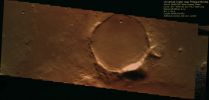
Craters-Unnamed_Crater-20080721a-PCF-LXTT.jpgUnnamed Crater near Phlegra Montes (Darkened and Enhanced Natural Colors; credits for the additional process. and color.: Dr Paolo C. Fienga - Lunexit Team)63 visitenessun commentoMareKromium
|
|

Craters-Unnamed_Crater-Arabia_Terra-PCF-LXTT.jpgDelta Formation in Arabia Terra (Saturated Natural Colors; credits: Dr Paolo C. Fienga - Lunexit Team)76 visitenessun commentoMareKromium
|
|
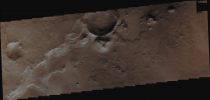
Craters-Unnamed_Crater-Arabia_Terra-PIA15217-PCF-LXTT.jpgUnnamed Crater and Layers in Arabia Terra (Absolute Natural Colors; credits for the additional process. and color.: Dr Paolo C. Fienga - Lunexit Team)133 visiteOrbit Number: 44265
Latitude: 15,3897° North
Longitude: 20,2306° East
Instrument: VIS
Captured: December, 7th, 2011MareKromium
|
|
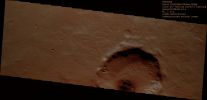
Craters-Unnamed_Crater-Argyre_Planum-20080612a-PCF-LXTT.jpgUnnamed Crater in Argyre Planum (Natural Colors; credits for the additional process. and color.: Dr Paolo C. Fienga - Lunexit Team)65 visitenessun commentoMareKromium
|
|
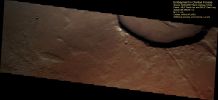
Craters-Unnamed_Crater-Claritas_Fossae-20080206a-PCF-LXTT.jpgUnnamed Crater with Embayment in Claritas Fossae (Absolute Natural Colors; credits for the additional process. and color.: Dr Paolo C. Fienga - Lunexit Team)77 visitenessun commentoMareKromium
|
|
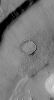
Craters-Unnamed_Crater-Deuteronilus_Mensae-PIA08472-00.jpgAlmost Buried Unnamed Crater in Deuteronilus Mensae (Original NASA/JPL/ASU b/w Frame)64 visiteCaption NASA originale: "This Unnamed Crater appears to be in the process of being covered over by downslope movement of material. These large slopes of material are common in Deuteronilus Mensae".
Image information: VIS instrument;
Latitude: 41,1° North;
Longitude: 17,8° East;
Resolution: 19 meter/pixel.
|
|
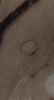
Craters-Unnamed_Crater-Deuteronilus_Mensae-PIA08472-01.jpgAlmost Buried Unnamed Crater in Deuteronilus Mensae (Absolute Natural Colors; credits for the additional process. and color.: Dr Paolo C. Fienga - Lunexit Team)141 visiteCaption NASA originale: "This Unnamed Crater appears to be in the process of being covered over by downslope movement of material. These large slopes of material are common in Deuteronilus Mensae".
Image information: VIS instrument;
Latitude: 41,1° North;
Longitude: 17,8° East;
Resolution: 19 meter/pixel. MareKromium
|
|
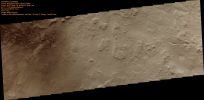
Craters-Unnamed_Crater-MO.jpgUnnamed Crater with Dunefield (Natural Colors; credits for the additional process. and color.: Dr Paolo C. Fienga - Lunexit Team)75 visitenessun commentoMareKromium
|
|

Craters-Unnamed_Crater-NT-PIA17420-PCF-LXTT-IPF.jpgUnnamed Crater with Dunefield (Absolute Natural Colors; credits for the additional process. and color.: Dr Paolo C. Fienga/Lunar Explorer Italia/Italian Planetary Foundation)69 visiteIn this VIS image, taken by the NASA - Mars Odyssey Orbiter on July 2nd, 2013, and during its 51.232nd orbit around the Red Planet, we can see a relatively large, dark and, probably, "Migrating" Dunefield that is found on the Floor of an old and Unnamed Impact Crater located in the Martian Southern Region known as Noachis Terra.
Even this Dunefield (just like the one found on the Floor of Proctor Crater - please, refer to yesterday's APOD if you want to know more -, as well as many others, located on both Martian Hemispheres) is being monitored by several Spacecrafts now orbiting the Red Planet (including the NASA- Mars Reconnaissance Orbiter) with the aim of identifying the movements (---> shifting, if any) of the Dunefield and the changes (again, if any) which might have occurred - over time - in the shape of the Dunefield itself.
Latitude (centered): 52,1373° South
Longitude (centered): 30,6046° East
Instrument: VIS
This frame (taken from an Original Mars Odyssey Orbiter b/w and Map-Projected frame published on the NASA - Planetary Photojournal with the ID n. PIA 17420) has been additionally processed, magnified, contrast enhanced, Gamma corrected and then colorized in Absolute Natural Colors (such as the colors that a human eye would actually perceive if someone were onboard the NASA - Mars Odyssey Orbiter and then looked down, towards the Surface of Mars), by using an original technique created - and, in time, dramatically improved - by the Lunar Explorer Italia Team.MareKromium
|
|

Craters-Unnamed_Crater-Northern_Regions-PIA08611.jpgUnnamed Crater in Vastitas Borealis (Original NASA/2001 Mars Odyssey b/w Frame)64 visiteImage information: VIS instrument;
Latitude: 69,1° North;
Longitude: 273,6° East;
Resolution: 20 mt/pixel.
|
|
| 1004 immagini su 84 pagina(e) |
 |
|
|
|
|
37 | |
|
|
|
|








