Mars from Orbit (from July 2009)
|
|
|
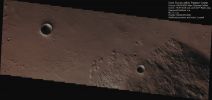
Craters-Pasteur_Crater-PCF-LXTT.jpgFeatures of Pasteur Crater (Absolute Natural Colors; credits for the additional process. and color: Dr Paolo C. Fienga - Lunexit Team)117 visitenessun commentoMareKromium
|
|
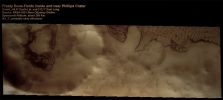
Craters-Phillips_Crater.jpgFrosty Dunefields inside and near Phillips Crater (Absolute Natural Colors; credits for the additional process. and color.: Dr Paolo C. Fienga - Lunexit Team) 133 visitenessun commentoMareKromium
|
|

Craters-Pollack_Crater-White_Rock_MO_1238-PCF-LXTT.jpgWhite Rock (Natural Colors; credits for the additional process. and color.: Dr Paolo C. Fienga - Lunexit Team)244 visitenessun commentoMareKromium
|
|

Craters-Pollack_Crater_and_White_Rock-20020419a-PCF-LXTT.jpgPollack Crater and "White Rock" (Slightly Saturated Absolute Natural Colors; credits for the additional process. and color.: Dr Paolo C. Fienga - Lunexit Team)64 visiteCaption NASA:"White Rock is the unofficial name for this unusual landform which was first observed during the Mariner 9 Mission in the early 70's. As later analysis of additional data sets would show, White Rock is neither white nor dense rock. Its apparent brightness arises from the fact that the material surrounding it is so dark. Images from the Mars Global Surveyor MOC camera revealed dark sand dunes surrounding White Rock and on the floor of the troughs within it.
Some of these dunes are just apparent in the THEMIS image. Although there was speculation that the material composing White Rock could be salts from an ancient dry lakebed, spectral data from the MGS TES instrument did not support this claim. Instead, the White Rock deposit may be the erosional remnant of a previously more continuous occurrence of air fall sediments, either volcanic ash or windblown dust.
The THEMIS image offers new evidence for the idea that the original deposit covered a larger area.
Approximately 10 Km to the South-East of the main deposit are some tiny knobs of similarly bright material preserved on the floor of a small crater. Given that the eolian erosion of the main White Rock deposit has produced isolated knobs at its edges, it is reasonable to suspect that the more distant outliers are the remnants of a once continuous deposit that stretched at least to this location.
The fact that so little remains of the larger deposit suggests that the material is very easily eroded and simply blows away".MareKromium
|
|

Craters-Proctor_Crater-20090615a-PCF-LXTT.jpgDunes in Proctor Crater (Natural Colors; credits for the additional process. and color.: Dr Paolo C. Fienga - Lunar Explorer Italia)68 visiteCoord. 48,1° South Lat. and 30,2° East Long.MareKromium
|
|
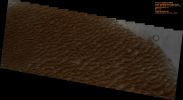
Craters-Proctor_Crater-20090922a.jpgProctor Crater (Natural Colors; credits: Lunar Explorer Italia)82 visitenessun commentoMareKromium
|
|
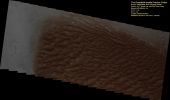
Craters-Proctor_Crater-20091015a.jpgProctor Crater (Natural Colors; credits: Lunar Explorer Italia)78 visitenessun commentoMareKromium
|
|

Craters-Proctor_Crater-Dunefield-PIA13916-PCF-LXTT.jpgProctor Crater's Dunefield (Natural Colors; credits for the additional process. and color.: Dr Paolo C. Fienga - Lunexit Team)228 visitenessun commentoMareKromium
|
|

Craters-Proctor_Crater-PIA17421-PCF-LXTT-IPF.jpgProctor Crater's Dunefield (Absolute Natural Colors; credits for the additional process. and color.: Dr Paolo C. Fienga/Lunar Explorer Italia/IPF)69 visiteIn this VIS image, taken by the NASA - Mars Odyssey Orbiter on July 4th, 2013, and during its 51.257th orbit around the Red Planet, we can see part of the very large Dunefield that is located located on the Floor of Proctor Crater (a large Impact Crater found in the Noachis Quadrangle of Mars, at about 48° South Latitude and 330,5° West Longitude).
Proctor Crater is approx. 168 Km (such as about 104,3 miles) in diameter and it was so named after Dr Richard A. Proctor, a British Astronomer (who was born in Chelsea - London, UK, on March, 23rd, 1837 and died in New York - USA - on September, 12th, 1888). Proctor Crater contains an approx. 35 x 65 Km (such as about 21,7 x 40,36 miles) Dark Dunefield that was one of the first Sand Dunefields ever recognized on Mars - note: this discovery was based on the NASA - Mariner 9 Spacecraft's images. Just out of curiosity, Proctor's Dunes are still being monitored by several Spacecrafts now orbiting the Red Planet (including the NASA- Mars Reconnaissance Orbiter) with the aim of identifying the changes (if any) which might have occurred - over time - in the shape of the Dunefield itself.
Latitude (centered): 47,4158° South
Longitude (centered): 30,9423° East
Instrument: VIS
This frame (taken from an Original Mars Odyssey Orbiter b/w and Map-Projected frame published on the NASA - Planetary Photojournal with the ID n. PIA 17421) has been additionally processed, magnified, contrast enhanced, Gamma corrected and then colorized in Absolute Natural Colors (such as the colors that a human eye would actually perceive if someone were onboard the NASA - Mars Odyssey Orbiter and then looked down, towards the Surface of Mars), by using an original technique created - and, in time, dramatically improved - by the Lunar Explorer Italia Team.MareKromium
|
|

Craters-RabeCrater-20091030a.jpgWarm Dunes inside Rabe Crater (Daytime IR)71 visiteCoord.: 43,8° South Lat. and 34,4° East Long.MareKromium
|
|

Craters-RabeCrater-MO-20090710a.jpgFeatures of Rabe Crater (IR daytime - Natural Colors; credits for the additional process. and color.: Dr Paolo C. Fienga - Lunexit Team)65 visiteCaption NASA:"This Daytime InfraRed image of Rabe Crater illustrates the warming effect of the Sun on sand.
The extensive sand sheet and dunes of Rabe Crater appear bright in the InfraRed indicating they are warmer than the surrounding floor and plains materials".MareKromium
|
|
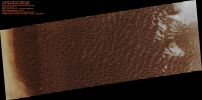
Craters-Rabe_Crater-Dunefield-PIA14468-PCF-LXTT.jpgReddish-Brown Dunefield inside Rabe Crater (Saturated Natural Colors; credits for the additional process. and color.: Dr Paolo C. Fienga - Lunexit Team)152 visitenessun commentoMareKromium
|
|
| 1004 immagini su 84 pagina(e) |
 |
|
|
|
|
33 | |
|
|
|
|








