Mars from Orbit (from July 2009)
|
|
|
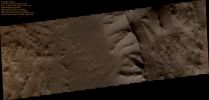
Coprates_Chasma-PIA13786-PCF-LXTT.jpgFeatures of Coprates Chasma (Natural Colors; credits for the additional process. and color.: Dr Paolo C. Fienga - Lunexit Team)69 visitenessun commentoMareKromium
|
|

Coprates_Chasma-PIA17517-PCF-LXTT-IPF.jpgFeatures of Coprates Chasma (Absolute Natural Colors; credits for the additional process. and color.: Dr Paolo C. Fienga/Lunar Explorer Italia/Italian Planetary Foundation)69 visiteIn this VIS image, taken by the NASA - Mars Odyssey Orbiter on August 12th, 2013, and during its 51.735th orbit around the Red Planet, we can see part of the Floor of Coprates Chasma, including a large Sand Sheet and a few smaller Dunes.
Latitude (centered): 13,967° South
Longitude (centered): 296,942° East
Instrument: VIS
This frame (taken from an Original Mars Odyssey Orbiter b/w and Map-Projected frame published on the NASA - Planetary Photojournal with the ID n. PIA 17517) has been additionally processed, magnified, contrast enhanced, Gamma corrected and then colorized in Absolute Natural Colors (such as the colors that a human eye would actually perceive if someone were onboard the NASA - Mars Odyssey Orbiter and then looked down, towards the Surface of Mars), by using an original technique created - and, in time, dramatically improved - by the Lunar Explorer Italia Team.MareKromium
|
|

Coprates_Labes-PIA16271-PCF-LXTT-IPF.jpgCoprates Labes (Absolute Natural Colors; credits for the additional process. and color.: Dr Paolo C. Fienga/Lunar Explorer Italia/Italian Planetary Foundation)74 visiteThe finely ridged Materials visible in the upper portion of this NASA - Mars Odyssey Orbiter image - taken by the Spacecraft during its 49.450th orbit around the Red Planet - are huge Landslide (associated, most likely, with Mudslide) Deposits called Coprates Labes. These Deposits are found on the Floor of Coprates Chasma: a huge Canyon characterized by very steep Walls which is located in the Coprates Quadrangle of Mars, at 13,4° South Latitude and 61,4° West Longitude. Coprates Chasma is just a portion of the Valles Marineris Canyon System; it is approx. 966 Km (such as a little less than 600 miles) long and it got its name after a so-called "Classical Albedo Feature".
Latitude (centered): 11,7442° South
Longitude (centered): 292,003° East
Instrument: VIS
Captured: February, 5th, 2013
This frame (which is an Original Mars Odyssey Orbiter b/w frame published on the NASA - Planetary Photojournal with the ID n. PIA 16271) has been additionally processed and then colorized in Absolute Natural Colors (such as the colors that a human eye would actually perceive if someone were onboard the NASA - Mars Odyssey Orbiter and then looked down, towards the Surface of Mars), by using an original technique created - and, in time, dramatically improved - by the Lunar Explorer Italia Team.MareKromium
|
|

Coracis_Fossae-PIA14524-PCF-LXTT.jpgFeatures of Coracis Fossae (Absolute Natural Colors; credits for the additional process. and color: Dr Paolo C. Fienga - Lunexit Team)148 visiteOrbit Number: 42634
Latitude: 39,051° South
Longitude: 278,428 East
Instrument: VIS
Captured: July, 25th, 2011
Mars Local Time (M.L.T.): 18:00 (Late Afternoon)
MareKromium
|
|
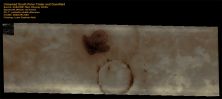
Crater-Unnamed_Buried_South_Polar_Crater.jpgUnnamed (and Buried) South Polar Crater (Absolute Natural Colors; credits for the additional process. and color.: Dr Paolo C. Fienga - Lunexit Team)124 visitenessun commentoMareKromium
|
|
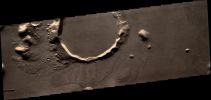
Crater-Unnamed_Crater_and_Lava_Flows_in_Amazonis_Planitia-PCF-LXTT.jpgUnnamed Crater and Lava Flows in Amazonis Planitia (Absolute Natural Colors; credits for the additional process. and color.: Drr Gianluigi Barca and Paolo C. Fienga - Lunexit Team)193 visitenessun commentoMareKromium
|
|
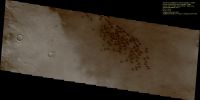
Craters-Arkhangelsky_Crater-20100202a.jpgSmall Dunefield in Arkhangelsky Crater (Saturated Natural Colors; credits: Dr Paolo C. Fienga - Lunexit Team) 65 visitenessun commentoMareKromium
|
|

Craters-Arkhangelsky_Crater-Dunefield-20080416a-PCF-LXTT.jpgThe Dunes of Arkhangelsky Crater (Darkened Natural Colors; credits for the additional process. and color.: Dr Paolo C. Fienga - Lunexit Team)63 visitenessun commentoMareKromium
|
|

Craters-Bacolor_Crater-PIA13664-PCF-LXTT.jpgBacolor Crater (Absolute Natural Colors; additional process. and color.: Dr Paolo C. Fienga - Lunexit Team)91 visiteCaption NASA:"Bacolor Crater is a magnificent Impact Surface Feature about 20 Km (approx. 12 miles) wide. The lines on the Ejecta Blanket surrounding the Crater rim come from a surge of superheated gas and debris flying outward in the wake of the Meteorite impact that created the Crater.
This view combines images taken during the period from September 2002 to October 2005 by the Thermal Emission Imaging System instrument on NASA's Mars Odyssey orbiter. It is part of a special set of images marking the occasion of Odyssey becoming the longest-working Mars Spacecraft in history.
The pictured location on Mars is 33° North Lat. and 118,6° East Long.".MareKromium
|
|
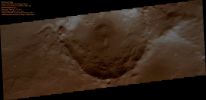
Craters-Balvicar_Crater-PIA13431.jpgBalvicar Crater (Natural Colors; credits for the additional process. and color.: Dr Paolo C. Fienga - Lunexit Team)86 visitenessun commentoMareKromium
|
|

Craters-Becquerel_Crater-PIA03676-1-PCF-LXTT.jpgRocky Deposit on the Floor of Becquerel Crater (Absolute Natural Colors; credits for the additional process. and color.: Dr Paolo C. Fienga - Lunexit Team)210 visiteImage information: VIS instrument
Latitude: 21,3° North
Longitude: 352,2° East
Resolution: 18 meter/pixelMareKromium
|
|
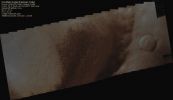
Craters-Brashear_Crater-20091126a.jpgLarge Dunefield in Brashear Crater (Absolute Natural Colors; credits for the additional process. and color.: Dr Paolo C. Fienga - Lunexit Team)68 visitenessun commentoMareKromium
|
|
| 1004 immagini su 84 pagina(e) |
 |
|
|
|
|
26 | |
|
|
|
|








