|
|

Titan-Clouds-White_Clouds-PIA06112.jpgWhite Clouds63 visiteCaption NASA:"Shown here is a blowup of a region of Titan imaged on July 2, 2004. This image was taken at a distance of 339.000 Km (about 210.600 miles) and shows brightness variations on the surface of Titan and a bright field of clouds near the South Pole. The field of clouds is 450 Km (about 280 miles) across and is the about the size of Arizona. Features as small as 10 Km (a little more than 6 miles) can be discerned".
|
|

Titan-Clouds-White_Clouds-PIA08736.jpgThe "White Clouds" of Titan64 visiteCaption NASA originale:"This image depicts Saturn's moon Titan as seen by the Visual and Infrared Mapping Spectrometer (VIMS) after the closest approach of July 22, 2006 (fly-by n. 16).
The image was generated using the 5 micron wavelength for red, the 2 micron wavelength for green and the 1,2 micron wavelength for blue. The clouds are of the same type seen previously and reported in the journal "Science".
The image shows the clouds spreading out along the 40° South Latitude line.
This image was taken from a distance of about 160.000 Km (roughly 99.000 miles) from Titan".
|
|

Titan-Craters-Guabonito_Crater-PIA08425.jpgGuabonito Crater70 visiteThis image of Saturn's moon Titan from the Synthetic Aperture Radar Instrument on the Cassini spacecraft shows the South-Western area of a feature called Xanadu (bottom right of the image). The area is bright because it reflects the radio wavelengths used to make this radar images and this image was taken on April 30, 2006. Xanadu is one of the most prominent features on Titan and was first seen in ground-based observations. The origin of Xanadu is still unknown, but this radar image reveals details previously unseen, such as numerous curvy features that may indicate fluid flows. Linear dark streaks visible in radar-dark areas are dune fields, also seen in previous radar images.
Near the center of the image is a prominent circular feature, named Guabonito, about 90 Km (about 56 miles) in diameter. It might be an impact crater or a cryovolcanic caldera. If this is an impact structure, the absence of an ejecta blanket suggests that the feature has been highly eroded, like some impact structures on Earth, or has been buried by the dune fields. Other radar-bright areas (top left and top right) appear to be topographically high and might act as obstacles, diverting the dunes around them".
|
|

Titan-Craters-Unnamed_Crater-PIA07368.jpgImpact Crater on Titan (radio-image)70 visiteCaption NASA originale:"This image shows a crater, approx. 60 Km in diameter, on the very eastern end of the radar image strip taken by the Cassini orbiter on its third close flyby of Titan on Feb. 15, 2005.
The appearance of the crater and the extremely bright (hence rough) blanket of material surrounding it is indicative of an origin by impact, in which a hypervelocity comet or asteroid, in this case, roughly 5-10 Km, in size, slammed into the surface of Titan. The bright surrounding blanket is debris, or ejecta, thrown out of the crater. The asymmetric appearance of this ejecta blanket could be an effect of "atmospheric winds" associated with the impact itself. Although clearly formed by impact, the feature lacks a central peak, suggesting that it has been eroded or otherwise modified after formation. Rainfall, wind erosion and softening of the solid material in which the crater formed are all possible processes that might have altered this impact feature".
|
|

Titan-Craters-Unnamed_Crater-PIA07868_fig1.jpgTitan's most prominent Impact Crater66 visiteCaption NASA originale:"This 3-panel image shows one of Titan's most prominent impact craters in an infrared-wavelength image (left), radar image (center) and in the false-color image (right). The Cassini radar imaged this crater during Cassini's 3rd flyby of Titan, on Feb. 15, 2005. The Crater, located at 16° West, 11°North, is about 80 Km in diameter and is surrounded beyond that by a blanket of material thrown out of the crater during impact. In radar, brighter surfaces mean rougher terrains, or else terrains tilted toward the radar. The Crater has a dark floor and a small bright area in the center and it is surrounded by bright material, which has a very faint halo slightly darker than the surrounding dark material".
|
|

Titan-Craters-Unnamed_Crater-PIA08737.jpgTitanian Crater64 visiteCaption NASA originale:"This image from Cassini's radar instrument shows an impact crater with a diameter of about 30 Km (19 miles) on the surface of Saturn's moon Titan. Cassini data have only revealed 3 definite impact craters on Titan so far, so each new discovery adds significantly to our body of knowledge. Impact craters are particularly important, as their shapes give scientists insight into the structure of the crust beneath Titan's surface. The difference in overall appearance between this crater, which has a central peak, and those without, such as Sinlap, indicates variations in the conditions of impact, thickness of the crust, or properties of the meteorite that made the crater. The dark floor indicates smooth or highly absorbing materials.
This image was acquired by the Cassini radar instrument in synthetic aperture mode during a Sept. 7, 2006, flyby of Titan.
This image is centered at 70° West Long.; 10° North Lat. and measures about 145 Km high by 180 Km wide (such as approx. 93 by 118 miles). The smallest details in this image are about 500 mt (approx. 550 yards) across".
|
|

Titan-Craters-Unnamed_Crater-PIA09175.jpgFresh Crater on Titan?65 visiteCaption NASA:"This radar image of Titan shows a semi-circular feature that may be part of an impact crater. Very few impact craters have been seen on Titan so far, implying that the surface is young. Each new crater identified on Titan helps scientists to constrain the age of the surface.
Taken by Cassini's radar mapper on Jan. 13, 2007, during a flyby of Titan, the image swath revealed what appeared to be the northernmost half of an impact crater. This crater is roughly 180 Km (about 110 miles) wide. Only three impact craters have been identified on Titan and several others, like this one, are likely to also have been caused by impact. The bright material is interpreted to be part of the crater's ejecta blanket, and is likely topographically higher than the surrounding plains. The inner part of the crater is dark, and may represent smooth deposits that have covered the inside of the crater.
This image was taken in synthetic aperture mode and has a resolution of approx. 350 mt (1150 feet). North is toward the top left corner of the image, which is approx. 240 Km (about 150 miles) wide by 140 Km (90 miles) high. The image is centered at about 26,5° North and 9° West".
|
|

Titan-Craters-Unnamed_Crater-Radar_Mapping-PIA07365-br500-01.jpgImpact Crater?76 visiteCaption NASA originale:"A huge annular feature with an outer diameter of approximately 440 kM (approx. 273 miles) appears in this image taken with Cassini's Titan radar mapper. It resembles a large crater or part of a ringed basin, either of which could be formed when a comet or asteroid tens of Kms in size slammed into Titan. This is the first impact feature identified in radar images of Titan. The surface of Titan appears to be very young compared to other Saturnian satellites. In Titan's case, debris raining down from the atmosphere or other geologic processes may mask or remove the craters. The pattern of brightness suggests that there is topography associated with this feature; for example, in the center of the image there appear to be mounds each about 25 Km across. Since they are dark on their lower edges that face away from the radar and bright on the opposite face, they must be elevated above the surrounding terrain".
|
|

Titan-Craters-Unnamed_Craters-PIA10655.jpgTitanian Craters (Impact Craters?) - radio-image; credits: NASA63 visiteCaption NASA:"This side-by-side view shows a newly discovered impact crater (at left) compared with a previously discovered crater (at right). The new crater was just discovered by the Cassini Spacecraft's Radar Instrument during its most recent Titan flyby on May 12, 2008. This makes the fourth feature definitely identified as an impact crater so far on Titan -- fewer than 100 features are regarded as possible impacts. Compared with Saturn's other moons, which have many thousands of craters, Titan's surface is very sparsely cratered. This is in part due to Titan's dense atmosphere, which burns up the smaller impacting bodies before they can hit the surface. Geological processes, such as wind-driven motion of sand and icy volcanism, may also wipe out craters.
Both images are about 350 Km (approx. 217 miles) in width.
The crater on the right was discovered by Cassini in 2005 and is shown here for comparison. It is about 80 Km (approx. 50 miles) in diameter, with the radar illumination from above.
Called "Sinlap", this crater is estimated to be about 1300 meters (984 feet) deep.
The new feature pictured on the left, which has not been named yet, is bigger than the Sinlap Crater with a diameter of about 112 Km (approx. 70 miles).
The new crater is located at about 26° North Latitude and 200° West Longitude, in the bright Region known as Dilmun, about 1000 Km (approx. 600 miles) north of the Huygens Landing Site.
In its image, also illuminated from above, it appears slightly irregular, suggesting that it was modified after it was formed, perhaps by collapses of segments of its rim onto the floor.
The crater floor appears flat, and two small bright spots indicate a likely central peak complex.
The ejecta blanket (surrounding material) from this crater is less prominent than that of the Sinlap Crater.
The crater's more degraded character suggests it could be older than Sinlap (assuming that erosive processes are the same at both locations, which are at similar latitudes)".MareKromium
|
|

Titan-Crescent-00.jpgTitan from approx. 347.000 Km64 visitenessun commento
|
|
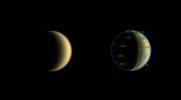
Titan-Crescent-01.jpgTitan from approx. 790.000 Km67 visitenessun commento
|
|

Titan-Crescent-EB-LXTT-00.jpgThe "Yellow Smile" of Titan (Natural Colors; credits: Elisabetta Bonora - Lunexit Team)64 visitenessun commentoMareKromium
|
|
| 428 immagini su 36 pagina(e) |
 |
|
|
|
6 | |
|
|
|
|
|





