|
|

Titan-Regions-Senkyo_Region-PIA11577-01.jpgLight and dark Surface Features of Senkyo66 visiteCaption NASA:"The Cassini Spacecraft peers through the hazy Atmosphere of Titan for a close view of light and dark Terrain on Saturn's largest moon.
This view is centered on Terrain at 28° South Lat. and 334° West Long. and shows a small part of the albedo feature named Senkyo on the Trailing Hemisphere of Titan.
The image was taken with the Cassini Spacecraft narrow-angle camera on July 9, 2009 using a spectral filter sensitive to wavelengths of Near-InfraRed Light centered at 938 nanometers. The view was obtained at a distance of approx. 251.000 Km (such as about 156.000 miles) from Titan and at a Sun-Titan-Spacecraft, or Phase, Angle of 27°.
Image scale is about 1 Km (3281 feet) per pixel".MareKromium
|
|

Titan-Regions-Senkyo_Region-PIA11577-02.jpgLight and dark Surface Features of Senkyo (possible Natural Colors; credits: Lunexit)78 visiteCaption NASA:"The Cassini Spacecraft peers through the hazy Atmosphere of Titan for a close view of light and dark Terrain on Saturn's largest moon.
This view is centered on Terrain at 28° South Lat. and 334° West Long. and shows a small part of the albedo feature named Senkyo on the Trailing Hemisphere of Titan.
The image was taken with the Cassini Spacecraft narrow-angle camera on July 9, 2009 using a spectral filter sensitive to wavelengths of Near-InfraRed Light centered at 938 nanometers. The view was obtained at a distance of approx. 251.000 Km (such as about 156.000 miles) from Titan and at a Sun-Titan-Spacecraft, or Phase, Angle of 27°.
Image scale is about 1 Km (3281 feet) per pixel".MareKromium
|
|

Titan-Regions-Senkyo_Region-PIA11636.jpgThrough the Fog, in the Darkness: the Senkyo Region (Absolute Natural Colors; credits for the additional process. and color.: Dr Paolo C. Fienga - Lunexit Team)66 visiteCaption NASA:"The low albedo feature known as Senkyo is (barely!) visible through the haze of Titan's Atmosphere.
See PIA08231 to learn about this area that appears dark near Titan's Equator. This view looks toward Saturn-facing Side of Titan and is centered on terrain at 1° South Lat. and 345° West Longitude. North on Titan is up and rotated 10° to the right.
The image was taken with the Cassini Spacecraft narrow-angle camera on Oct. 12, 2009 using a spectral filter sensitive to wavelengths of Near-InfraRed Light centered at 938 nanometers. The view was acquired at a distance of approx. 296.000 Km (about 184.000 miles) from Titan and at a Sun-Titan-Spacecraft, or Phase, Angle of 11°.
Image scale is about 2 Km (approx. 1,3 mile) per pixel".MareKromium
|
|

Titan-Regions-Senkyo_and_Aaru_Region-PIA10565.jpgSenkyo and Aaru Region102 visiteCaption NASA:"Named for other-worldly Paradises, the dark regions of Senkyo and Aaru comprise the center of this image of Saturn's moon Titan. The Egyptian fields of Aaru were Paradise for the god Osiris. This side of Titan, which always faces Saturn, is on the opposite side of the moon from Shangri-La and Adiri, the home to the Huygens probe.
The craft touched down on the border between the lowland dunes of Shangri-La and the higher terrains of Adiri. Like Senkyo and Aaru, these Regions' namesakes reflect heavenly aspirations. North is up in this image.
Senkyo is the Equatorial Region to the right of the center of the image. Aaru is above Senkyo.
The image was taken with the Cassini Spacecraft narrow-angle camera on Dec. 12, 2008 using a spectral filter sensitive to wavelengths of infrared light centered at 938 nanometers.The view was acquired at a distance of approx. 2,4 MKM (such as about 1,5 MMs) from Titan and at a Phase Angle of 35°.
Image scale is roughly 14 Km (about 9 miles) per pixel".MareKromium
|
|

Titan-Regions-Senkyo_and_Aaru_Regions-PIA08231.jpgAaru and Senkyo89 visiteAs it approached Titan for yet another revealing encounter, the Cassini spacecraft acquired this image showing terrain on the moon's Saturn-facing hemisphere.
Prominent dark areas found in the moon's equatorial region appear to contain vast and continuous dune fields, discovered by the Cassini Radar experiment and likely composed of particles that drop from Titan's unique, smoggy atmosphere.
The Dark Regions seen here are provisionally named Aaru and Senkyo, with parts of Western Fensal and Aztlan showing at left, near the terminator.
The image was taken with the Cassini spacecraft wide-angle camera using a spectral filter sensitive to wavelengths of infrared light centered at 752 nanometers. The view was obtained on July 2, 2006 at a distance of approx. 163.000 Km (about 101.000 miles) from Titan and at a Sun-Titan-spacecraft, or phase, angle of 62°.
Image scale is roughly 19 Km (such as about 12 miles) per pixel.
|
|

Titan-Regions-Shangri_La_Region-PIA08971.jpgShangri-la and other Equatorial Regions of Titan65 visiteCaption NASA:"This view of Titan's surface highlights NorthWestern Shangri-la - a large, Equatorial Dark Region revealed by radar observations to be covered in longitudinal dune fields. The bright, circular feature right of center is a potential impact crater - few of which have been spotted on Titan thus far.
North on Titan is up and rotated about 15° to the right. This view was created by combining multiple images taken using a combination of spectral filters sensitive to wavelengths of infrared light centered at 938 and 619 nanometers.
The images were taken with the Cassini spacecraft narrow-angle camera on May 13, 2007 at a distance of approx. 125.000 Km (about 77.000 miles) from Titan. Image scale is roughly 1 Km (0,6 miles) per pixel. Due to scattering of light by Titan's hazy atmosphere, the sizes of surface features that can be resolved are a few times larger than the actual pixel scale".MareKromium
|
|

Titan-Regions-Shangri_La_and_Xanadu_Region-PIA07752.jpgThe "New World": Shangri-La and Xanadu Region68 visiteOriginal caption:"This mosaic is a HR close-up of two contrasting Regions: dark Shangri-La and bright Xanadu. This view has a resolution of 1 Km (such as 0,6 mile) per pixel and is centered at 2,5° North Lat. and 145° West Long., near the feature called Santorini Facula.
The mosaic is composed of 10 images obtained on Oct. 28, 2005, each processed to enhance surface detail. It is an orthographic projection, rotated so that North on Titan is up".
|
|

Titan-Regions-Shikoku_Facula-PIA08426.jpgThe Brightest Region of Titan: Shikoku Facula66 visiteCaption NASA originale:"This image of Saturn's moon Titan from the Synthetic Aperture Radar Instrument on the Cassini spacecraft shows Shikoku Facula, a Region that is bright in both radar and visible wavelengths. This radar image was taken on April 30, 2006.
A circular feature with a radar-dark interior, probably an impact crater, is seen near the top of the image and is about 35 Km (about 22 miles) in diameter.
Numerous linear dark features are seen running across the image, mostly on the right-hand side. These features were seen on other radar images and interpreted as dune fields. Bright, ridge-like features mainly on the lower half of the image may be topographically "High Regions" (qualcosa di simile alle HighLands della Scozia). Radar-dark, thin, sinuous features, which may be channels draining from the bright to the dark Regions, are seen below the circular feature".
|
|

Titan-Regions-Sinlap_Region-LS28_PSS_LASoderblom_VIMSRADAR20070323.jpgSinlap Region and Guabonito Crater63 visiteIn this composite image, Titan's surface areas are correlated.
The top pair is composed by Cassini's radar images, while the bottom pair shows Cassini's VIMS images. Each of the four panels corresponds to an area about 200 Km wide.
The left views show the Sinlap Crater; the brown features in the bottom panel correspond to the large dune fields visible in the top panel.
The right views show the Guabonito Region situated at about 150 Km East of the Huygens Landing Site. MareKromium
|
|
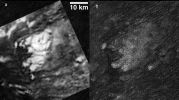
Titan-Regions-Tortula_Facula_Region-PIA13895.jpgTortula Facula (alias "Nondescript Obstacle")236 visiteCaption NASA:"These side-by-side images obtained by NASA's Cassini Spacecraft show the feature named Tortola Facula on Titan. The left image was obtained by the Visual and InfraRed Mapping Spectrometer data on Oct. 26, 2004, at a resolution of about 2 Km (1,242 mile) per pixel. This mosaic focuses on an area around 9° North Latitude and 145° West Longitude.
In 2005, scientists interpreted Tortola Facula as an ice volcano.
The right image shows the same feature, as seen by Cassini's Radar Instrument on May 12, 2008, at a much higher resolution of approx. 300 meters per pixel. Scientists now think that this feature is a "Nondescript Obstacle" surrounded by obvious wind-blown Sand Dunes, similar to those commonly found in this Region of Titan.
In radar images, objects appear bright when they are tilted toward the Spacecraft or have rough surfaces". MareKromium
|
|

Titan-Regions-Xanadu_Region-PIA06107.jpgXanadu Region62 visiteThis image taken on Oct. 24, 2004, reveals Titan's bright "continent-sized" terrain known as Xanadu. It was acquired with the narrow angle camera on Cassini's imaging science subsystem through a spectral filter centered at 938 nnmts, a wavelength region at which Titan's surface can be most easily detected. The surface is seen at a higher contrast than in previously released imaging science subsystem images due to a lower phase angle (Sun-Titan-Cassini angle), which minimizes scattering by the haze.
The image shows details about 10 times smaller than those seen from Earth. Surface materials with different brightness properties (or albedos) rather than topographic shading are highlighted. The image has been calibrated and slightly enhanced for contrast. It will be further processed to reduce atmospheric blurring and to optimize mapping of surface features. The origin and geography of Xanadu remain mysteries at this range. Bright features near the South Pole (bottom) are clouds.
|
|

Titan-River-PIA16197-PCF-LXTT-IPF.jpgTitanian River (Absolute Natural Colors; credits for the additional process. and color.: Dr Paolo C. Fienga/Lunar Explorer Italia/Italian Planetary Foundation)100 visiteThis image, taken by the NASA - Cassini Spacecraft on September 26, 2012, during its 87th close Fly-By of Titan, shows a vast River System located in the High Northern Regions of this always more intriguing and fascinating Saturnian moon. As a matter of fact, this is the first time that an image coming from Outer Space has revealed what appears to be a true River System that is so vast and structured, anywhere other than on our Home Planet Earth. The River Valley crosses Titan's North Polar Regions and runs directly into the Ligeia Mare: one of the 3 (three) Great Seas that have been so far discovered in the High Northern Latitudes of Titan. This River (still unnamed, but, in a way, very similar to the famous Terrestrial River known as Nile) stretches for more than 200 miles (such as approx. 322 Km).
Scientists have deduced that the River should be filled with actual liquid substances, because (among other things) it appears very dark along its entire extent in this High-Resolution Radar Image: a data, this one, that is indicative of the fact that we are in presence of a smooth Surface. These liquid substances are, presumably, Ethane mixed with Methane, the former having been already positively identified in the AD 2008 by Cassini's Visual and InfraRed Mapping Spectrometer at the Lake known as Ontario Lacus (this one, however, located in Titan's Southern Hemisphere). Even though some short, local Meander (---> a bend in a sinuous watercourse), is visible, the relative straightness of the River Valley suggests that it follows the trace of at least one Fault-line, just like other large Rivers running into the Southern Margin of Ligeia Mare do. Such Faults may lead to the opening of Basins and, perhaps (and in the end), to the formation of the Giant Seas themselves. North is toward the top of the image.
This frame (which is an Original NASA - CASSINI Spacecraft Radio-Image published on the NASA - Planetary Photojournal with the n. PIA 16197), since it is just a Radio-Image of the Titanian Surface and NOT a real view of it, has been colorized, according to an informed speculation carried out by Dr Paolo C. Fienga (LXTT-IPF), in what they could reasonably be its possible Absolute Natural Colors (such as the colors that a human eye would perceive if someone were onboard the NASA - CASSINI Spacecraft and, once the thick layer of Titanian Hazes and Fogs shall have been completely overcome, looked down, towards the Surface of Titan itself), by using an original technique created - and, in time, dramatically improved - by the Lunar Explorer Italia Team.MareKromium
|
|
| 428 immagini su 36 pagina(e) |
 |
|
|
|
|
28 | |
|
|
|
|





