Phobos: the "Doomed" Moon
|
|
|

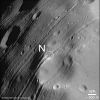
PHOBOS-Image022-417-20081008-5889-6-src-01-PhobosSeries_H1.jpgStaring at Phobos' Limb68 visiteThis image of Phobos’s was obtained by the Super Resolution Channel (or SRC, a part of the High Resolution Stereo Camera experiment) on board ESA’s Mars Express on 3 August 2008 (orbit 5889).
The distance from the moon’s centre was approx. 656 Km, and the image resolution is 6 mt/pixel. The original image has been corrected for mirror distortion.MareKromium
|
|
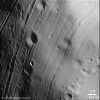
PHOBOS-Image023-417-20081008-5889-6-src-02-PhobosSeries_H1.jpgPhobos' North Polar Regions69 visiteThis image of Phobos’s surface was obtained by the Super Resolution Channel (or SRC, a part of the High Resolution Stereo Camera experiment) on board ESA’s Mars Express on 8 August 2008 (orbit 5908).
The distance from the moon’s centre was approx. 1024 Km, and the image resolution is 9 mt/pixel. The original image has been corrected for mirror distortion.MareKromium
|
|
PHOBOS-Image024-417-20081008-5889-6-src-03-PhobosSeries_H1.jpgThe Surface of Phobos: the "Striations"75 visiteThis image of Phobos’s surface was obtained by the Super Resolution Channel (or SRC, a part of the High Resolution Stereo Camera experiment) on board ESA’s Mars Express on 3 August 2008 (orbit 5889).
The distance from the moon’s centre was approx. 656 Km, and the image resolution is 6 mt/pixel. The original image has been corrected for mirror distortion.MareKromium
|
|
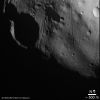
PHOBOS-Image025-417-20081008-5889-6-src-04-PhobosSeries_H1.jpgPhobos' Terminator70 visiteThis image of Phobos’s surface was obtained by the Super Resolution Channel (or SRC, a part of the High Resolution Stereo Camera experiment) on board ESA’s Mars Express on 3 August 2008 (orbit 5889).
The distance from the moon’s centre was approx. 656 Km, and the image resolution is 6 mt/pixel. The original image has been corrected for mirror distortion.MareKromium
|
|
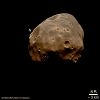
PHOBOS-Image031-420-20081008-6042-6-src-02-PhobosSeries_H1.jpgApproaching Phobos (natural colors; credits: Lunexit)68 visiteThis image of Phobos was obtained by the Super Resolution Channel (or SRC, a part of the High Resolution Stereo Camera experiment) on board ESA’s Mars Express on 15 September 2008 (orbit 6042).
The distance from the moon’s centre was 3718 km, and the image resolution is 34 m/pixel.
The original image has been corrected for mirror distortion.
MareKromium
|
|
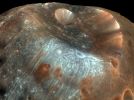
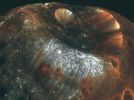
PSP_007769_9010-Stickney-0.jpgStickney Crater (Natural Colors; credits: NASA)70 visiteThe most prominent feature here is the large impact crater Stickney. With a diameter of 9 Km, it is the largest feature on Phobos. A series of grooves and crater chains is obvious on the other parts of the moon.
Although many appear radial to Stickney, previous studies show that the grooves radiate from a different point on Phobos. Hypotheses for their formation vary.
Some scientists believe the grooves and crater chains are related to the formation of Stickney, whereas others think they may have formed from ejecta from impacts on Mars that later collided with Phobos.
The lineated textures on the walls of Stickney and other large craters are landslides formed from materials falling into the crater interiors in the weak Phobos gravity (less than 1/1000th the gravity on Earth).MareKromium
|
|
PSP_007769_9010-Stickney-1.jpgStickney Crater (Natural Colors + MULTISPECTRUM; credits: NASA & Lunexit)75 visitenessun commentoMareKromium
|
|
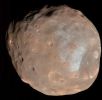
PSP_007769_9010_IRB.jpgPhobos (Natural Colors; credits: NASA)67 visiteHiRISE acquired 2 dramatic views of the Martian moon, Phobos, on 23 March 2008. Observation PSP_007769_9010, acquired at a distance of 6800 Km from Phobos, provides surface detail at 6,8 mt/pixel scale and a object diameter of about 3200 pixels.
The second observation, PSP_007769_9015, providing a closer look at 5800 Km, views the surface at slightly more detail (5,8 mt/pixel with an object diameter of about 4000 pixels).
The 2 images were taken within 10' of each other and show roughly the same features, but from a different angle so that they can be combined to yield a stereo view.
The illuminated part of Phobos visible in the images is about 21 Km across. Images from previous spacecraft have been of smaller pixel scale (for example, Mars Global Surveyor got data at 4 mt/pixel, because this spacecraft came closer to Phobos), but the HiRISE images have greater signal-to-noise, making the new data some of the best ever for Phobos.MareKromium
|
|
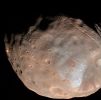
PSP_007769_9015_IRB.jpgPhobos (Natural Colors; credits: NASA)68 visitePhobos, and the second Martian moon, Deimos, are interesting for several reasons. Both objects are small, with average diameters of just 22 and 12 Km, respectively.
At this size, their gravity is insufficient (less than 1/1000th of Earth) to pull them into spherical shapes, in contrast to the larger moons and planets in the Solar System.
Both moons are tidally locked to Mars, meaning, like our own moon relative to Earth, they present the same side to Mars all the time. The small size and composition (determined from spectroscopy) of Phobos and Deimos make them very similar to some asteroids.
Most asteroids are located in a belt between Mars and Jupiter, with others having orbits that cross that of Mars. Therefore, it is possible that Phobos and Deimos are captured asteroids.
Other hypotheses are that they formed with Mars in the early Solar System, or are composed of material blasted off of Mars by impacts.MareKromium
|
|
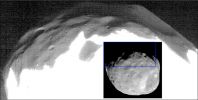
PSP_007769_9015_MarsShine.jpgIn the Mars-Shine... (credits: NASA)67 visiteThis is a close-up and enhanced part of image PSP_007769_9015. In the original image, detail in the black, un-illuminated portion is not apparent. However, seen in enhanced detail here, craters are clearly visible.
This faint illumination is from reflected light off of Mars (“Marsshine”). This is directly analogous to “Earthshine,” where reflected sunlight from our planet illuminates the dark side of the Moon.
The ability to see features on Phobos illuminated by Marsshine demonstrates the high sensitivity of the HiRISE camera.MareKromium
|
|
PSP_007769_9015_RED.jpgPhobos (RAW Frame; credits: NASA)66 visitenessun commentoMareKromium
|
|
![Phobos-F854A81[1]-PCF-LXTT.jpg](albums/userpics/10060/small_Phobos-F854A81%5B1%5D-PCF-LXTT.jpg "Nome del file=Phobos-F854A81[1]-PCF-LXTT.jpg
Dimensione del file=412KiB
Dimensioni=1930x2200
Aggiunta il=Giu 21, 2011")
Phobos-F854A81[1]-PCF-LXTT.jpgStickney Crater and Surface Striations (Absolute Natural Colors; credits for the additional process. and color: Dr Paolo C. Fienga - Lunexit Team)342 visitenessun commentoMareKromium
|
|
| 53 immagini su 5 pagina(e) |
2 |  |
|
|








