Mars, Deimos and Phobos: Maps
|
|
|
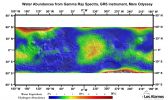
023-Mars_Water-2.jpgWhere is the "Water" of Mars? (Equatorial and Middle Latitude Regions)66 visiteA Neutron Spectrometer on the Mars Odyssey Spacecraft measures the abundances of neutrons of various energies emitted from Mars' Surface.
The ratio of low- to high-energy neutrons is a sensitive test of water abundances within a meter of Mars' surface.
There is LOTS of water. No one had expected any where near this much water near the Martian Surface.
All this is BETTER described in a press release from the Los Alamos National Laboratory, home of the Neutron Spectrometer and the scientists who run it (http://www.lanl.gov/news/releases/archive/03-101.shtml). MareKromium
|
|
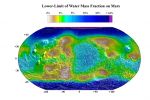
023-Mars_Water-3.jpgMap of Water on Mars102 visiteI raggi cosmici, dopo aver aver raggiunto il Pianeta, interagiscono rapidamente con gli elementi presenti negli strati superficiali del suolo Marziano. Da questo impatto e dalle conseguenti reazioni, scaturisce una (+ o - elevata) dispersione di neutroni. Sapendo che, per quanto maggiore è il quantitativo di H presente in detti strati, tanto minore è la dispersione di neutroni, misurando il loro > o < assorbimento, misuriamo anche il > o < quantitativo di H presente in essi.Sapendo che la forma più probabile in cui si può trovare H in prossimità della superficie di Marte è quella che lo vede aggregato all’O2, deduciamo che, laddove viene rilevata una maggiore presenza di H è altrettanto probabile che vi sia anche una maggiore presenza di H2O.
|
|

024-Iani_Chaos_and_Ares_Valles.jpgMargaritifer Terra75 visiteCaption ESA originale:"This map shows that the Iani Chaos depression – 180 Km long and 200 Km wide – is connected to the beginning of Ares Vallis by a 100-Km wide Transition Zone, centred around 342,5º East and 3º North".
|
|

025-Mars_Global_with_Nomenclature.jpgMars Map for Beginners64 visiteUna Mappa semplice ed immediata non guasta mai...MareKromium
|
|
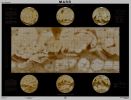
026-Mars_Advanced_Map.jpgAdvanced Mars Global Map63 visitePublisher: Aeronautical Chart and Information Center
Scale: 1:35.000.000
Projection: Mercator MareKromium
|
|

027-Mars_Super_Advanced_Map.jpgExtremely Advanced Mars Geologic Global Map63 visitePublisher: U.S. Geological Survey
Scale: 1:25.000.000
Projection: Mercator
MareKromium
|
|
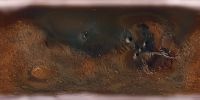
028-Mars_Colors-MF-LXTT2.jpgFull Map of Mars (Approximate Natural Colors; credits: Dr Marco Faccin - Lunexit Team)94 visite...E anche questa è ARTE...MareKromium
|
|

029-Mars-16-PIA09224_fig1.jpgThe "Thickness" of Mars' South Polar Layered Deposits (Map 1)65 visiteThis map shows the thickness of the South Polar Layered Deposits of Mars, an ice-rich geologic unit that was probed by the Mars Advanced Radar for Subsurface and Ionospheric Sounding (MARSIS). The MARSIS radar is an instrument on the European Space Agency's Mars Express orbiter. The thickness of the layered deposits was determined by measuring the time delay between radar echoes from the surface and those from the lower boundary, or "bed", of the deposits.
The radar data indicate that the deposit, larger than Texas in area, is more than 3,7 Km (about 2,3 miles) thick in places, and that the material consists of nearly pure water ice with only a small component of dust.
|
|

030-Mars-17-PIA09225_fig1.jpgThe "Lower Boundary" of the Icy Layers Covering Mars' South Polar Region (Map 2)70 visiteThis map shows the topography of the South Polar Region of Mars, including topography buried by thick deposits of icy material. The map is a combination of surface elevation data acquired by the Mars Orbiter Laser Altimeter aboard NASA's Mars Global Surveyor orbiter, and subsurface elevation data acquired by the Mars Advanced Radar for Subsurface and Ionospheric Sounding (MARSIS) aboard the European Space Agency's Mars Express orbiter.
The black line shows the boundary of the South Polar Layered Deposits, an ice-rich geologic unit that was probed by MARSIS. Elevation values within the black outline, as measured by MARSIS, show the topography at the boundary between the layered deposits and the underlying material, an interface known as the "bed" of the deposits. The elevation of the terrain is shown by colors, with purple and blue representing the lowest areas, and orange and red the highest. The total range of elevation shown is about 5 Km.
The radar data reveal previously undetected features of topography of the bed, including depressions as deep as 1 Km (0,6 miles) shown in purple in the near-polar region.
The boundary of the layered deposits was mapped by scientists from the U.S. Geological Survey. The dark circle in the upper center is the area poleward of 87° South Latitude, where MARSIS data cannot be collected.
The map covers an area of 1670 by 1800 Km (about 1035 by 1115 miles).
|
|

031-Mars-18-PIA09226_fig1.jpgThe "Upper Surface" of the Icy Layers Covering Mars' South Polar Region (Map 3)64 visiteThis map shows the topography of the South Polar Region of Mars. The data were collected by the Mars Orbiter Laser Altimeter aboard NASA's Mars Global Surveyor orbiter between 1997 and 2001. The elevation of the terrain is shown by colors, with purple and blue representing the lowest areas, and orange and red the highest. The total range of elevation shown is about 5 Km. The black line shows the boundary of the South Polar Layered Deposits, an ice-rich geologic unit that was probed by the Mars Advanced Radar for Subsurface and Ionospheric Sounding (MARSIS) aboard the European Space Agency's Mars Express orbiter.
The radar data indicate that the deposit is more than 3,7 Km (about 2,3 miles) thick in places, and that the material consists of nearly pure water ice, with only a small component of dust. The MARSIS team also determined that the total volume of ice in the layered deposits is equivalent to a water layer 11 mt (36 feet) deep, if spread evenly across the Planet. The boundary of the Layered Deposits was mapped by scientists from the U.S. Geological Survey. The dark circle in the upper center is the area poleward of 87° South Latitude, where MARSIS data cannot be collected.
The image covers an area of 1670 by 1800 Km (about 1035 by 1115 miles).
|
|

032-Mars_Interior.jpgWhat's inside Mars?194 visiteMars interior is simply modeled as a core and mantle with a thin crust, similar to Earth. Mars' size and total mass are known. Given four parameters, the core size and mass and mantle size and mass can be determined.
The combination of Pathfinder Doppler data with earlier data from the Viking Landers has determined a very important parameter, the "Moment of Inertia", through measurement of Mars' precession rate. A fourth measurement is needed to complete the interior model. This may be achieved through future Doppler tracking of Pathfinder, since the presence of a fluid core may be detectable through its effect on Mars' nutation. The determination of the moment of inertia is a significant constraint on possible models for Mars' interior. If the core is as dense as possible (i.e. completely iron) and the mantle is similar to Earth's (or similar to the SNC meteorites thought to originate on Mars) then the minimum core radius is about 1300 Km. If the core is made of less-dense material (i.e. a mixture of iron and sulfur) than the core radius is probably no more than 2000 Km.
|
|

033-Mars_Rotation.jpgMars' Rotation and Orbit Dynamics141 visiteMars rotation around its pole causes a signature in the data with a daily minimum, when the Lander is closest to the Earth. Changes in such a daily signature may reveal information about the interior of Mars, through its effect on Mars' precession and nutation.
The signature is also sensitive to variations in Mars' Rotation Rate, as the mass of the atmosphere increases and decreases along with the Polar Caps increase and decrease (obviously the Polar Caps increase during the Martian Fall and Winter and then, due to the higher heating of the Planet - and subsequent evaporation phoenomena - they decrease in Spring and Summer).
Long term signatures in the range to the Lander are caused by asteroids perturbing Mars' orbit; an analysis of these perturbations may allow us to also determinate the masses of these asteroids.
|
|
| 54 immagini su 5 pagina(e) |
 |
3 | |
|








