Mars, Deimos and Phobos: Maps
|
|
|

011-Mars_North_Pole.jpgThe North Polar Region of Mars158 visitenessun commento
|
|

012-Thermal_Inertia.jpgMars Global Map: Thermal Inertia108 visitenessun commento
|
|

013-Mars_Visual_Albedo_.jpgMars Visual Albedo through a RED Filter64 visiteThis image of Mars is from the Mars Orbiter Camera (MOC) on the Mars Global Surveyor (MGS) Spacecraft.
The image means the "Visual Brighness" of Mars, meaning how Mars would appear to the human eye through a red filter.
The mosaic is from a short time in 1999, when there was a significant dust storm in Hellas Basin (brigh spot on right side near bottom).
There is no data from the South Pole, because it was in total darkness at the time - and Mars' North Pole was pointed towards the Sun.MareKromium
|
|
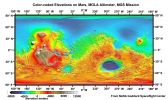
014-Mars_Altitudes.jpgMars "Ups and Downs"...64 visiteThe MOLA Laser Altimeter produced detailed topographic maps and profiles of Mars, and really revolutionized our understanding of Mars.
So much from elevation alone!
These maps show the MOLA altitude data coded into colors - blue is low and red/white are high.MareKromium
|
|

015-Mars_Altitudes.jpgMars "Ups and Downs"... (shaded version)64 visiteHere, the MOLA Altimetry is cast as a 3-D model, a shaded relief map illuminated from the upper right.
BEWARE: this lighting can not ever happen on Mars!
The large volcanos stand out beautifully, as do the impact basins of Hellas and Argyre. Also clear here is how flat the Northern Plains really are (remnants of an ocean basin?), the incredible number of craters on the Highlands, and the distinct difference in elelvations between the Highlands and the Lowlands.MareKromium
|
|

016-Mars_Altitudes.jpgMars "Ups and Downs"...64 visiteTo complement the MOLA Laser Altimeter Mercator maps of Mars' elevations and topography, the MOLA Team also produced views of selected hemispheres.
These views emphasize specific interesting areas or angles. These maps show altitude data coded into colors - blue is low and red/white are high.
These two hemispheres are centered on the Tharsis Plateau (including the Valles Marineris and the large volcanos) and on the Isidis Impact Basin (with the Hellas Basin to the South).MareKromium
|
|

017-Mars_Crustal_Magnetism.jpgMars Crustal Magnetism64 visiteThe Mars Global Surveyor spacecraft carried a Magnetometer, the MAG/ER.
During MGS's aerobraking procedure, the MAG/ER found that Mars does not have a global Magnetic Field like the Earth does, but large areas are strongly magnetic.
There are few good ideas of what this magnetism means, although plate tectonic processes do not seem likely. The area of Magnetic Anomalies seems to make a girdle around Mars, and this is (at least partly) because that's where MGS's orbit took it closest to Mars during aerobraking.MareKromium
|
|

018-Mars_Magnetic_Anomalies.jpgThe Magnetic Anomalies of Mars64 visiteThe Magnetic Anomalies found by the MAG/ER experiment on the Mars Global Surveyor spacecraft are inconveniently bisected by the 180° Longitude line, and so appear at both ends of the standard Mars Mercator Projection.
Here, the MAG/ER team have made hemispheric projections centered on the area of strongest anomalies.
The 3 hemispheres show the 3 components of the Magnetic Field: B(r) is the Radial Field, which is perpendicular to Mars' Surface; B(Θ) is the Polar Field, oriented along lines of Longitude; and B(Φ) is the Circumferential Field, oriented along lines of Latitude. MareKromium
|
|

019-North_Pole.jpgThe North Pole of Mars (Mercator Projection - credits: NASA/MOLA)64 visitenessun commentoMareKromium
|
|

020-Mars_South_Pole.jpgThe South Pole of Mars (Mercator Projection - credits: NASA/MOLA)64 visitenessun commentoMareKromium
|
|
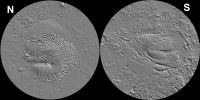
021-Mars_Poles.jpgThe Poles of Mars64 visiteThe Mercator Projection distorts Polar Regions beyond recognition, so Polar Projection Maps are commonly made separately. These MOLA shaded topography images of Mars's North and South Polar Regions are stereographic projections, from Latitudes 72° N and S towards the respective Poles. The line of 0° Longitude is to the bottom of the North Pole images, and toward the top of the South Pole image.
Both Poles are covered by layered ice caps with smooth undulating surfaces. The North Polar Cap sits of a flat plain, while the South Polar Cap sits on heavily cratered land.MareKromium
|
|

022-Mars_Water-1.jpgWhere is the "Water" of Mars? (Polar Regions)67 visiteWater abundances in the Martian Polar Regions, from the Neutron Spectrometer on Mars Odyssey, are shown here to complement the Mercator Projections of Equatorial Regions.
The North Pole is nearly pure water ice, while the South Pole is water iced mixed with other stuff, most likely dry ice (CO2) and mineral dust.
More details are available in the Los Alamos National Lab press release.MareKromium
|
|
| 54 immagini su 5 pagina(e) |
2 |  |
|
|








