|
|

A_Pair_of_Small_Pit_Craters_(PSP_009488_1745)-1.jpgA Pair of Collapse Pits92 visiteThe pair of Pit Craters visible here are the smallest anomalous Pits known to exist at this time. These have either vertical or sub-vertical interior Walls (not visible from a nearly overhead viewing perspective), and each Pit is deep enough that Sunlight does not hit the floor when the Sun is at the Zenith.
Unfortunately, the only Thermal-InfraRed camera currently orbiting Mars cannot resolve features this small, so the temperature characteristics of these Pits must remain unknown for now, underscoring the need for a high-resolution thermal instrument on future missions.
Intriguingly, when Pit Craters on Earth have similar characteristics to the pair shown here, they often have Cave entrances in their bases connecting to large underground networks.
Current investigations are determining whether the anomalous Martian Pits may be shown to contain such entrances.MareKromium
|
|

A_Pair_of_Small_Pit_Craters_(PSP_009488_1745)-2.jpgCollapse Pit84 visitePit Craters exist in volcanic regions across Mars, and form when surface materials collapse into large underground cavities. Such Pits are generally bowl-shaped, filled with sediment, and are relatively shallow when compared with their diameters.
Recently, a small number of anomalous pit craters were identified with strikingly different visible and thermal characteristics such as: sheer cliff walls; deep interiors that can extend out-of-sight beneath the Surface and temperature fluctuations that behave unlike any known feature on Mars.MareKromium
|
|
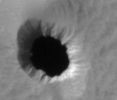
A_Pair_of_Small_Pit_Craters_(PSP_009488_1745)-3.jpgCollapse Pit83 visiteThe ability to detect and explore Martian Caves is of intense interest to many disciplines in Planetary Science. Caves may expose entire sets of stratigraphic layers, providing windows into Mars' Geologic and Atmospheric histories.
Cave environments can also protect organic life from extremely harsh conditions on the Martian Surface, and may provide future human explorers with secure habitats. Accordingly, Caves are considered among the most promising locations to find preserved evidence of past or present microbial life.
Furthermore, the challenges associated with Mars Cave exploration may inspire a range new technologies, such as advanced robotics and target-specific landing capabilities.MareKromium
|
|

Chain_of_Pits_on_Arsia_Mons_(PSP_005414_1735)-1.jpgCollapse Pit on Arsia Mons82 visitenessun commentoMareKromium
|
|

Chain_of_Pits_on_Arsia_Mons_(PSP_005414_1735)-2.jpgCollapse Pit on Arsia Mons (Natural Colors; credits: Lunar Explorer Italia)80 visitenessun commentoMareKromium
|
|
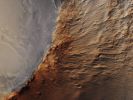
Chrise_Planitia-PIA14462-PCF-LXTT.jpgFeatures of Chrise Planitia (Absolute Natural Colors; credits for the additional process. and color: Dr Paolo C. Fienga - Lunexit Team)194 visiteThe suggested area in this observation is characterized by a group of Cones, such as "shield-like" features, and round Mounds. They are a few hundred meters to kilometers in diameter, but their heights are still unknown.MareKromium
|
|

Claritas_Fossae-PIA14461-PCF-LXTT.jpgFeatures of Claritas Fossae (Absolute Natural Colors; credits for the additional process. and color: Dr Paolo C. Fienga - Lunexit Team)206 visiteThe Claritas Fossae Region is characterised by systems of "Graben" running mainly North-West to South-East. A Graben forms when a block of the Planet's Crust drops down between two Faults, due to extension, or pulling, of the Crust itself.
MareKromium
|
|

Collapse_Pit_in_Tractus_Fossae_(ESP_011386_2065)-1.jpgCollapse Pit in Tractus Fossae83 visiteThis HiRISE image shows a Collapse Pit in Tractus Fossae, a Region of large ridges and troughs created by tectonic activity.
The "Fossae" occur on the Tharsis Volcanic Rise, a giant Region of enhanced volcanic activity that includes the three large volcanoes Ascraeus Mons, Pavonis Mons and Arsia Mons.
The Pit in this image has very steep walls, and so only a narrow arc is illuminated by Sunlight. The rest of the Pit is in dark shadow. However, a stretched version of the image shows details of the pit floor, due to a small amount of scattered Sunlight.
Pits like this form by collapse into underground voids, such as those left by propagating magma-filled dikes. They may sometimes have overhanging walls, although in this case the walls can be seen and appear nearly vertical. Some similar features are found on Earth: Devils Throat, in Hawaii, is one example. Other similar examples have been imaged on Mars as well.MareKromium
|
|

Collapse_Pit_in_Tractus_Fossae_(ESP_011386_2065)-2.jpgCollapse Pit in Tractus Fossae (stretched version)82 visitenessun commentoMareKromium
|
|

Crack_of_Unknown_Origin-ESP_022298_1555-GB-PCF-LXTT-00.jpgPossible Evidence of relatively recent Seismic Activity on Mars (credits for the Research and additional process.: Drr Gianluigi Barca and Paolo C. Fienga - Lunexit Team)453 visiteSin da una (ancora) notevole distanza (quasi 258 Km dall'obbiettivo ripreso) e con un livello di magnificazione non ottimale, è già possibile scorgere una "crepa" piuttosto profonda la quale si caratterizza non solo per la sua forma (sinuosa), ma anche per il fatto di essere ASSOLUTAMENTE UNICA nell'intero quadro di riferimento.
Istintivamente abbiamo pensato alla traccia di un "rolling boulder" (macigno rotolante), ma l'effettiva configurazione della Superficie coinvolta dal solco - la quale non è idonea ad assecondare un rotolamento di questo tipo -, unita al fatto che, a magnificazioni più elevate, non ci sia stato possibile vedere alcun macigno ad alcuno degli estremi del solco stesso, ci hanno fatto abbandonare questa ipotesi.
La NASA, purtroppo, non ci è stata di aiuto, in quanto si è focalizzata, per quanto attiene questo frame, sul solo fatto che il terreno ripreso potrebbe essere ricco di Olivina.
E allora? E allora, vista la configurazione e la texture del "solco" ed una volta esclusa - per ovvi e logici motivi - l'ipotesi di estrusione d'acqua con susseguente verificazione di un fenomeno di "ruscellamento", abbiamo pensato ad un "crack" da movimento sismico oppure derivato da una (forte) vibrazione del suolo causata da un impatto meteorico occorso ad una distanza non troppo grande dal punto ripreso (qualche decina di Km al massimo).
A magnificazioni più "spinte", potrete notare che i bordi della crepa sono arrotondati e smussati (e questo dimostrerebbe che la crepa non è recentissima, anzi...), ma si potrà anche vedere che all'interno del crack sono presenti solo in minima parte dei depositi di sabbia coerenti, per forma e texture, alle ripples che circondano l'area in oggetto (e questo dettaglio ci sembra indice della circostanza per cui la crepa non è neppure troppo vecchia, anzi...). Si tratta, come ovvio a questo punto, di una "Singolarità Superficiale", poichè l'intera zona ripresa non evidenzia alcuna configurazione simile a quella che ha colpito la nostra attenzione.
Circa la Natura effettiva del dettaglio, purtroppo, non possiamo spingerci oltre le poche righe di cui sopra, anche se - operando alla massima magnificazione - abbiamo notato una sostanziale incoerenza del diametro interno della crepa, il che ESCLUDEREBBE al 100% l'ipotesi di un solco da rotolamento (ipotesi, per altro, già abbastanza remota alla luce della suesposta considerazione in virtù della quale, per prodursi un solco da rotolamento, occorre un grave che rotoli; un grave che, in queste immagini, non appare).
Per il resto, se aveste idee, ipotesi o speculazioni da sottoporci, non dovete far altro che scrivere...MareKromium
|
|

Crack_of_Unknown_Origin-ESP_022298_1555-GB-PCF-LXTT-01.jpgPossible Evidence of relatively recent Seismic Activity on Mars (credits for the Research and additional process.: Drr Gianluigi Barca and Paolo C. Fienga - Lunexit Team)250 visitenessun commentoMareKromium
|
|

Crack_of_Unknown_Origin-ESP_022298_1555-GB-PCF-LXTT-02.jpgPossible Evidence of relatively recent Seismic Activity on Mars (credits for the Research and additional process.: Drr Gianluigi Barca and Paolo C. Fienga - Lunexit Team)252 visitenessun commentoMareKromium
|
|
| 199 immagini su 17 pagina(e) |
1 |
 |
|
|
|
|
|
|
|
|
|








