Mars through Mars Express (ESA - Original Raw Frames & Orbital Panoramas)
|
|
|
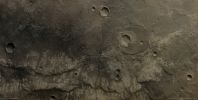
Ma_AdimVallis-ESA-PF.jpgMa'adim Vallis (possible Natural Colors; credits ESA - additional color. and process. Dr Paolo C. Fienga)92 visiteMars Express image of a region close to Ma’adim Vallis, one of the largest canyons on Mars. After Valles Marineris, Ma’adim Vallis is one of the largest canyons on Mars. The imaged region lies South-East of Ma’adim Vallis; the pictures are centred at about 29° South Lat. and 182° East Long. and have a ground resolution of approx. 15 mt/pixel.
Ma’adim Vallis is located between the Volcanic Region of Tharsis, which harbours four volcanoes, including the largest in the Solar System, and the Hellas Planitia Impact Basin.
The canyon, about 20 Km wide and 2 Km deep, originates in the southern highlands close to the ‘Dichotomy Boundary’ and ends in Gusev Crater.
The Dichotomy Boundary is a narrow region separating the Cratered Highlands, located mostly in the Southern Hemisphere of Mars, from the Northern Hemisphere's Lowland Plains.
Nota Lunexit: a nostro avviso questa "immagine" NON E' VERA! E' un disegno. Al limite, è la trasposizione digitale di un frame RAW originale unprocessed (ma ne dubitiamo). MareKromium
|
|
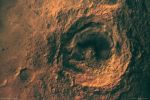
MaunderCrater.jpgMaunder Crater (Natural Colors + MULTISPECTRUM; credits: ESA & Lunexit)88 visiteThe above image shows the striking Maunder crater lying at approx. 50° South Lat. and 2° East Long., in the Noachis Terra Region on Mars.
The High Resolution Stereo Camera (HRSC) on ESA’s Mars Express orbiter took pictures of the Noachis Terra Region during orbits 2412 and 2467 on 29 November and 14 December 2005, respectively, with a ground resolution of approx. 15 mt/pixel.
The Sun illuminates the scene from the North-East (top left in the image).
Maunder crater, named after the British Astronomer Edward W. Maunder, is located halfway between Argyre Planitia and Hellas Planitia on the Southern Highlands of Mars.
With a diameter of 90 Km and a depth of barely 900 mt, the Crater is not one of the largest impact craters on Mars at present, but it used to be much deeper. It has since been filled partially with large amounts of material.MareKromium
|
|
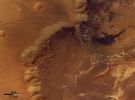
Melas_Chasma.jpgMars from orbit: Melas Chasma Region (Enhanced Natural Colors; credits: ESA - G. Neukum (FU Berlin) and oth.s - Mars Express - DLR)124 visiteA parte ogni considerazione estetica (si tratta di un'immagine davvero bellissima, per qualità e nitidezza), ci stiamo domandando se il colore di Marte non possa variare drammaticamente a seconda del tipo di ripresa che viene effettuata. Nelle immagini riprese da Sonde in orbita, infatti, il colore della superficie appare sempre (o quasi) di un acceso color arancio mentre, al suolo, tutto sembra sbiadirsi o, addirittura, trasformarsi (dal giallo al marrone e dal rosso fuoco al verde scuro). Fantasia?!?
|
|
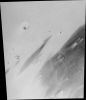
NP-S-h0241_0009_nd3-00.jpgFrame Mars Express RAW n. h0241_0009_nd367 visiteMareKromium
|
|

NP-h1169_0000_nd2-00.jpgFrame Mars Express RAW n. h1169_0000_nd291 visiteMareKromium
|
|

NP-h1169_0000_p12-00.jpgFrame Mars Express RAW n. h1169_0000_p1282 visiteMareKromium
|
|
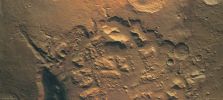
NepenthesMensae-385-090408-5212-6-co1-01.jpgNepenthes Mensae (MULTISPECTRUM; credits: Lunexit)111 visiteThe High Resolution Stereo Camera on board ESA’s Mars Express Orbiter imaged Nepenthes Mensae, a river delta on Mars, on 22 January 2008.
The data was acquired in the Region lying at approx. 3° North and 121° East, with a ground resolution of 15 mt/pixel.
The southern part of the image shows a structure reminiscent of a river delta on Earth, whose material was eroded from a valley, about 30 Km long and upto 1000 mt deep. This formed a fan-shaped deposit at the mouth of the valley. The rim of the deposit stands roughly 300 mt above the floor of the depression.
The resemblance of the structure to river deltas on Earth suggests that it was formed by a similar mechanism. Scientists believe that sediment transported by water was deposited as the flow of the water slowed down where the channel widened and met the mouth of the river.
The pictures show that the Region was affected by two episodes of flooding.
The first left a cone-shaped deposit, reaching far out into the lowland.
The second episode formed the fan with the distinct margin. This margin could indicate the location where sediments flowed into a standing body of water or ice.
Numerous hills and flat-topped mountains visible in the central part of the depression are remnants of the material that was present in the area.
The material was then eroded forming the depression, leaving behind the elevations visible today.MareKromium
|
|
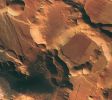
NoctisLabyrinthus.jpgNoctis Labyrinthus (Natural Colors + MULTISPECTRUM; credits: ESA & Lunexit)140 visiteThis image was taken by the High-Resolution Stereo Camera (HRSC), onboard ESA’s Mars Express imaged the Noctis Labyrinthus Region, the ‘Labyrinth of the Night’ on Mars.
The HRSC took these pictures on 25 June 2006 in orbit 3155, with a ground resolution of approx. 16 mt/pixel.MareKromium
|
|
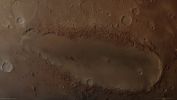
Orcus_Patera-472-20103007-2216-2238-6-co-01-PCF-LXTT1.jpgOrcus Patera (Natural Colors; credits: Dr Paolo C. Fienga - Lunexit Team)146 visiteCaption ESA:"Orcus Patera is an enigmatic elliptical depression located between Elysium and Olympus Mons.
This well-defined depression extends approximately 380 by 140 Km in a N/NE–S/SW direction. It has a Rim that rises up to 1800 mt above the surrounding Plains, while its Floor lies 400–600 mt below the surroundings. The term ‘Patera’ is used for deep, complex or irregularly shaped Volcanic Craters such as the Hadriaca Patera and Tyrrhena Patera at the N/E margin of the Hellas Impact Basin.
However, despite its name and the fact that it is positioned near Volcanoes, the actual origin of Orcus Patera still remains unclear".MareKromium
|
|
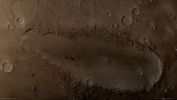
Orcus_Patera-472-20103007-2216-2238-6-co-01-PCF-LXTT2.jpgOrcus Patera (Absolute Natural Colors; credits: Dr Paolo C. Fienga - Lunexit Team)177 visiteCaption ESA:"The High-Resolution Stereo Camera (HRSC), on ESA Mars Express Spacecraft obtained image data in the Orcus Patera Region on 5 and 11 October 2005. The data were acquired during orbits 2216 and 2238 and this image was derived from the HRSC nadir channel, which provides the highest detail of all the channels".MareKromium
|
|

Phobos-400-455-20091201.jpgBig Brother and Little Brother69 visitePhobos and Deimos RAW (left panel) and processed images (right panel).
In a first, ESA’s Mars Express Orbiter imaged the Martian Moons Phobos and Deimos together on November, 5th, 2009.
Apart from their ‘wow’ factor, these unique images will help the HRSC team validate and refine existing orbit models of the two moons.
The images were acquired with the Super Resolution Channel (SRC) of the High Resolution Stereo Camera (HRSC). The camera took 130 images of the moons on November 5th at 09:14 CET in a span of 1,5 minutes at intervals of 1", speeding up to 0,5" intervals toward the end. The image resolution is 110 m/pixel for Phobos and 240 m/pixel for Deimos — Deimos was more than twice as far from the camera.
The Super Resolution Channel of the HRSC uses an additional lens, which has a very narrow field of view of just 0,5°, providing four times the magnification than otherwise providing four times the resolution of the HRSC colour stereo channel.
Phobos, the larger of the two moons, orbits closer to the Red Planet, circling it every 7 hours and 39 minutes. It travels faster relative to Mars than the Moon relative to Earth.
Phobos was about 11.800 Km from Mars Express when the images were taken. Deimos, instead, was about 26.200 Km away.MareKromium
|
|
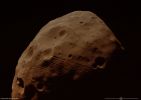
Phobos-401-20080729-5851-6-na-1a-Phobos-Flyby_H1.jpgPhobos in HR (Enhanced Natural Colors; credits for the additional process. and color.: Dr Paolo C. Fienga - Lunexit Team)72 visiteCaption ESA:"On July 23, 2008, the High Resolution Stereo Camera on board the ESA’s Mars Express took the highest-resolution full-disc image yet of the surface of the moon Phobos.
The image data were acquired from a distance of about 97 Km from Phobos' Surface, with a spatial resolution of about 3,7 mt/pixel, during orbit 5851.
These images have surpassed all previous images from other missions in continuous coverage of the illuminated surface at the highest spatial resolution of 3,7 mt/pixel".
This image has been geometrically corrected and exhibits the original illumination and photometric conditions". MareKromium
|
|
| 106 immagini su 9 pagina(e) |
 |
|
|
|
6 | |
|
|








