Mars through Mars Express (ESA - Original Raw Frames & Orbital Panoramas)
|
|
|
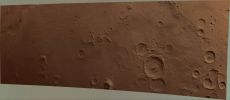
Hellas_Planitia-H0572_0000_ND2_H-PCF-LXTT.jpgFrame H0572_0000_ND2: Hellas Planitia Region220 visiteCaption ESA:"The HRSC on board ESA's Mars Express Spacecraft obtained this image on July, 1st, 2004 during orbit 572 with a ground resolution of approx. 45,1 mt per pixel.
The scene shows a portion of Hellas Planitia, a Region which is about 234 Km wide in the North, 345 Km in the South, about 898 Km in length, and centred at approx. 89° East Long. and 29° South Lat.
This image represents an area on the Northern Eastern Rim of Hellas Planitia, also known as the Hellas Impact Basin in Mars's Southern Hemispere. The Basin is thought to have formed around 3900 Million Years ago in a single massive impact".MareKromium
|
|
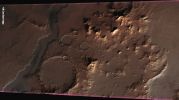
Hellespontus_Region_and_Reull_Vallis.jpgHellespontus and Reull Region (MULTISPECTRUM processing, from an idea of Keith Laney)68 visitenessun commentoMareKromium
|
|

Hesperia_Planum-224co01_H-PCF-LXTT.jpgHuge Massif in Hesperia Planum247 visiteCaption ESA:"The HRSC on ESA's Mars Express obtained this image on June, 13th, 2004, during orbit 506 with a ground resolution of approx. 37,6 mt per pixel.
This view shows a portion of the Hesperia Planum Region, containing the Massif, and located at approx. 30,3° South Lat. and 97,8° East Long.".MareKromium
|
|
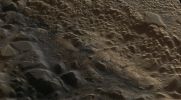
IaniChaos-ESA-PF.jpgIani Chaos (possible Natural Colors; credits ESA - additional color. and process. Dr Paolo C. Fienga)109 visiteIani Chaos on Mars, an area where Light Toned Deposits, or LTD, are known to be present. An analysis of data and images from Mars Express suggests that several LTD, some of the least understood structures on Mars, were formed when large amounts of groundwater burst on to the Surface. Scientists propose that groundwater had a greater role in shaping the Martian Surface than previously believed, and may have sheltered primitive life forms as the Planet started drying up.
This image was obtained with the High Resolution Stereo Camera on board ESA’s Mars Express Spacecraft.
Nota Lunexit: a nostro avviso questa "immagine" NON E' VERA! E' un disegno. Al limite, è la trasposizione digitale di un frame RAW originale unprocessed (ma ne dubitiamo). MareKromium
|
|

Ismenius_Lacus-H1201_0000_ND2_H-PCF-LXTT.jpgFrame H1201_0000_ND2: Ismenius Lacus Region222 visiteCaption ESA:"The scene shows the Region of Ismenius Lacus, about 77 Km wide in the North and 63 Km wide in the South, about 845 Km in length, and centered at - approx. - 25° East Long and 40° North Lat.
The image represents a Transitional Region on the Surface separating the heavily Cratered Highlands in the South from the smooth Northern Plains.
The Dissected Terrain contains a series of Mesas (i.e.: isolated "High Plateaux") and Buttes (i.e.: small and flat-topped Hills).MareKromium
|
|
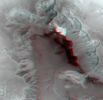
Juventae_Chasma_3D-1.JPGJuventae Chasma (High-Def-3D; credits: ESA)107 visiteSpettacolare: un 3D assolutamente straordinario.
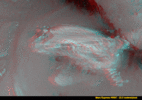
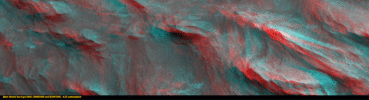
Original caption:"These images, taken by the HR Stereo Camera (HRSC) on board ESA’s Mars Express spacecraft, show the depression of Juventae Chasma, cut into the plains of Lunae Planum on Mars.
The HRSC obtained these images during orbit 243 with a ground resolution of approximately 23,4 mt per pixel. The scenes show the region of Lunae Planum, at approximately 5° South and 297° East.
The depression of Juventae Chasma, located North of Valles Marineris, cuts more than 5000 mt into the plains of Lunae Planum. The floor of Juventae Chasma is partly covered by dunes.
In the valley, to the North-East, there is a mountain composed of bright, layered material. This mountain is approximately 2500 mt high, it has a length of 59 Km and a width of up to 23 Km. The OMEGA spectrometer on board Mars Express discovered sulphate on the surface of Mars and confirmed that this mountain is indeed composed of sulphate deposits".
|
|
Juventae_Chasma_3D-2.gifJuventae Chasma (High-Def-3D - EDM n.1; credits: ESA)70 visitenessun commento
|
|
Juventae_Chasma_3D-3.gifJuventae Chasma (High-Def-3D - EDM n.2; credits: ESA)85 visitenessun commento
|
|
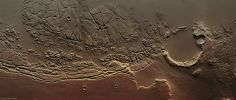
Kasei_Valles_and_Sacra_Fossae-448-20091007-6241-6-co-01_H1.jpgKasei Valles and Sacrae Fossae (Absolute Natural Colors; credits for the additional process. and color.: Dr Paolo C. Fienga - Lunexit Team)73 visiteCaption ESA:"Mars Express flew over the boundary between Kasei Valles and Sacra Fossae and imaged the Region, acquiring spectacular views of the Chaotic Terrain in the area.
The image is centred at about 12° North Latitude and 285° East Longitude and have a ground resolution of approx. 21 mt/pixel.
They cover about 225 x 95 Km (or 21.375 sq Km); an area roughly half the size of the Netherlands".MareKromium
|
|

L-h0513_0009_nd2-00.jpgFrame Mars Express RAW n. h0513_0009_nd293 visiteMareKromium
|
|
Lava_Flows-Daedalia_Planum-PCF-LXTT.jpgDaedalia Planum (Absolute Natural Colors; credits for the additional process. and color.: Dr Paolo C. Fienga - Lunexit Team)91 visitenessun commentoMareKromium
|
|

MA_ADIM_VALLIS-440-20090629-6393-6-co-01_H1-1.jpgProximities of Ma'adim Vallis (Natural Colors; credits: ESA)84 visiteCaption ESA:"Mars Express image of a Region close to Ma’adim Vallis, one of the largest - after Vallis Marineris - canyons on Mars.
The imaged Region lies South-East of Ma’adim Vallis; the pictures are centred at about 29° South Lat. and 182° East Long. and have a ground resolution of 15 mt/pixel.
Ma’adim Vallis is located between the Volcanic Province of Tharsis, which harbours 4 volcanoes, including the largest in the Solar System, and the Hellas Planitia Impact Basin.
The canyon, approx. 20 Km wide and 2 Km deep, originates in the Southern Highlands close to the so-called ‘Dichotomy Boundary’ and ends in Gusev Crater.
The Dichotomy Boundary is a narrow Region separating the cratered Highlands, located mostly in the Southern Hemisphere of Mars, from the Northern Hemisphere's Lowland Plains".MareKromium
|
|
| 106 immagini su 9 pagina(e) |
 |
|
|
5 | |
|
|
|








