Mars through Mars Express (ESA - Original Raw Frames & Orbital Panoramas)
|
|
|
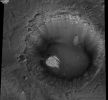
Craters-Pollack_Crater-H1201_0001_ND3_crop_wide-0.jpgPollack Crater and "White Rock" (RAW Frame; credits: ESA - Mars Express)71 visitenessun commentoMareKromium
|
|
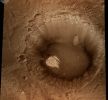
Craters-Pollack_Crater-H1201_0001_ND3_crop_wide-3.jpgPollack Crater and "White Rock" (Natural Colors - Tri-Chromatic Version; credits for the additional process. and color.: Dr Paolo C. Fienga - Lunexit Team)69 visitenessun commentoMareKromium
|
|

Craters-Pollack_Crater-H1201_0001_ND3_crop_wide-PCF-LXTT-3.jpgPollack Crater and "White Rock" (Absolute Natural Colors; credits for the additional process. and color.: Dr Paolo C. Fienga - Lunexit Team)258 visitePollack Crater is located in the "Sinus Sabaeus Quadrangle! of Mars, at approx. 7,9° South Lat. and 334,8° West Long. Pollack Crater is about 96 Km in diameter and it was named after Dr James B. Pollack, an American physicist (1938 –1994).
Pollack Crater contains a large Light-toned Deposit (known as "White Rock" or "Pollack's White Fingers") that was once thought to be a Salt Deposit. Truth is that nobody knows, so far, the real nature of White Rock and the reason of its bright color - even though some people - Scientists and Professional Researchers - say that White Rock "only APPEARS white, but it is not", and the reason why of this appearence is in the fact that its surroundings are exceptionally dark.
On the other hand, we believe, as Lunar Explorer Italia Team, that such a "theory" is incredibly lame and does not deserve to ba called and known as a "theory" at all.
MareKromium
|
|
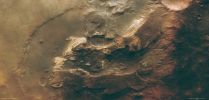
Craters-Terby_Crater.jpgTerby Crater (Natural Colors + MULTISPECTRUM; credits: ESA & Lunexit)85 visiteThe High Resolution Stereo Camera (HRSC) on board ESA’s Mars Express Orbiter imaged the Terby Crater on Mars on 13 April 2007 during orbit 4199.
The Region is of great scientific interest as sediments there hold information on the role of water in the history of the Planet. Eye-catching finger-shaped plateaux extend in the North-South direction. They rise up to 2000 mt above the surrounding terrain. The relatively old crater was filled with sediments in the past, which formed plateaux on erosion.
The flanks of the plateaux clearly exhibit layering of different-coloured material. Differences in colour usually indicate changes in the composition of the material and such layering is called ‘bedding’. Bedding structures are typical of sedimentary rock, which has been deposited either by wind or water. Different rock layers erode differently, forming terraces.
The valleys exhibit gullies, or channels cut in the ground by running liquid, mainly in the Northern part of the image.
These gullies and the rock-bedding structure indicate that the region has been affected by water.
MareKromium
|
|

Craters-Unnamed_Crater_at_the_end_of_Mamers_Valles-392-250408-3304-6-co-01.jpgBird's-Eye view of Mamers Valles (MULTISPECTRUM; credits: Lunexit)121 visiteThe High-Resolution Stereo Camera (HRSC) onboard the ESA Spacecraft Mars Express obtained images focusing on a depression that displays a crater at the end of the long, winding Valley System known as Mamers Valles.
The data was obtained on 5 August 2006, with a ground resolution of approx. 14 mt/pixel. The image is centred at approx. 39° North and 17° East on the Planet.
The Mamers Valles System is approx. 1000 Km long, running along the boundary between the Northern Lowlands and Southern Highlands in the Region of Deuteronilus Mensae.
Scientists term a Region such as Mamers Valles ‘fretted terrain’ because it shows numerous deep and wide labyrinth-like valleys and circular depressions which often show structures formed by flowing liquid on their even floors. The structures formed by the flows are thought to be ice-rich debris flows. They show some resemblance to block glaciers seen on Earth.
The patches of rock at the centre of the depression are thought to be remnants of rock detached from the flanks of the depression and transported into its centre MareKromium
|
|

Craters-Unnamed_Crater_in_Promethei_Terra-PCF-LXTT.jpgUnnamed Crater in Promethei Terra (Absolute Natural Colors; credits for the additional process. and color.: Dr Paolo C. Fienga - Lunar Explorer Italia)96 visitenessun commento
|
|

Craters-Unnamed_Double_Crater_in_Terra_Tyrrhena.jpgDouble Impact Crater in Terra Tyrrhena (Natural Colors + MULTISPECTRUM; credits: ESA & Lunexit)85 visiteThe High Resolution Stereo Camera (HRSC), ESA's Mars Express obtained images of the Tyrrhena Terra Impact Region on Mars.
On 10 May 2007, the spacecraft was in orbit number 4294 when it snapped pictures of the Region located at 18° South Lat. and 99° East Long. with a ground resolution of approximately 15 meters per pixel.
The Western part of the scene is dominated by a 35 Km-wide and approx. 1000 mt-deep impact crater with an extremely cliffy and chiseled edge. Another, 18 Km-long and approx. 750 mt-deep impact crater, in all likelihood a double impact crater, is located South of the large crater.
These 'double impact craters' develop when two objects, part of a binary, hit the surface almost simultaneously.MareKromium
|
|

Cydonia_Region-h3253_0000_s12-2.jpgDo you recognize this place? (natural colors; credits: Dr G. Barca & Lunexit)81 visiteUn semplice "Space-quiz": che Regione è quella che vedete in questo frame? Le Vostre risposte - motivate - possono essere inserite nei "Commenti".MareKromium
|
|
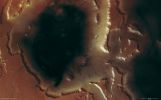
Deuteronilus_Mensae_Region-PCF-LXTT.jpgDeuteronilus Mensae (Enhanced Natural Colors; credits for the additional process. and color.: Dr Paolo C. Fienga - Lunar Explorer Italia69 visiteThis image shows the Deuteronilus Mensae Region on Mars, an area primarily characterized by (peri)glacial features.
It was taken on 14 March 2005 (orbit number 1483) by the High Resolution Stereo Camera (HRSC) onboard ESA's Mars Express with a ground resolution of approx. 29 mt per pixel.
The area is located on the Northern edge of Arabia Terra and borders the Southern High- and Northern Lowlands, at approx. 39° North Lat. and 23° East Long. MareKromium
|
|
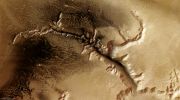
Echus_Chasma-398-260508-2204-6-co-01-H1.jpgEchus Chasma (False Colors)70 visiteThe High-Resolution Stereo Camera (HRSC) on board ESA's Mars Express has returned images of Echus Chasma, one of the largest Water Source Regions on the Red Planet.
The data were acquired on September, 25, 2005.
The pictures are centred at about 1° North and 278° East and have a ground resolution of approx. 17 mt/pixel.
Echus Chasma is an approx. 100 Km long and 10 Km wide incision in the Lunae Planum High Plateau North of Valles Marineris, the "Grand Canyon" of Mars. Echus Chasma is the Water Source Region of Kasei Valles, which extends thousands of Km to the North, and its southern-most part. The images of the Echus Chasma plateau show valleys that are about 10 km long and 1000 m deep. The main valley, Kasei Valles, is about 4 km in depth. The smaller valleys, also called sapping canyons, originate from the discharge of groundwater.
Echus Chasma is bounded to the West by the Echus Chasma Plateau, which lies about 4 Km above Echus' floor. MareKromium
|
|

Echus_Chasma-398-260508-2204-6-co-01-H2.jpgHigh Cliffs Surrounding Echus Chasma on Mars75 visiteWhat created this great cliff on Mars? Did giant waterfalls once plummet through its grooves? With a four-kilometer drop, this high cliff surrounding Echus Chasma, near an impressive impact crater, was carved by either water or lava. A leading hypothesis is that Echus Chasma, at 100-Km long and 10-Km wide, was once one of the largest water sources on Mars. If true, water once held in Echus Chasma likely ran over the Martian Surface to carve the impressive Kasei Valles, which extends over 3000 Km to the North. Even if initially carved by water, lava appears to have later flowed in the valley, leaving an extraordinarily smooth floor. Echus Chasma lies north of tremendous Valles Marineris, the largest canyon in the Solar System. The above image was taken by the robotic Mars Express spacecraft currently orbiting Mars.
Nota Lunexit: checchè ne dica la NASA, questo frame NON E' una fotografia.MareKromium
|
|

Hebes_Chasma.jpgHebes Chasma (Natural Colors + MULTISPECTRUM; credits: ESA and Lunexit)70 visiteThe Region is an "Enclosed Trough" situated in Valles Marineris, the Grand Canyon of Mars, where water is believed to have flowed.
The High Resolution Stereo Camera (HRSC) on ESA's Mars Express studied the area providing new pictorial clues to its history.
Hebes Chasma is located at approx. 1° South Lat. and 282° East Long. Image data was obtained on 16 September 2005 with a ground resolution of approx. 15 mt/pixel.
The Region is an enclosed, almost 8 Km-deep trough in the most northern part of Valles Marineris, the 3000-Km long Grand Canyon of Mars.
The steep flanks of the trough show branched incisions and small veins of rock. Below the flanks, run-off and material from larger landslides is also visible.
A flat-topped mountain is located in the centre of Hebes Chasma.
It reaches 8000 mt above the graben floor and rises to almost the same height as the plains surrounding the trough. MareKromium
|
|
| 106 immagini su 9 pagina(e) |
 |
|
4 | |
|
|
|
|








