Mars through Mars Express (ESA - Original Raw Frames & Orbital Panoramas)
|
|
|
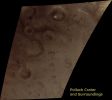
CR-h0330_0000_nd3-PCF-LXTT.jpgFrame h0330_0000_nd3 - Pollack Crater and Surroundings (Natural Colors; credits for the additional process. and color.: Dr Paolo C. Fienga - Lunexit Team)198 visitenessun commentoMareKromium
|
|
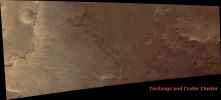
CR-h0500_0000_nd3-00-PCF-LXTT.jpgFrame h0500_0000_nd3-00 - Yardangs and Crater Cluster (Natural Colors; credits for the additional process. and color.: Dr Paolo C. Fienga - Lunexit Team)213 visitenessun commentoMareKromium
|
|

CR-h0550_0000_nd3-01-PCF-LXTT.jpgFrame h0550_0000_nd3-01 - Rayed Crater and Collapse Features (Natural Colors; credits for the additional process. and color.: Dr Paolo C. Fienga - Lunexit Team)235 visitenessun commentoMareKromium
|
|
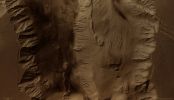
Chasmas-Candor_Chasma.jpgCandor Chasma (Natural Colors; credits: Lunexit)72 visitenessun commentoMareKromium
|
|
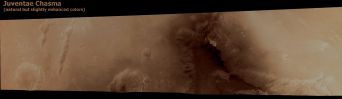
Chasmas-Juventae_Chasma-h0243_0000_nd3.jpgJuventae Chasma (Natural Colors, Tri-Chromatic Version - credits for the additional process. and color.: Dr Paolo C. Fienga - Lunexit Team)115 visitenessun commentoMareKromium
|
|

Chasmas-Tithonium_Chasma-2-121-221004-0442-6-co-01.jpgTithonium Chasma - Valles Marineris155 visiteCaption ESA originale:"This image shows the western end of the canyons Tithonium Chasma and Ius Chasma, part of the Valles Marineris canyon system, which are up to 5,5 Km deep.
The image was taken on 26 May 2004 during orbit 442 with a ground resolution of approximately 52 metres per pixel. The displayed region is located at the beginning of the canyon system at about latitude 7° South and longitude 269° East. North is to the left".
|
|

Claritas_Fossae-1-029-290304-0068-6-co-02.jpgClaritas Fossae (1 - ESA/ DLR/ FU Berlin - G. Neukum)98 visiteCaption ESA originale:"These Mars Express images show Claritas Fossae, an ancient tectonic region on Mars, west of Solis Planum, a tectonic and volcanic area south-east of the Tharsis volcano group.
The images were taken by the High-Resolution Stereo Camera (HRSC) on Mars in orbit 68 from an altitude of 271 Km. The images are centred at 255,7° East and 30,9° North. North is on the left".
|
|

Claritas_Fossae-2-029-290304-0068-6-co-02.jpgClaritas Fossae (2 - ESA/ DLR/ FU Berlin - G. Neukum)79 visitevedi il commento al frame che precede
|
|

Claritas_Fossae-3-096-140904-0508-6-co-01-ClaritasFossae_hires.jpgClaritas Fossae (3 - ESA/ DLR/ FU Berlin - G. Neukum)86 visiteCaption ESA originale:"The displayed region is the eastern part of Claritas Fossae and the western part of Solis Planum at longitude 260° East and latitude of about 28° South.
The diffuse blue-white streaks in the northern parts of the scene (Sx di chi guarda) are clouds or aerosols. The Claritas Fossae (‘fossa’ is Latin for trough----->canale) region is characterised by systems of ‘grabens’ running mainly north-west to south-east. These can be traced several hundred kilometres up to the northern Tharsis shield volcanoes.
A "graben" forms when a block of the planet’s crust drops down between 2 faults, due to extension, or pulling, of the crust. A ‘horst and graben’ system can occur where there are several parallel faults.
Geographically, the grabens separate the eastern volcanic plains of the Solis Planum region from the western Daedalia Planum lava plains.
|
|

Claritas_Fossae-4-096-140904-0508-6-co-01-ClaritasFossae_hires.jpgClaritas Fossae (4 - ESA/ DLR/ FU Berlin - G. Neukum)76 visiteCaption ESA originale:"The lava blankets of the Solis Planum area cover the eastern parts of the older Claritas Fossae ridge and surround some of the higher ground. The geological history of this region can be reconstructed by analysing the layers of tectonic grabens, impact craters, volcanic features and even small valley networks. The complexity of Claritas Fossae Region suggests that some of the events took place at the same time. Furthermore, the detailed view of the large southern impact crater shows patches of dark material which are located near the central and marginal parts of the impact crater floor. This material may be of volcanic origin".
|
|

Claritas_Fossae-5-098-140904-0508-6-3d-01-ClaritasFossae_hires.jpgClaritas Fossae (5 - ESA/ DLR/ FU Berlin - G. Neukum)91 visitenessun commento
|
|
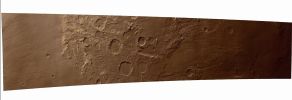
Claritas_Fossae-H0530_0000_ND2-PCF-LXTT.jpgFrame H0530_0000_ND2: Claritas Fossae Region225 visiteCaption ESA:"The HRSC on board ESA's Mars Express Spacecraft obtained this image on June, 20th, 2004, during orbit 530, with a ground resolution of approx. 31,4 mt per pixel.
This scene shows portion of the Claritas Fossae Region, covering an area roughly 200 by 1150 Km and centered at approx. 258° East Long. and 32° South Lat".
MareKromium
|
|
| 106 immagini su 9 pagina(e) |
2 |  |
|
|
|
|
|
|








