After One-Thousand Soles...
|
|
|

OPP-SOL2410-GB-PCF-LXTT-Panoramic_nav.jpgIntrepid Crater - Sol 2410 (an Image-Mosaic in Absolute Natural Colors by Drr Gianluigi Barca and Paolo C. Fienga - Lunexit Team)129 visitenessun commentoMareKromium
|
|
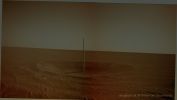
OPP-SOL2410-HD3D-MF-PCF-LXTT.jpgWaiting for a Flag... - Sol 2410 (by Marco Faccin)97 visitenessun commentoMareKromium
|
|

OPP-SOL2410-PIA13596-PCF-LXTT.jpgYankee Clipper - Sol 2410 (an Original NASA Image Mosaic colorized in Absolute Natural Colors; credits for the additional process. and color.: Dr Paolo C. Fienga - Lunexit Team)100 visitenessun commentoMareKromium
|
|

OPP-SOL2410-PIA13596.jpgYankee Clipper - Sol 2410 (an Original NASA b/w Image-Mosaic - credits: NASA/JPL-Caltech)64 visiteCaption NASA:"Yankee Clipper Crater on Mars carries the name of the CSM (Command and Service Module) of NASA's 1969 Apollo 12 Mission to the Moon.
NASA's Mars Exploration Rover Opportunity recorded this view of the Crater during a pause in a 102-meter (365-foot) drive during the 2410th Sol of the Rover's work on Mars (such as Nov., 4th, 2010).
This view is a mosaic of three frames taken by the left eye of Opportunity's NavCam. Yankee Clipper Crater is about 10 meters (33 feet) in diameter.
The Rover Science Team uses a convention of assigning the names of historic ships of exploration as the informal names for Craters seen by Opportunity. Apollo 12's Yankee Clipper orbited Earth's Moon while the Mission's LM (Lunar Module) carried two Astronauts to the Lunar Surface on November, 19th, 1969, and later brought all three of the Mission's Astronauts back to Earth, arriving on November, 24th, 1969".MareKromium
|
|

OPP-SOL2411-1P342239512EDNAVQFP2691R4M1-PCF-LXTT.jpgSetting Sun over Meridiani Planum - Sol 2411 (Natural Colors; credits for the additional process. and color.: Dr Paolo C. Fienga - Lunexit Team)400 visiteQuesto processing in Colori Naturali del Tramonto Marziano occorso al termine del Sol 2411 del MER Opportunity è stato ottenuto utilizzando i consueti criteri propri della "Colorizzazione Naturale" (NON Assoluta), ed ipotizzando una TAU medio/bassa.
La differenza più eclatante fra questo processo di colorizzazione ed i relativi risultati, rispetto al processo di colorizzazione (e relativi risultati) adottato dalla NASA è nella estrema chiarezza e luminosità del panorama Marziano; una chiarezza e luminosità che nei frames processati in "approximate true/natural colors" dalla NASA appare invece inesistente (il Cielo Marziano del tramonto, according to NASA, è quasi sempre di color rosa scuro ed uniforme, oppure di un azzurro scurissimo - diremmo "azzurro tenebra"...).
Strano.
Strano, soprattutto perchè è proprio la NASA ad aver detto e scritto, molte volte, che il Cielo Marziano del tramonto è "extremely bright" e che la sua "brightness" resiste anche sino a 2 (o più) ore dopo il calar del Sole (a causa, inter alia e soprattutto, delle polveri sottilissime in sospensione che si trovano negli strati medio alti ed alti dell'Atmosfera del Pianeta Rosso, le quali continuano a riflettere e diffondere la Luce del Sole - ancora (relativamente) intensa, evidentemente, dal loro angolo visuale).MareKromium
|
|
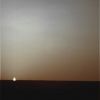
OPP-SOL2411-1P342239737EDNAVQFP2691R4M1-PCF-LXTT.jpgSetting Sun over Meridiani Planum - Sol 2411 (Natural Colors; credits for the additional process. and color.: Dr Paolo C. Fienga - Lunexit Team)382 visitenessun commentoMareKromium
|
|

OPP-SOL2411-1P342239888EDNAVQFP2691R4M2-PCF-LXTT.jpgAfterlight... - Sol 2411 (Natural Colors; credits for the additional process. and color.: Dr Paolo C. Fienga - Lunexit Team)381 visitenessun commentoMareKromium
|
|

OPP-SOL2411-1P342240418EDNAVQFP2691L7M1-PCF-LXTT.jpgAfterlight... - Sol 2411 (Natural Colors; credits for the additional process. and color.: Dr Paolo C. Fienga - Lunexit Team)328 visitenessun commentoMareKromium
|
|

OPP-SOL2411-PIA13736.jpgSunset over Meridiani Planum - Sol 2411 (credits: NASA/JPL-Caltech/Cornell/Texas A&M)103 visiteThe Sun descends to the Martian Horizon and sets in this image from the PanCam on NASA's Mars Exploration Rover Opportunity. The Rover Team uses the PanCam to view Sunsets a few times a year, when the Rover power is adequate, as a way to monitor distribution and variability of Dust in the Lower Atmosphere.
This picture has been taken taken through the PanCam's 440 nanometer-wavelength (blue), and 864 nanometer-wavelength (near InfraRed) filters, on Opportunity's 2411th Martian Day, or Sol (such as Nov., 5, 2010). The Sun's glare saturated part of the image and so part of the the glare has been removed and then it has been inserted a non-saturated image of the Sun, taken from the previous day's imaging using PanCam's special solar filter.
The end result simulates watching the Sun set on Mars using a good pair of dark sunglasses.MareKromium
|
|

OPP-SOL2411_Sunset.gifSunset over Meridiani Planum - Sol 2411 (a GIF-Movie in RAW Natural Colors by Dr Gianluigi Barca - Lunexit Team)431 visitenessun commentoMareKromium
|
|

OPP-SOL2415-PIA13737.jpgPhobos eclipsing the Sun - Sol 2415 (credits: NASA/JPL-Caltech/Cornell/Texas A&M)120 visiteThe larger of the two moons of Mars, Phobos, transits the Sun in this image from the PanCam on NASA's Mars Exploration Rover Opportunity taken on the Rover's 2415th Martian Day, or Sol (such as Nov. 9, 2010).
Images of solar transits of Phobos and the other Mars moon, Deimos, taken over many years by Mars Rovers aid in studies of slight changes in the moons' orbits.
The silhouette of Phobos looks smaller here than in some other Mars Rover transit images (for example, PIA05554) because when Phobos is near the Horizon it is more than 30% farther from the camera's location than when it is straight overhead.MareKromium
|
|

OPP-SOL2417-Intrepid_Crater-1.jpgIntrepid Crater - Sol 2417 (Approximately True Colors; credits for the additonal process. and color.: Mars Exploration Rover Mission, Cornell, JPL, NASA)105 visiteCaption NASA:"Intrepid Crater on Mars carries the name of the Lunar Module of NASA's Apollo 12 Mission, which landed on Earth's Moon on November 19, 1969. NASA's Mars Exploration Rover Opportunity recorded this view of the Crater during the 2417th Martian Day, or Sol, of the Rover's work on Mars (Nov. 11, 2010).
This view is presented in Approximately True Color, combining exposures taken by Opportunity's Panoramic Camera (PanCam) through three filters admitting wavelengths of 752 nanometers, 535 nanometers and 432 nanometers. Intrepid Crater is about 20 meters (66 feet) in diameter. That is about the same size as the Crater where Opportunity spent its first two months on Mars: Eagle Crater.
The Rover's look-back image into Eagle Crater after driving out of it in 2004 is at PIA05755.
The Rover Science Team uses a convention of assigning the names of historic ships of exploration as the informal names for craters seen by Opportunity. Apollo 12's LM Intrepid carried Astronauts Alan Bean and Pete Conrad to the Surface of Earth's Moon while crewmate Dick Gordon orbited overhead in the Mission's CSM (Command and Service Module), Yankee Clipper. A view of Bean next to Intrepid on the Moon is online at http://spaceflight.nasa.gov/gallery/images/apollo/apollo12/html/as12-46-6749.html . An image of Conrad inspecting Robotic Lander Surveyor 3, with Intrepid on the Lunar Horizon nearby, is online at http://spaceflight.nasa.gov/gallery/images/apollo/apollo12/html/as12-48-7133.html".MareKromium
|
|
| 2387 immagini su 199 pagina(e) |
 |
|
|
|
|
95 | |
|
|
|
|








