After One-Thousand Soles...
|
|
|
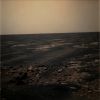
OPP-SOL1950-GB-LXT-3.jpgAfternoon in Meridiani Planum (3) - Sol 1950 (Natural Colors; credits: Dr G. Barca & Lunexit)63 visitenessun commentoMareKromium
|
|
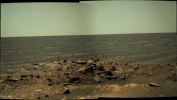
OPP-SOL1950-GB-LXT1.jpgPossible Secondary Crater near Victoria Crater (Resolution Crater) - Sol 1950 (Photo-composite Panorama - Natural Colors/Blue-Green Filters ON; credits: Dr. G. Barca & Lunexit)63 visitenessun commentoMareKromium
|
|
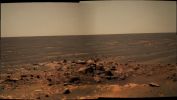
OPP-SOL1950-GB-LXT2.jpgPossible Secondary Crater near Victoria Crater (Resolution Crater) - Sol 1950 (Photo-composite Panorama - Natural Colors/Blue-Green Filters OFF; credits: Dr. G. Barca & Lunexit)65 visitenessun commentoMareKromium
|
|
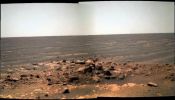
OPP-SOL1950-MF.jpgPossible Secondary Crater near Victoria Crater (Resolution Crater) - Sol 1950 (Photo-composite Panorama - Natural Colors; credits: Matteo Fagone)63 visitenessun commentoMareKromium
|
|
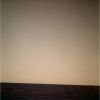
OPP-SOL1957-1_copia2.jpgMeridiani Skyline - Sol 1957 (Natural Colors; credits: Dr G. Barca)63 visitenessun commentoMareKromium
|
|
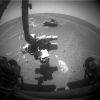
OPP-SOL1959-PIA12160.jpgApproaching Block Island: a "new" Martian Meteorite Fragment - Sol 195963 visiteCaption NASA:"This image of “Block Island” was taken on July 28, 2009, with the front Hazard-Identification Camera on NASA’s Mars Exploration Rover Opportunity.
Scientists will be testing the rock with the Particle X-Ray Spectrometer to get composition measurements and to confirm if indeed it is a meteorite".MareKromium
|
|
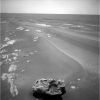
OPP-SOL1959-PIA12161.jpgBlock Island - Sol 195963 visiteCaption NASA:"This is a picture of “Block Island”, an odd-shaped, dark rock, which may be a meteorite. This rock was imaged with the Navigation Camera on NASA’s Mars Exploration Rover Opportunity on Sol 1959 (July 28, 2009)".MareKromium
|
|
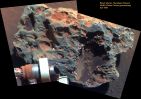
OPP-SOL1961-1249578498_17705-1_BlockIsland_VP_L257_full1.jpgBlock Island - Sol 1961 (False Colors; credits: NASA/JPL-Caltech/Cornell University)83 visiteCaption NASA:"This view of a rock called "Block Island", such as the largest meteorite yet found on Mars, comes from the Panoramic Camera (PanCam) on NASA's MER (Mars Exploration Rover) Opportunity.
Analysis of Block Island's composition using the Rover's Alpha Particle X-Ray Spectrometer confirmed that it is rich in Iron and Nickel. The rock is about 60 centimeters (approx. 2 feet) across.
This is a False-Color, red-green-blue composite view generated from images taken through the PanCam's 750-nanometer, 530-nanometer and 430-nanometer filters. The exaggeraged color is used for enhancing the visibility of differences among the types of rock and soil materials".MareKromium
|
|
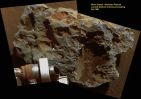
OPP-SOL1961-1249578498_17705-1_BlockIsland_VP_L257_full2.jpgBlock Island - Sol 1961 (Natural Colors; credits: Lunexit)63 visitenessun commentoMareKromium
|
|
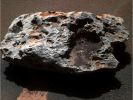
OPP-SOL1961-GB1.jpgBlock Island - Sol 1961 (Natural Colors; credits: Dr G. Barca)63 visitenessun commentoMareKromium
|
|
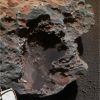
OPP-SOL1961-GB2.jpgBlock Island - Sol 1961 (Natural Colors; credits: Dr G. Barca)82 visitenessun commentoMareKromium
|
|
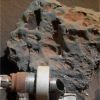
OPP-SOL1961-GB3.jpgBlock Island - Sol 1961 (Natural Colors; credits: Dr G. Barca)78 visitenessun commentoMareKromium
|
|
| 2387 immagini su 199 pagina(e) |
 |
|
|
|
|
60 | |
|
|
|
|








