After One-Thousand Soles...
|
|
|
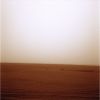
OPP-SOL1235-1P237817092EFF85W0P2689L6M1.jpgThe pale Sky over Meridiani (3 - natural colors, elab. Lunexit)98 visitenessun commentoMareKromium
|
|
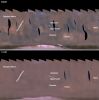
OPP-SOL1235-PIA-00936.jpgSeries of Storms Shrouds Mars in Dust (1) - NASA/JPL/Malin Space Science Systems64 visiteSince late June 2007, Mars has been having a series of regional dust storms. The dust raised by these individual storms has obscured most of the planet over the past few weeks. The two maps shown here are mosaics of images acquired by the Mars Reconnaissance Orbiter (MRO) Mars Color Imager (MARCI) on two days separated by about 3 and a half weeks. The first, on 22 June, shows that there was a dust storm occurring near the east end of the Valles Marineris trough system (left of the label for "Opportunity" in the map). This was the first in the series of storms. The second mosaic shows how Mars appeared on 17 July, after dust was lofted high into the atmosphere by several regional storms and countless smaller, local dust storms.
Each map was constructed from 13 pole-to-pole image swaths at red, green, and blue wavelengths acquired by the MRO MARCI. The maps are simple cylindrical projections, with north at the top and south at the bottom. Each image swath was acquired at about 3 p.m. local time on Mars over the course of 13 orbits. The black gaps occur in the MARCI data at places where the MRO spacecraft was slewed east or west to point its instruments at a specific target of scientific interest. The north polar region is not shown because winter began on 4 July and the north polar region is in wintertime darkness. Key features labeled on the maps include the Tharsis Montes and Olympus Mons volcanoes, the Hellas impact basin, Noachis Terra, Sinus Meridiani, and the two Mars Exploration Rover (MER) landing sites, Opportunity and Spirit. The dust storms, and the planet-encircling dust veil they generated, has greatly reduced the amount of sunlight available to run the two solar-powered rovers.
MareKromium
|
|
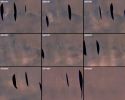
OPP-SOL1235-PIA-00937.jpgSeries of Storms Shrouds Mars in Dust (2) - NASA/JPL/Malin Space Science Systems64 visiteThis sequence of Mars Reconnaissance Orbiter (MRO) Mars Color Imager (MARCI) daily mosaics shows some of the dust storm activity that occurred near the Mars Exploration Rover (MER) Opportunity landing site between 21 June 2007 and 18 July 2007. The Opportunity rover is located near the martian prime meridian and equator. The top and middle rows of images show the first six days of dust storm activity near the rover site as dust advanced from the west to the south and passed south of the rover over the course of a week. By the end of that first week, storm activity strengthened and continued to move east, eventually passing over nearly half of the martian southern hemisphere. Other storms spawned by this atmospheric disturbance affected the MER Spirit rover on the other side of the planet, while new storms developed, approached, and affected Opportunity. The bottom three images show dust activity over the MER Opportunity site on 3, 14, and 18 July. By 19 July, most of the martian surface was obscured by the dust lofted from these storms. As with previous large dust-raising events on Mars, once the active storms die down, many weeks to months will pass before the dust settles out and the atmosphere clears. The white circle indicates the location of the Opportunity landing site, the black gaps are caused by slewing the spacecraft east or west to image specific science targets, and north in each picture is toward the top, west is to the left.
MareKromium
|
|

OPP-SOL1235-PIA09935-DustStorm.gifPlanetary Dust Storm (GIF Movie)64 visiteNASA's Opportunity rover is literally seeing some of its darkest days. Both Mars Exploration Rovers have been riding out a regional dust storm for several weeks. Conditions became particularly dreary in the Meridiani Planum region where Opportunity sits, perched on the edge of "Victoria Crater."
This image is a time-lapse composite where each horizon-survey image has been compressed horizontally (but not vertically) to emphasize the sky. The relative brightness and darkness of the sky from sol to sol (over a 30-sol period beginning June 14, 2007) is depicted accurately in these images, which view roughly the same part of the plains southwest of the rover. The images are approximately true color composites, generated from calibrated radiance data files using the panoramic camera's 601-nanometer, 535-nanometer and 482-nanometer filters.
The rovers' atmospheric science team is concerned that smaller, regional dust storms could expand into a larger, globe-encircling storm. That could extend the time the sun stays obscured, challenging the capability of Opportunity's solar panels to produce enough electricity for the rover to function.
Fortunately, as of July 19, 2007, the Opportunity site is clearing slightly. When the storm ends, atmospheric scientists hope to review data from the rovers that will help them determine what sort of dust was being lifted and distributed.
The numbers across the top of the image report a measurement of atmospheric opacity, called by the Greek letter tau. The lower the number, the clearer the sky. Both Opportunity and Spirit have been recording higher tau measurements in July 2007 than they had seen any time previously in their three and a half years on Mars. The five sol numbers across the bottom correspond (left to right) to June 14, June 30, July 5, July 13 and July 15, 2007.
MareKromium
|
|

OPP-SOL1254-1P239512176EFF85W0P2351L7M1.jpgRover Tracks and bright "berries" all over... - Sol 1254 (False Colors; credits: Lunexit)64 visiteUna splendida immagine dei Berries che circondano Opportunity ci arriva (diremmo finalmente!) da Meridiani Planum, Sol 1254. Forse la tempesta di sabbia che aveva messo in pericolo la sopravvivenza dei MER si sta esaurendo e, forse, è ancora presto per dichiarare il cessato allarme.
Comunque sia, questa immagine (assieme a molte altre appena pervenute e da poco processate e colorizzate) ci dimostra che Opportunity è ancora in eccellente salute e riesce a fare il proprio lavoro egregiamente.
Noi - in tutta sincerità - non ne abbiamo mai dubitato.MareKromium
|
|

OPP-SOL1254-1P239512176EFF85W0P2351L7M1~0.jpgThe Surface of Meridiani Planum - Sol 1254 (Absolute Natural Colors; credits for the additional process. and color.: Drr Gianluigi Barca and Paolo C. Fienga - Lunexit Team)121 visitenessun commentoMareKromium
|
|
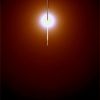
OPP-SOL1255-1N239597006EDN85W0P1550L0M1.jpgThere's still a "dark reddish sky" over Opportunity... - Sol 125568 visiteElaborazione in colori naturali del Cielo di Marte così come potrebbe e dovrebbe apparire ai nostri occhi durante questi giorni di "oscurità" (rectius: di elevatissima Opacità Atmosferica).
MareKromium
|
|
OPP-SOL1259-1R239952419EFF85W0P1369L0M1.jpgDusty Days over Opportunity... - Sol 125964 visitenessun commentoMareKromium
|
|
OPP-SOL1261-1N240130679EDN85W0P1550L0M1.jpgDark Sun, Dark Sky - Sol 126164 visitenessun commentoMareKromium
|
|

OPP-SOL1266-1N240572984EDN85W0P1585L0M1.jpgThe sky over Opportunity - Sol 1266 (natural colors; elab. Lunexit)64 visitenessun commentoMareKromium
|
|

OPP-SOL1266-1R240573239EFF85W0P1369L0M1.jpgA still dusty sky and horizon... - Sol 1266 (natural colors; elab. Lunexit)64 visitenessun commentoMareKromium
|
|

OPP-SOL1274-1P241281469ESF8600P2143L5M1-2.jpgThe "Breathing Lungs" of Mars - Sol 127464 visitePer il commento relativo a questo frame Vi suggeriamo di leggere l'ultimo articolo del Dr Paolo C. Fienga pubblicato su TruePlanets e dal titolo "I Polmoni di Marte".
Buona lettura!MareKromium
|
|
| 2387 immagini su 199 pagina(e) |
 |
|
|
|
|
17 | |
|
|
|
|








