Inizio Registrati Login

Elenco album Ultimi arrivi Ultimi commenti Più viste Più votate Preferiti Cerca

Inizio > DEEP SKY > Deep Sky Objects
Ritorna alla pagina delle miniature FILE 1067/25332 Torna all'inizio Guarda foto precedente Guarda foto successiva Salta alla fine
Phoenix Planets
"...Qualsiasi Creatura dell'Universo la quale sia tanto evoluta da riuscire a raggiungere il nostro Pianeta, coprendo distanze che sono difficili da cogliere anche alla nostra immaginazione, deve essere altrettanto saggia da capire - dopo averci trovati - che è meglio starsene lontana da noi..."

(dalla serie televisiva "CSI")

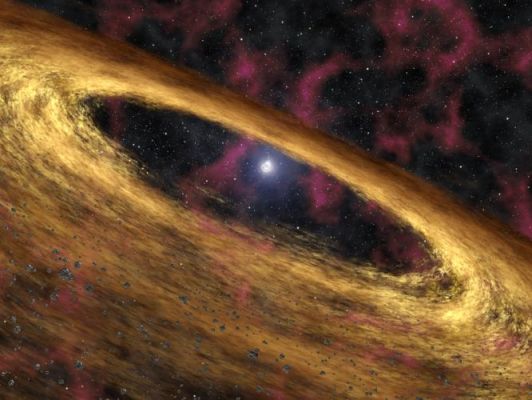
Caption originale: This artist's concept depicts a type of dead star called pulsar and the surrounding disk of rubble discovered by NASA's SST. The pulsar, called 4U 0142+61, was once a massive star until about 100.000 years ago when it blew up in a supernova explosion and scattered dusty debris into space. Some of that debris was captured into what astronomers refer to as a "fallback disk", now circling the remaining stellar core, or pulsar. The disk resembles protoplanetary disks around young stars, out of which planets are thought to be born. 
Supernovas are a source of Iron, Nitrogen and other heavy metals in the universe. They spray these elements out into space, where they eventually come together in clouds that give rise to new stars and planets. The Spitzer finding demonstrates that supernovas might also contribute heavy metals to their own planets, a possibility that was first suggested when astronomers discovered planets circling a pulsar called PSR B1257+12 in 1992.
Parole chiave: Artistic Visions of the Universe

Phoenix Planets

"...Qualsiasi Creatura dell'Universo la quale sia tanto evoluta da riuscire a raggiungere il nostro Pianeta, coprendo distanze che sono difficili da cogliere anche alla nostra immaginazione, deve essere altrettanto saggia da capire - dopo averci trovati - che è meglio starsene lontana da noi..."

(dalla serie televisiva "CSI")

Caption originale: This artist's concept depicts a type of dead star called pulsar and the surrounding disk of rubble discovered by NASA's SST. The pulsar, called 4U 0142+61, was once a massive star until about 100.000 years ago when it blew up in a supernova explosion and scattered dusty debris into space. Some of that debris was captured into what astronomers refer to as a "fallback disk", now circling the remaining stellar core, or pulsar. The disk resembles protoplanetary disks around young stars, out of which planets are thought to be born.
Supernovas are a source of Iron, Nitrogen and other heavy metals in the universe. They spray these elements out into space, where they eventually come together in clouds that give rise to new stars and planets. The Spitzer finding demonstrates that supernovas might also contribute heavy metals to their own planets, a possibility that was first suggested when astronomers discovered planets circling a pulsar called PSR B1257+12 in 1992.

M-035-2.jpg M-043-91.jpg Phoenix Planets-PIA08040_modest.jpg NGC-0869_and_0884.jpg Solar Eclypse 2006-tse2006_ayiomamitis_f.jpg
Informazioni sul file
Nome del file:Phoenix Planets-PIA08040_modest.jpg
Nome album:Deep Sky Objects
Valutazione (11 voti):55555(Mostra dettagli)
Parole chiave:Artistic / Visions / of / the / Universe
Copyright:NASA/JPL-Caltech
Dimensione del file:55 KiB
Data di inserimento:Apr 13, 2006
Dimensioni:666 x 500 pixels
Visualizzato:72 volte
URL:https://www.lunexit.it/gallery/displayimage.php?pid=10587
Preferiti:Aggiungi ai preferiti

Commento 1 a 4 di 4
Pagina: 1

MareKromium   [Nov 15, 2019 at 04:41 PM]
Il "quote" di questo frame é Saggezza allo stato puro, ahinoi.....
Anakin   [Nov 18, 2019 at 11:42 AM]
infatti non sono più tornati
MareKromium   [Nov 18, 2019 at 08:09 PM]
...già... ma forse, un giorno, chissà... Lasciami sognare.... :-)
Anakin   [Nov 19, 2019 at 07:33 AM]
:-) sì hai ragione. Sognare non ci costa nulla. Spero che arrivino presto e assomiglino tanto a Belen

Commento 1 a 4 di 4
Pagina: 1


Powered by Coppermine Photo Gallery