|
|
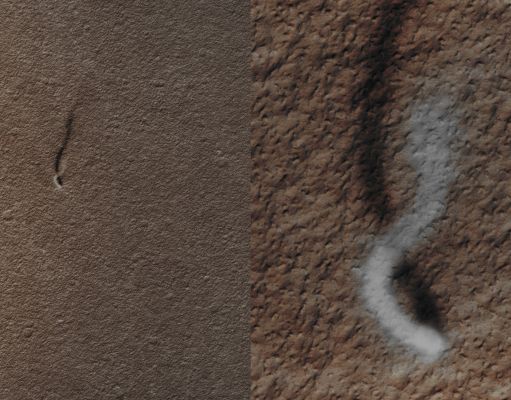
Serpentine Dust Devil in Amazonis Planitia (CTX Frame - Absolute Natural Colors; credits for the additional process. and color.: Dr Paolo C. Fienga - Lunexit Team)
|
A "towering" (----> very tall, of imposing height) Dust Devil (also hereafter written "DD") casts a serpentine shadow over the Surface in this beautiful, late Springtime image of the Amazonis Planitia Region of Mars. The length of the shadow of this DD indicates (a simple calculation is needed and all the necessary data to make it are available) that the Dust Plume is/should be more than 800 meters, or about half a mile, in height; on the other hand, the delicate arc that gave to the Dust Plume its serpentine appearence, was most likely produced by a Westerly (----> coming from the West) Breeze which blew at about 250-meter of its height, thus causing the top of the Plume itself to bend towards the East. The Dust Plume itself is approximately 30 meters in diameter.
A consistent number of Dust Devil Tracks (also hereafter written "DD Tracks" or "DDT" for short) trend from the North/West to the South/East and it is really interesting to notice that these Tracks are quite bright, whereas Dust Devil Tracks visible elsewhere on Mars are usually dark. However, Dark DD Tracks are believed to form where Bright Dust is lifted from the Surface by these swirling small Hurricanes, thus revealing a darker Substrate; but here, in the Amazonis Planitia Region of Mars, the Dust Cover (such as the amount of Dust covering the Surface of the Region) is still too thick to be penetrated by such kind of a scouring (as a matter of fact, you have to remember that a thick blanket of Bright and fresh Dust was deposited over Amazonis Planitia recently, during a Regional and - relatively - long Dust Storm, that occurred right before the arrival of the NASA - Mars Reconnaissance Orbiter). Anyway, the Bright Tracks could also form when the already settled Dust is stirred up by the strong Winds generated by the Dust Devils (Tangential Winds whose Speed reached up to 70 mph - miles-per-hour - have, actually, already been recorded in previous HiRISE images of other Dust Devils).
It is also extremely interesting to underline that this image was taken during the time of year when Mars is farthest from the Sun. Just as on Earth, Martian Winds are powered by Solar Heating. Exposure to the Sun's Rays should be at a minimum during this season and yet, even now, Dust Devils act relentlessly to clean the Surface of freshly deposited Dust, a little bit at a time.
Picture's Data
Mars Local Time: 15:03 (Early Afternoon)
Coord. (centered): 35,8° North Lat. and 207,5° East Long.
Spacecraft altitude: 307,7 Km (such as about 192,3 miles)
Original image scale range: 30,8 cm/pixel (with 1 x 1 binning) so objects ~ 92 cm across are resolved
Map projected scale: 25 cm/pixel
Map projection: EQUIRECTANGULAR
Emission Angle: 16,1°
Phase Angle: 25,1°
Solar Incidence Angle: 41° (meaning that the Sun is about 49° above the Local Horizon)
Solar Longitude: 71,3° (Northern Spring)
Credits: NASA/JPL/University of Arizona
|
|









Primo: ma Vi siete accorti dell'APOD? Vi piace? Datemi un feedback!!!!...
Secondo: ma perchè non votate mai niente nei Sondaggi? Vi sembrano inutili e ridondanti? Volete che li elimini? Datemi un segnale, please....
Abbraccio Circolare - paolo
2) Sondaggi?
Gli APOD sono belli. Dove si possono commentare?
Questo in particolare per me indica qualcosa (carbonato?) che si è "sciolto" creando quella scia a forma di S