Inizio Registrati Login

Elenco album Ultimi arrivi Ultimi commenti Più viste Più votate Preferiti Cerca

Inizio > MARS > Mars Reconnaissance Orbiter (MRO)
Ritorna alla pagina delle miniature FILE 2123/2235 Torna all'inizio Guarda foto precedente Guarda foto successiva Salta alla fine
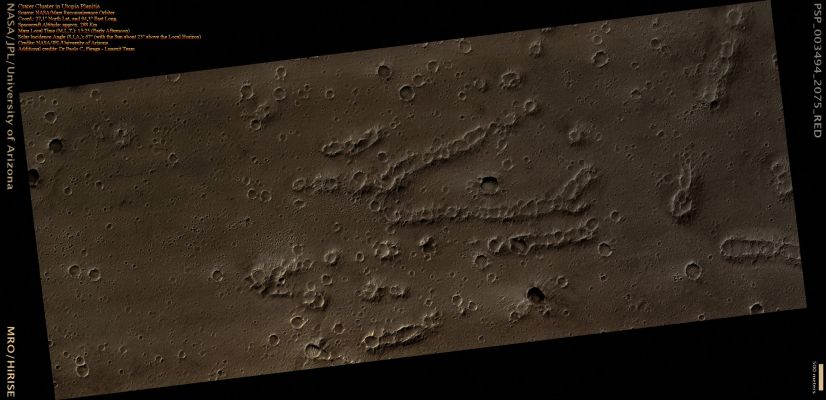
Crater Cluster with Cones and Ridges in Utopia Planitia (Natural Colors; credits for the additional process. and color.: Dr Paolo C. Fienga - Lunexit Team)
This image shows Cratered Cones in Utopia Planitia. Cones with Summit Craters join together in places to form Ridges up to several kilometers long, with Troughs running along the Summit. 
In many of these cases it is evident that the Ridge Systems formed by merging of multiple Cones, since the arcs of individual Cones can be distinguished. 
These features are probably formed by eruption of Subsurface material-Mud or Lava. Lava can form Cinder or Spatter Cones, and eruptions from localized sources along a single Fissure could produce the Ridges. 
The absence of obvious (---> evidenti) Lava Flows near the Cones may argue against this mechanism, but ascending Lava could have interacted with Subsurface Water or Ice, leading to a more explosive eruption. 
An alternative is eruptions of pressurized Mud from depth ("Mud Volcanism"), a process which occurs in certain environments on Earth. 

This observation has a few minor gaps where transmission errors caused data to be lost. These appear as narrow black bars.
Parole chiave: Mars from orbit - Crater Cluster - Utopia Planitia

Crater Cluster with Cones and Ridges in Utopia Planitia (Natural Colors; credits for the additional process. and color.: Dr Paolo C. Fienga - Lunexit Team)

This image shows Cratered Cones in Utopia Planitia. Cones with Summit Craters join together in places to form Ridges up to several kilometers long, with Troughs running along the Summit.
In many of these cases it is evident that the Ridge Systems formed by merging of multiple Cones, since the arcs of individual Cones can be distinguished.
These features are probably formed by eruption of Subsurface material-Mud or Lava. Lava can form Cinder or Spatter Cones, and eruptions from localized sources along a single Fissure could produce the Ridges.
The absence of obvious (---> evidenti) Lava Flows near the Cones may argue against this mechanism, but ascending Lava could have interacted with Subsurface Water or Ice, leading to a more explosive eruption.
An alternative is eruptions of pressurized Mud from depth ("Mud Volcanism"), a process which occurs in certain environments on Earth.

This observation has a few minor gaps where transmission errors caused data to be lost. These appear as narrow black bars.

PSP_007930_2310_RED_abrowse-PCF-LXTT.jpg ESP_020061_1720_RED_abrowse-PCF-LXTT.jpg PSP_003494_2075_RED_abrowse.jpg PSP_004052_2045_RED_abrowse-01.jpg PSP_004018_1505_RED_abrowse.jpg
Informazioni sul file
Nome del file:PSP_003494_2075_RED_abrowse.jpg
Nome album:MareKromium / Mars Reconnaissance Orbiter (MRO)
Valutazione (1 voti):55555(Mostra dettagli)
Parole chiave:Mars / from / orbit / - / Crater / Cluster / - / Utopia / Planitia
Copyright:NASA/JPL/Univ. of Arizona and Paolo C. Fienga/Lunexit Team per l'additional process. e la colorizzazione
Dimensione del file:924 KiB
Data di inserimento:Dic 29, 2010
Dimensioni:3700 x 1790 pixels
Visualizzato:117 volte
URL:https://www.lunexit.it/gallery/displayimage.php?pid=28083
Preferiti:Aggiungi ai preferiti


Powered by Coppermine Photo Gallery