Inizio Registrati Login

Elenco album Ultimi arrivi Ultimi commenti Più viste Più votate Preferiti Cerca

Inizio > MARS > Mars Reconnaissance Orbiter (MRO)
Ritorna alla pagina delle miniature FILE 489/2235 Torna all'inizio Guarda foto precedente Guarda foto successiva Salta alla fine
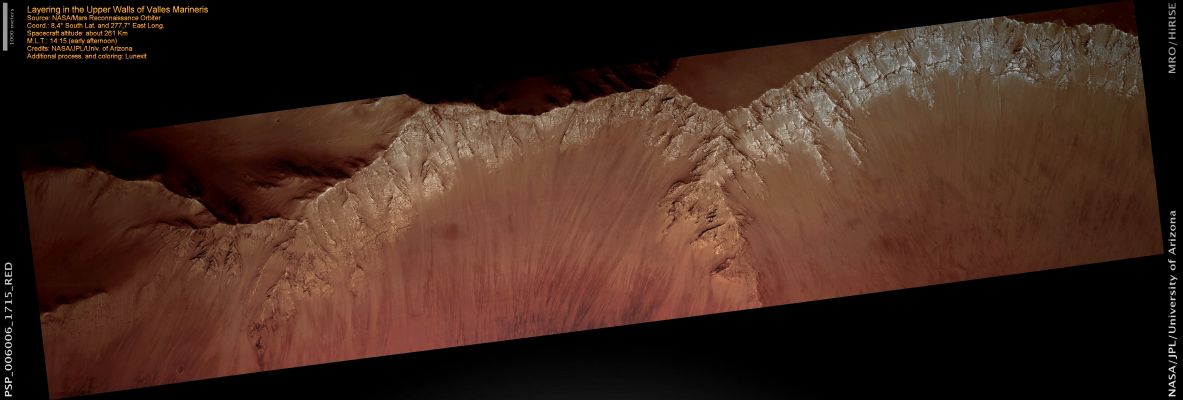
Layering in the Upper Walls of Valles Marineris (Enhanced and Saturated Natural Colors; credits for the additional process. and color.: Dr Paolo C. Fienga - Lunexit Team)
This observation shows parts of the upper walls of Valles Marineris with layered rocks. These layers extend down to a smooth-appearing slope, that is likely material shed from the upper parts of the chasm walls; down-slope stripes are visible, indicating that material has fallen or slid downhill in a process termed Mass Wasting (nota Lunexit: anche noto come Gravity Wasting). 

The layers, exposed in most rock outcrops in this image, are most likely lava flows from flood lavas that once erupted across the region. These layers are located in the upper walls of most of Valles Marineris and are sometimes exposed at depths well below the surrounding plateau, recording extensive volcanism in the history of the region. Similar, thick successions of lava flows are found at some sites on Earth (for example, the Columbia River flood basalts in the North-West of the U.S.).

Mass Wasting: is a geologic term that encompasses the rapid downhill movement of rocks and fine particles due to the force of gravity. One of the most common and generic types of mass wasting features on Earth are landslides, but there are many others such as rock falls, debris flows, soil creep, and debris avalanches. Landslides or any other mass wasting feature, require some type of triggering mechanism to induce the movement of particles under gravity. Some of these mechanisms include volume expansion of fractures (i.e. cracks) in rocks by freeze/thaw processes, increase in soil pore pressure (i.e. water content), undermining or removal of less-resistant material below a stronger material layer, and strong vibrational forces produced from above (e.g., meteorite impact) or below ground (e.g., volcanic eruption, earthquake). On Mars, two of the most common Mass Wasting features are landslides and dust avalanches (also referred to as Slope Streaks). Some of the most spectacular landslides in the Solar System are found in the Valles Marineris Canyon System on Mars and exhibit many of the classic characteristics of landslides on Earth. These characteristics include a semi-circular main scarp in the source region, a hummocky (i.e. irregular) or blocky surface in the upper portion of the deposit, surface ridges parallel to landslide flow direction in the middle portion of the deposit, and a lobate outer margin that has some significant thickness (e.g., tens to hundreds of meters). Dust avalanches are common on dune faces, crater interior walls, mesa slopes, and canyon scarps. The streaks are thought to occur when dust and/or other small particles on a sloped surface begins to move due to sublimation of a thin layer of water frost or by the oversteepening of slopes in localized dusty air fall deposits. 
Parole chiave: Mars from orbit - Valles Marineris Region

Layering in the Upper Walls of Valles Marineris (Enhanced and Saturated Natural Colors; credits for the additional process. and color.: Dr Paolo C. Fienga - Lunexit Team)

This observation shows parts of the upper walls of Valles Marineris with layered rocks. These layers extend down to a smooth-appearing slope, that is likely material shed from the upper parts of the chasm walls; down-slope stripes are visible, indicating that material has fallen or slid downhill in a process termed Mass Wasting (nota Lunexit: anche noto come Gravity Wasting).

The layers, exposed in most rock outcrops in this image, are most likely lava flows from flood lavas that once erupted across the region. These layers are located in the upper walls of most of Valles Marineris and are sometimes exposed at depths well below the surrounding plateau, recording extensive volcanism in the history of the region. Similar, thick successions of lava flows are found at some sites on Earth (for example, the Columbia River flood basalts in the North-West of the U.S.).

Mass Wasting: is a geologic term that encompasses the rapid downhill movement of rocks and fine particles due to the force of gravity. One of the most common and generic types of mass wasting features on Earth are landslides, but there are many others such as rock falls, debris flows, soil creep, and debris avalanches. Landslides or any other mass wasting feature, require some type of triggering mechanism to induce the movement of particles under gravity. Some of these mechanisms include volume expansion of fractures (i.e. cracks) in rocks by freeze/thaw processes, increase in soil pore pressure (i.e. water content), undermining or removal of less-resistant material below a stronger material layer, and strong vibrational forces produced from above (e.g., meteorite impact) or below ground (e.g., volcanic eruption, earthquake). On Mars, two of the most common Mass Wasting features are landslides and dust avalanches (also referred to as Slope Streaks). Some of the most spectacular landslides in the Solar System are found in the Valles Marineris Canyon System on Mars and exhibit many of the classic characteristics of landslides on Earth. These characteristics include a semi-circular main scarp in the source region, a hummocky (i.e. irregular) or blocky surface in the upper portion of the deposit, surface ridges parallel to landslide flow direction in the middle portion of the deposit, and a lobate outer margin that has some significant thickness (e.g., tens to hundreds of meters). Dust avalanches are common on dune faces, crater interior walls, mesa slopes, and canyon scarps. The streaks are thought to occur when dust and/or other small particles on a sloped surface begins to move due to sublimation of a thin layer of water frost or by the oversteepening of slopes in localized dusty air fall deposits.

PSP_006567_2220_RED_abrowse-00.jpg PSP_008161_2505_RED_abrowse.jpg PSP_006006_1715_RED_abrowse.jpg PSP_006237_1460_RED_abrowse.jpg PSP_008311_1835_RED_abrowse-01.jpg
Informazioni sul file
Nome del file:PSP_006006_1715_RED_abrowse.jpg
Nome album:MareKromium / Mars Reconnaissance Orbiter (MRO)
Valutazione (5 voti):55555(Mostra dettagli)
Parole chiave:Mars / from / orbit / - / Valles / Marineris / Region
Copyright:NASA/JPL/University of Arizona e Lunar Explorer Italia per l'elaborazione addizionale e la colorizzazione MULTISPECTRUM del frame
Dimensione del file:1525 KiB
Data di inserimento:Giu 14, 2008
Dimensioni:6501 x 2197 pixels
Visualizzato:57 volte
URL:https://www.lunexit.it/gallery/displayimage.php?pid=20727
Preferiti:Aggiungi ai preferiti


Powered by Coppermine Photo Gallery