Inizio Registrati Login

Elenco album Ultimi arrivi Ultimi commenti Più viste Più votate Preferiti Cerca

Inizio > SOLAR SYSTEM > Pluto and Charon: The "Double Planet"
Ritorna alla pagina delle miniature FILE 21/75 Torna all'inizio Guarda foto precedente Guarda foto successiva Salta alla fine
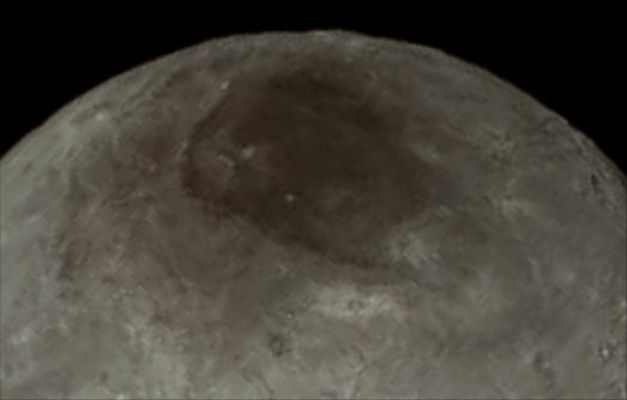
The Dark North Polar Regions of Charon  (Absolute Natural Colors; credits for the additional process. and color.: Dr Paolo C. Fienga - Lunexit Team)
As you can see very well here, in today's APOD, remarkable new details of Pluto's largest moon Charon are revealed in this wonderful Extra Detail Magnification (or "EDM", for short) that shows us the North Polar Regions of Charon itself - the original Contextual Picture was taken from the New Horizons' Long Range Reconnaissance Imager (or "LORRI", for short), late on July 13, 2015, from a distance of about 289.000 miles (such as approx. 465.099,26 Km) from the Surface of this - however - unusually-looking Celestial Body.
Generally speaking, the Mission Scientists are surprised by the apparent lack of Impact Craters on Charon. But, in particular, all over Charon's North Polar Regions (that is VERY WELL seen here), a dark marking - which was already prominent in the NASA - New Horizons Spacecraft' approach images - is now showing a diffuse (---> lighter in color) Boundary, suggesting that it could be a (thin?) Deposit of Dark Material (whose nature and origin are still - and, maybe, will remain - unknown). 
So, what are we talking about? A North Polar Cap made out of Frozen Hydrocarbons? Or, perhaps, a Layer of a powdered dark mineral - like Coal - which, eons after eons, fell over a Surface of bright Water Ice North Polar Cap and then turned its color (almost) completely black? Who knows...

The image has been compressed to reduce its file size for transmission to Earth. In high-contrast areas of the original Contextual Image, Surface Features as small as about 3 miles (approx. 4,828 Km) across can be seen. Some lower-contrast detail is obscured by the compression of the image, which may make some areas appear smoother than they really are. The uncompressed version still resides in New Horizons' Computer Memory and is scheduled to be transmitted at a later date. Remember that the NASA - New Horizons Spacecraft traveled more than three billion miles over nine-and-a-half years to reach the Plutonian System.

The image (which is a crop taken from an Original NASA - New Horizons Spacecraft's falsely colored and NON Map-Projected frame published on the NASA - Planetary Phojournal with the ID n. 19709) has been additionally processed, magnified to aid the visibility of the details, contrast enhanced and sharpened, Gamma corrected and then re-colorized (according to an educated guess carried out by Dr Paolo C. Fienga-LXTT-IPF) in Absolute Natural Colors (such as the colors that a normal human eye would actually perceive if someone were onboard the NASA - New Horizons Spacecraft and then looked ahead, towards the Plutonian moon Charon), by using an original technique created - and, in time, dramatically improved - by the Lunar Explorer Italia Team.
Parole chiave: Pluto's moons - Charon

The Dark North Polar Regions of Charon (Absolute Natural Colors; credits for the additional process. and color.: Dr Paolo C. Fienga - Lunexit Team)

As you can see very well here, in today's APOD, remarkable new details of Pluto's largest moon Charon are revealed in this wonderful Extra Detail Magnification (or "EDM", for short) that shows us the North Polar Regions of Charon itself - the original Contextual Picture was taken from the New Horizons' Long Range Reconnaissance Imager (or "LORRI", for short), late on July 13, 2015, from a distance of about 289.000 miles (such as approx. 465.099,26 Km) from the Surface of this - however - unusually-looking Celestial Body.
Generally speaking, the Mission Scientists are surprised by the apparent lack of Impact Craters on Charon. But, in particular, all over Charon's North Polar Regions (that is VERY WELL seen here), a dark marking - which was already prominent in the NASA - New Horizons Spacecraft' approach images - is now showing a diffuse (---> lighter in color) Boundary, suggesting that it could be a (thin?) Deposit of Dark Material (whose nature and origin are still - and, maybe, will remain - unknown).
So, what are we talking about? A North Polar Cap made out of Frozen Hydrocarbons? Or, perhaps, a Layer of a powdered dark mineral - like Coal - which, eons after eons, fell over a Surface of bright Water Ice North Polar Cap and then turned its color (almost) completely black? Who knows...

The image has been compressed to reduce its file size for transmission to Earth. In high-contrast areas of the original Contextual Image, Surface Features as small as about 3 miles (approx. 4,828 Km) across can be seen. Some lower-contrast detail is obscured by the compression of the image, which may make some areas appear smoother than they really are. The uncompressed version still resides in New Horizons' Computer Memory and is scheduled to be transmitted at a later date. Remember that the NASA - New Horizons Spacecraft traveled more than three billion miles over nine-and-a-half years to reach the Plutonian System.

The image (which is a crop taken from an Original NASA - New Horizons Spacecraft's falsely colored and NON Map-Projected frame published on the NASA - Planetary Phojournal with the ID n. 19709) has been additionally processed, magnified to aid the visibility of the details, contrast enhanced and sharpened, Gamma corrected and then re-colorized (according to an educated guess carried out by Dr Paolo C. Fienga-LXTT-IPF) in Absolute Natural Colors (such as the colors that a normal human eye would actually perceive if someone were onboard the NASA - New Horizons Spacecraft and then looked ahead, towards the Plutonian moon Charon), by using an original technique created - and, in time, dramatically improved - by the Lunar Explorer Italia Team.

ZQ-Pluto System 02.jpg ZZ-ZZ-ZZ-ZZ-ZZ-ZZ-Z-Pluto-lor_0299124574_0x632_sci_1-PCF-LXTT-IPF.jpg ZZ-ZZ-ZZ-ZZ-ZZ-ZZ-Charon-PIA19709-PCF-LXTT-IPF-1.jpg ZZ-ZZ-ZZ-ZZ-ZZ-ZZ-Nix-PIA19847-PCF-LXTT-IPF.jpg ZZ-ZZ-ZZ-ZZ-ZZ-ZZ-Hydra-PIA19847-PCF-LXTT-IPF.jpg
Informazioni sul file
Nome del file:ZZ-ZZ-ZZ-ZZ-ZZ-ZZ-Charon-PIA19709-PCF-LXTT-IPF-1.jpg
Nome album:MareKromium / Pluto and Charon: The "Double Planet"
Valutazione (5 voti):55555(Mostra dettagli)
Parole chiave:Pluto's / moons / - / Charon
Copyright:Credits: NASA/Johns Hopkins University Applied Physics Laboratory/Southwest Research Institute and Dr Paolo C. Fienga/LXTT/IPF for the additional process. and color.
Dimensione del file:221 KiB
Data di inserimento:Set 22, 2015
Dimensioni:2998 x 1911 pixels
Visualizzato:61 volte
URL:https://www.lunexit.it/gallery/displayimage.php?pid=31228
Preferiti:Aggiungi ai preferiti


Powered by Coppermine Photo Gallery