Inizio Registrati Login

Elenco album Ultimi arrivi Ultimi commenti Più viste Più votate Preferiti Cerca

Inizio > SOLAR SYSTEM > Uranus and His Moons
Ritorna alla pagina delle miniature FILE 5/109 Torna all'inizio Guarda foto precedente Guarda foto successiva Salta alla fine
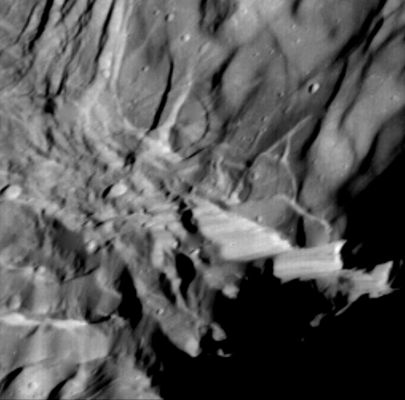
Miranda (super close-up of "Verona Rupes") - HR
Caption NASA originale:"This HR image of Miranda was acquired by Voyager 2 on Jan. 24, 1986, when the spacecraft was 36.250 Km (22.500 miles) from the Uranian moon. In this clear-filter, narrow-angle image, Miranda displays a dramatically varied surface. Well shown at this resolution of 660 meters (2.160 feet) are numerous ridges and valleys - a topography that was probably produced by compressional tectonics. Cutting across the ridges and valleys are many faults. The largest fault scarp, or cliff, is seen below and right of center; it shows grooves probably made by the contact of the fault blocks as they rubbed against each other (leaving what are known as slickensides). Movement of the down-dropped block is shown by the offset of the ridges. The fault may be 5 Km (3 mi) high, or higher than the walls of the Grand Canyon on Earth. NASA's Voyager 2 probe encountered the planet Uranus and its collection of moons in 1986. The small moon Miranda, with a diameter of 472 km, has a surface made up of a jumble of bizarre geological features. One of the most prominent of these features is an enormous cliff with a vertical relief of about 20 km (12 miles). This cliff, named Verona Rupes, is 10 times higher than the walls of the Grand Canyon on Earth. That this towering cliff is so huge is made even more remarkable by the small size of Miranda itself. The white material exposed in the cliff face is probably mostly water ice". 
Parole chiave: Uranus' Moons - Miranda

Miranda (super close-up of "Verona Rupes") - HR

Caption NASA originale:"This HR image of Miranda was acquired by Voyager 2 on Jan. 24, 1986, when the spacecraft was 36.250 Km (22.500 miles) from the Uranian moon. In this clear-filter, narrow-angle image, Miranda displays a dramatically varied surface. Well shown at this resolution of 660 meters (2.160 feet) are numerous ridges and valleys - a topography that was probably produced by compressional tectonics. Cutting across the ridges and valleys are many faults. The largest fault scarp, or cliff, is seen below and right of center; it shows grooves probably made by the contact of the fault blocks as they rubbed against each other (leaving what are known as slickensides). Movement of the down-dropped block is shown by the offset of the ridges. The fault may be 5 Km (3 mi) high, or higher than the walls of the Grand Canyon on Earth. NASA's Voyager 2 probe encountered the planet Uranus and its collection of moons in 1986. The small moon Miranda, with a diameter of 472 km, has a surface made up of a jumble of bizarre geological features. One of the most prominent of these features is an enormous cliff with a vertical relief of about 20 km (12 miles). This cliff, named Verona Rupes, is 10 times higher than the walls of the Grand Canyon on Earth. That this towering cliff is so huge is made even more remarkable by the small size of Miranda itself. The white material exposed in the cliff face is probably mostly water ice".

Uranus-HST-CJH.jpg Miranda-PIA02217.jpg Miranda-PIA00044_modest.jpg AAA-Uranus&Co..jpg Miranda-PIA00038_modest.jpg
Informazioni sul file
Nome del file:Miranda-PIA00044_modest.jpg
Nome album:Uranus and His Moons
Valutazione (12 voti):55555(Mostra dettagli)
Parole chiave:Uranus' / Moons / - / Miranda
Copyright:NASA - Voyager 2 Project
Dimensione del file:71 KiB
Data di inserimento:Gen 13, 2005
Dimensioni:1006 x 993 pixels
Visualizzato:100 volte
URL:https://www.lunexit.it/gallery/displayimage.php?pid=3953
Preferiti:Aggiungi ai preferiti


Powered by Coppermine Photo Gallery