Inizio Registrati Login

Elenco album Ultimi arrivi Ultimi commenti Più viste Più votate Preferiti Cerca

Inizio > SOLAR SYSTEM > Jupiter: the "King" and His Moons
Ritorna alla pagina delle miniature FILE 113/324 Torna all'inizio Guarda foto precedente Guarda foto successiva Salta alla fine
Look at Me!
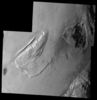
When 17th-century astronomers first turned their telescopes to Jupiter, they noted a conspicuous reddish spot on the Giant Planet. This Great Red Spot is still present in Jupiter's atmosphere, more than 300 years later. It is now known that it is a vast storm, spinning like a cyclone. Unlike a low-pressure hurricane in the Caribbean Sea, however, the Red Spot rotates in a counterclockwise direction in the Southern Hemisphere, showing that it is a high-pressure system. Winds inside this Jovian storm reach speeds of about 270 mph.
The Red Spot is the largest known storm in the Solar System. With a diameter of about 15.400 miles, it is almost twice the size of the entire Earth and 1/6th the diameter of Jupiter itself.
The long lifetime of the Red Spot may be due to the fact that Jupiter is mainly a gaseous planet. It possibly has liquid layers, but lacks a solid surface, which would dissipate the storm's energy, much as happens when a hurricane makes landfall on the Earth. However, the Red Spot does change its shape, size, and color, sometimes dramatically. Such changes are demonstrated in high-resolution Wide Field and Planetary Cameras 1 & 2 images of Jupiter obtained by NASA's Hubble Space Telescope between 1992 and 1999(PIA01594 thru PIA01599 and PIA02400 thru PIA02402). This image was obtained in April 1997.
Parole chiave: Hubble Images - Jupiter

Look at Me!

When 17th-century astronomers first turned their telescopes to Jupiter, they noted a conspicuous reddish spot on the Giant Planet. This Great Red Spot is still present in Jupiter's atmosphere, more than 300 years later. It is now known that it is a vast storm, spinning like a cyclone. Unlike a low-pressure hurricane in the Caribbean Sea, however, the Red Spot rotates in a counterclockwise direction in the Southern Hemisphere, showing that it is a high-pressure system. Winds inside this Jovian storm reach speeds of about 270 mph.
The Red Spot is the largest known storm in the Solar System. With a diameter of about 15.400 miles, it is almost twice the size of the entire Earth and 1/6th the diameter of Jupiter itself.
The long lifetime of the Red Spot may be due to the fact that Jupiter is mainly a gaseous planet. It possibly has liquid layers, but lacks a solid surface, which would dissipate the storm's energy, much as happens when a hurricane makes landfall on the Earth. However, the Red Spot does change its shape, size, and color, sometimes dramatically. Such changes are demonstrated in high-resolution Wide Field and Planetary Cameras 1 & 2 images of Jupiter obtained by NASA's Hubble Space Telescope between 1992 and 1999(PIA01594 thru PIA01599 and PIA02400 thru PIA02402). This image was obtained in April 1997.

IO_-_TRUE_COLOR_FROM_GALILEO.jpg Io-Tohill-Scarp-00.jpg Jupiter-PIA02401.jpg Jupiter-PIA02873.jpg Io-PIA02555.jpg
Informazioni sul file
Nome del file:Jupiter-PIA02401.jpg
Nome album:Jupiter: the "King" and His Moons
Valutazione (6 voti):55555(Mostra dettagli)
Parole chiave:Hubble / Images / - / Jupiter
Copyright:NASA - HST
Dimensione del file:10 KiB
Data di inserimento:Gen 03, 2006
Dimensioni:321 x 321 pixels
Visualizzato:61 volte
URL:https://www.lunexit.it/gallery/displayimage.php?pid=9037
Preferiti:Aggiungi ai preferiti


Powered by Coppermine Photo Gallery