|
|
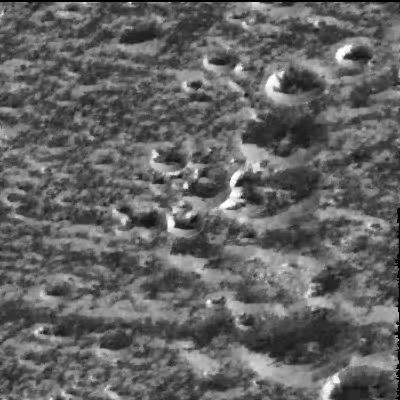
Frost on crater-tops of Ganymede
|
Scientists believe that water-ice frosts are the likely cause for the brightening seen around the circular rims of these craters located at a high northern latitude (57°) on Jupiter's moon Ganymede in this image taken by NASA's Galileo spacecraft on September 6, 1996. The image shows the same kind of bright, high-latitude surface areas as those first seen by the Voyager 1 spacecraft in 1979, but at higher resolution (this image spans about 18 Km - or 11 miles on a side). Even though the Sun is shining from the south, the north-facing walls of the ridges and craters are brighter than the walls facing the Sun. This is interpreted to mean that the very bright north-facing slopes are covered with surface water-ice frosts, and that these frosts preferentially accumulate in such high-latitude locations.
Galileo scientists say that at the HR seen in Galileo images, the high-latitude brightness seen by Voyager 1 might be partly attributable to frosts forming on cooler, north-facing slopes. The right-hand side of the image is dominated by a north-south line of impact craters; the smallest ones at the top are about 2 kilometers (1.2 miles) in diameter and the large one at the bottom is about 5 kilometers (about 3 miles) in diameter. Ganymede is the largest moon in the solar system, larger than the planet Mercury and nearly the size of Mars.
|
|