Inizio Registrati Login

Elenco album Ultimi arrivi Ultimi commenti Più viste Più votate Preferiti Cerca

Inizio > SOLAR SYSTEM > Jupiter: the "King" and His Moons
Ritorna alla pagina delle miniature FILE 36/324 Torna all'inizio Guarda foto precedente Guarda foto successiva Salta alla fine
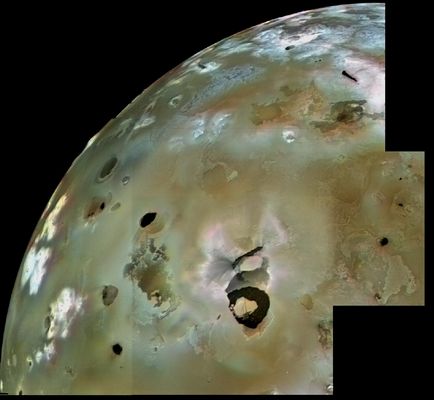
Loki patera: an everlasting eruption...
A huge area of Io's volcanic plains is shown in this Voyager 1 image mosaic. Numerous volcanic calderas and lava flows are visible here. Loki Patera, an active lava lake, is the large shield-shaped black feature. Heat emitted from Loki can be seen through telescopes all the way from Earth. These telescopic observations tell us that Loki has been active continuously (or at least every time astronomers have looked) since the Voyager 1 flyby in March 1979. The composition of Io's volcanic plains and lava flows has not been determined, but they could consist dominantly of Sulphur (S) with surface frosts of S dioxide or of silicates (such as basalts) encrusted with S and S dioxide condensates. The bright whitish patches probably consist of freshly deposited SO2 frost. The black spots, including Loki, are probably hot sulfur lava, which may remain molten by intrusions of molten silicate magma, coming up from deeper within Io. The ultimate source of heat that keeps Io active is tidal frictional heating due to the continual flexure of Io by the gravity of Jupiter and Europa, another of Jupiter's satellites.
Parole chiave: Jupiter Moons - Io

Loki patera: an everlasting eruption...

A huge area of Io's volcanic plains is shown in this Voyager 1 image mosaic. Numerous volcanic calderas and lava flows are visible here. Loki Patera, an active lava lake, is the large shield-shaped black feature. Heat emitted from Loki can be seen through telescopes all the way from Earth. These telescopic observations tell us that Loki has been active continuously (or at least every time astronomers have looked) since the Voyager 1 flyby in March 1979. The composition of Io's volcanic plains and lava flows has not been determined, but they could consist dominantly of Sulphur (S) with surface frosts of S dioxide or of silicates (such as basalts) encrusted with S and S dioxide condensates. The bright whitish patches probably consist of freshly deposited SO2 frost. The black spots, including Loki, are probably hot sulfur lava, which may remain molten by intrusions of molten silicate magma, coming up from deeper within Io. The ultimate source of heat that keeps Io active is tidal frictional heating due to the continual flexure of Io by the gravity of Jupiter and Europa, another of Jupiter's satellites.

Io-PIA01070.jpg Io-GalaiPatera-PIA00324.jpg Io-LokiPatera-PIA00320.jpg Jupiter_s Rings-PIA01628.jpg Ganymede-PIA00706.jpg
Informazioni sul file
Nome del file:Io-LokiPatera-PIA00320.jpg
Nome album:Jupiter: the "King" and His Moons
Valutazione (10 voti):55555(Mostra dettagli)
Parole chiave:Jupiter / Moons / - / Io
Copyright:NASA - Voyager 1 Mission
Dimensione del file:152 KiB
Data di inserimento:Ott 20, 2005
Dimensioni:1520 x 1400 pixels
Visualizzato:54 volte
URL:https://www.lunexit.it/gallery/displayimage.php?pid=7895
Preferiti:Aggiungi ai preferiti


Powered by Coppermine Photo Gallery