Inizio Registrati Login

Elenco album Ultimi arrivi Ultimi commenti Più viste Più votate Preferiti Cerca

Inizio > SOLAR SYSTEM > Jupiter: the "King" and His Moons
Ritorna alla pagina delle miniature FILE 37/324 Torna all'inizio Guarda foto precedente Guarda foto successiva Salta alla fine
The Rings of Jupiter (2)
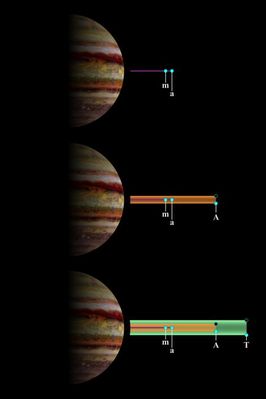
Scientists studying data from Galileo spacecraft have found that the Ring System is made up of impact debris created when meteoroids, which are fragments of comets and asteroids, slam into Jupiter`s four smallest satellites. The top panel shows that the Main Ring (red) is formed mostly from meteoroid impact debris kicked up from the innermost moons, Metis (m) and Adrastea (a). Since both satellites orbit in paths not inclined to Jupiter's equator, the Main Ring appears as a narrow line. The middle panel shows the additional effect of dust ejected from the satellite Amalthea (A), responsible for producing 1 of the 2 moon components of the Gossamer Ring. Amalthea's orbit is inclined to Jupiter's equatorial plane and at different times the satellite's vertical position can range anywhere between the 2 extreme limits shown. Dust ejected from Amalthea (orange) produces a ring whose thickness equals Amalthea's vertical projections beyond Jupiter's equatorial plane. The lower panel shows the additional effect of dust ejected from Thebe (T), which makes up the second component (shown in green) of the gossamer ring. Again, the two positions shown represent the maximum projections of Thebe from Jupiter's equatorial plane. This component of the gossamer ring is thicker than the component due to Amaltheas dust because Thebe's orbit is more inclined than that of Amalthea.


Parole chiave: Jupiter Rings

The Rings of Jupiter (2)

Scientists studying data from Galileo spacecraft have found that the Ring System is made up of impact debris created when meteoroids, which are fragments of comets and asteroids, slam into Jupiter`s four smallest satellites. The top panel shows that the Main Ring (red) is formed mostly from meteoroid impact debris kicked up from the innermost moons, Metis (m) and Adrastea (a). Since both satellites orbit in paths not inclined to Jupiter's equator, the Main Ring appears as a narrow line. The middle panel shows the additional effect of dust ejected from the satellite Amalthea (A), responsible for producing 1 of the 2 moon components of the Gossamer Ring. Amalthea's orbit is inclined to Jupiter's equatorial plane and at different times the satellite's vertical position can range anywhere between the 2 extreme limits shown. Dust ejected from Amalthea (orange) produces a ring whose thickness equals Amalthea's vertical projections beyond Jupiter's equatorial plane. The lower panel shows the additional effect of dust ejected from Thebe (T), which makes up the second component (shown in green) of the gossamer ring. Again, the two positions shown represent the maximum projections of Thebe from Jupiter's equatorial plane. This component of the gossamer ring is thicker than the component due to Amaltheas dust because Thebe's orbit is more inclined than that of Amalthea.

Io-GalaiPatera-PIA00324.jpg Io-LokiPatera-PIA00320.jpg Jupiter_s Rings-PIA01628.jpg Ganymede-PIA00706.jpg Ganymede-V1-PIA02233_modest.jpg
Informazioni sul file
Nome del file:Jupiter_s Rings-PIA01628.jpg
Nome album:Jupiter: the "King" and His Moons
Valutazione (10 voti):55555(Mostra dettagli)
Parole chiave:Jupiter / Rings
Copyright:NASA/JPL/Galileo Project Team/HST
Dimensione del file:16 KiB
Data di inserimento:Ott 17, 2005
Dimensioni:471 x 707 pixels
Visualizzato:56 volte
URL:https://www.lunexit.it/gallery/displayimage.php?pid=7854
Preferiti:Aggiungi ai preferiti


Powered by Coppermine Photo Gallery