Inizio Registrati Login

Elenco album Ultimi arrivi Ultimi commenti Più viste Più votate Preferiti Cerca

Inizio > SOLAR SYSTEM > Jupiter: the "King" and His Moons
Ritorna alla pagina delle miniature FILE 305/324 Torna all'inizio Guarda foto precedente Guarda foto successiva Salta alla fine
The "Zamama" flow field
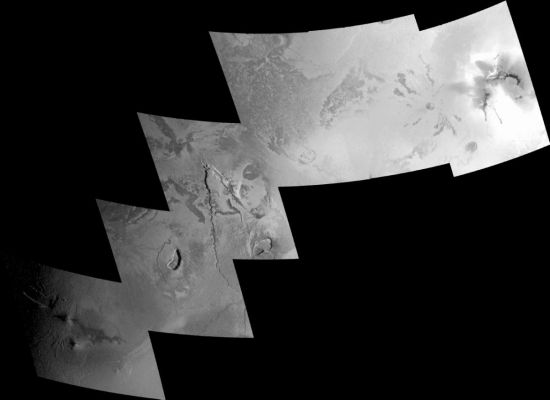
The source area of what had been a towering volcanic plume two months earlier lies in the far-right frame of this mosaic of images taken of Jupiter's moon Io by NASA's Galileo spacecraft on Oct. 16, 2001.

The region in the images includes the Zamama lava flow in Jupiter's northern hemisphere. The Zamama flow field emanates from the northernmost of two small volcanoes in the far left frame. These lava flows were not present in Voyager images of Io, so they formed some time between the Voyager 1 flyby in 1979 and the first Galileo observations of Io in 1996. Galileo also observed Zamama during Io encounters in 1999, and scientists identified narrow, long, dark lava flows thought to be similar to lava flows in Hawaii.

Moving northeast, the second and third frames of this mosaic contain lava flow fields and several unnamed volcanic depressions, called "paterae." It is unclear whether the broad, shield-like features or plateaus on which the paterae rest were created by eruptions from the paterae, or if they were preexisting features. Some fractures and dark lines suggest that the crust here is breaking up, creating cracks that magma can use to rise to the surface.

The far-right frame of this mosaic shows dark lava flows and bright spots. The bright spots are probably sulfur-bearing plume deposits, which are thought to be associated with the source of a plume eruption 500 kilometers (310 miles) high that was observed by the Galileo spacecraft in August, 2001. It was the largest plume eruption ever observed on Io.


Parole chiave: Jupiter's moons - Io

The "Zamama" flow field

The source area of what had been a towering volcanic plume two months earlier lies in the far-right frame of this mosaic of images taken of Jupiter's moon Io by NASA's Galileo spacecraft on Oct. 16, 2001.

The region in the images includes the Zamama lava flow in Jupiter's northern hemisphere. The Zamama flow field emanates from the northernmost of two small volcanoes in the far left frame. These lava flows were not present in Voyager images of Io, so they formed some time between the Voyager 1 flyby in 1979 and the first Galileo observations of Io in 1996. Galileo also observed Zamama during Io encounters in 1999, and scientists identified narrow, long, dark lava flows thought to be similar to lava flows in Hawaii.

Moving northeast, the second and third frames of this mosaic contain lava flow fields and several unnamed volcanic depressions, called "paterae." It is unclear whether the broad, shield-like features or plateaus on which the paterae rest were created by eruptions from the paterae, or if they were preexisting features. Some fractures and dark lines suggest that the crust here is breaking up, creating cracks that magma can use to rise to the surface.

The far-right frame of this mosaic shows dark lava flows and bright spots. The bright spots are probably sulfur-bearing plume deposits, which are thought to be associated with the source of a plume eruption 500 kilometers (310 miles) high that was observed by the Galileo spacecraft in August, 2001. It was the largest plume eruption ever observed on Io.

Io-Volcanic_Depression-PIA03532_modest1.jpg Io-Pele plume-PIA02546_modest.jpg Io-Zamama Plume-PIA03531_modest.jpg Ganymede-PIA01618.jpg Amalthea-PIA01074.jpg
Informazioni sul file
Nome del file:Io-Zamama Plume-PIA03531_modest.jpg
Nome album:Jupiter: the "King" and His Moons
Valutazione (15 voti):55555(Mostra dettagli)
Parole chiave:Jupiter's / moons / - / Io
Copyright:NASA - Galileo Project
Dimensione del file:53 KiB
Data di inserimento:Set 08, 2004
Dimensioni:1173 x 852 pixels
Visualizzato:55 volte
URL:https://www.lunexit.it/gallery/displayimage.php?pid=2407
Preferiti:Aggiungi ai preferiti


Powered by Coppermine Photo Gallery