Inizio Registrati Login

Elenco album Ultimi arrivi Ultimi commenti Più viste Più votate Preferiti Cerca

Inizio > SOLAR SYSTEM > Jupiter: the "King" and His Moons
Ritorna alla pagina delle miniature FILE 81/324 Torna all'inizio Guarda foto precedente Guarda foto successiva Salta alla fine
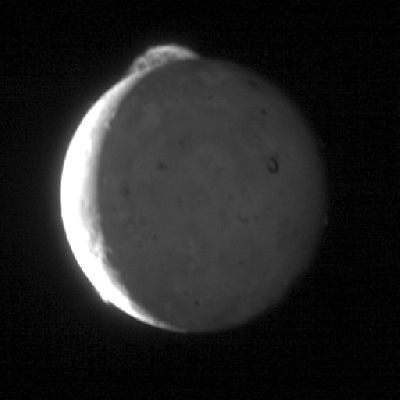
Erupting Tvashtar (GIF Movie)
This five-frame sequence of New Horizons images captures the giant plume from Io's Tvashtar volcano. Snapped by the probe’s Long Range Reconnaissance Imager (LORRI) as the spacecraft flew past Jupiter earlier this year, this first-ever “movie” of an Io plume clearly shows motion in the cloud of volcanic debris, which extends 330 Km (200 miles) above the moon’s surface. Only the upper part of the plume is visible from this vantage point – the plume’s source is 130 Km (about 80 miles) below the edge of Io's disk, on the far side of the moon.
The appearance and motion of the plume is remarkably similar to an ornamental fountain on Earth, replicated on a gigantic scale. The knots and filaments that allow us to track the plume’s motion are still mysterious, but this movie is likely to help scientists understand their origin, as well as provide unique information on the plume dynamics.
Io's hyperactive nature is emphasized by the fact that two other volcanic plumes are also visible off the edge of Io's disk: Masubi at the 7 o'clock position, and a very faint plume, possibly from the volcano Zal, at the 10 o'clock position. 
Jupiter illuminates the night side of Io, and the most prominent feature visible on the disk is the dark horseshoe shape of the volcano Loki, likely an enormous lava lake. Boosaule Mons, which at 18 Km (about 11 miles) is the highest mountain on Io and one of the highest mountains in the Solar System, pokes above the edge of the disk on the right side. 
The five images were obtained over an 8-minute span, with two minutes between frames, from 23:50 to 23:58 Universal Time (UT) on March 1, 2007. Io was approx. 3,8 MKM (about 2,4 MMs) from New Horizons; the image is centered at Io coordinates 0° North Lat. and 342° West Long. 

The pictures were part of a sequence designed to look at Jupiter's Rings, but planners included Io in the sequence because the moon was passing behind Jupiter's Rings at the time.
Parole chiave: Jupiter's Moon - Io

Erupting Tvashtar (GIF Movie)

This five-frame sequence of New Horizons images captures the giant plume from Io's Tvashtar volcano. Snapped by the probe’s Long Range Reconnaissance Imager (LORRI) as the spacecraft flew past Jupiter earlier this year, this first-ever “movie” of an Io plume clearly shows motion in the cloud of volcanic debris, which extends 330 Km (200 miles) above the moon’s surface. Only the upper part of the plume is visible from this vantage point – the plume’s source is 130 Km (about 80 miles) below the edge of Io's disk, on the far side of the moon.
The appearance and motion of the plume is remarkably similar to an ornamental fountain on Earth, replicated on a gigantic scale. The knots and filaments that allow us to track the plume’s motion are still mysterious, but this movie is likely to help scientists understand their origin, as well as provide unique information on the plume dynamics.
Io's hyperactive nature is emphasized by the fact that two other volcanic plumes are also visible off the edge of Io's disk: Masubi at the 7 o'clock position, and a very faint plume, possibly from the volcano Zal, at the 10 o'clock position.
Jupiter illuminates the night side of Io, and the most prominent feature visible on the disk is the dark horseshoe shape of the volcano Loki, likely an enormous lava lake. Boosaule Mons, which at 18 Km (about 11 miles) is the highest mountain on Io and one of the highest mountains in the Solar System, pokes above the edge of the disk on the right side.
The five images were obtained over an 8-minute span, with two minutes between frames, from 23:50 to 23:58 Universal Time (UT) on March 1, 2007. Io was approx. 3,8 MKM (about 2,4 MMs) from New Horizons; the image is centered at Io coordinates 0° North Lat. and 342° West Long.

The pictures were part of a sequence designed to look at Jupiter's Rings, but planners included Io in the sequence because the moon was passing behind Jupiter's Rings at the time.

Io-Natural_Colors-PCF-LXTT.jpg Io-TelegonusMensa-PIA03528_modest.jpg Io-051407_loop.gif Io-050107_08~0.jpg Europa-050107_01.jpg
Informazioni sul file
Nome del file:Io-051407_loop.gif
Nome album:MareKromium / Jupiter: the "King" and His Moons
Valutazione (7 voti):55555(Mostra dettagli)
Parole chiave:Jupiter's / Moon / - / Io
Copyright:NASA/Johns Hopkins University Applied Physics Laboratory/Southwest Research Institute
Dimensione del file:748 KiB
Data di inserimento:Mag 16, 2007
Dimensioni:512 x 512 pixels
Visualizzato:59 volte
URL:https://www.lunexit.it/gallery/displayimage.php?pid=16838
Preferiti:Aggiungi ai preferiti


Powered by Coppermine Photo Gallery