Inizio Registrati Login

Elenco album Ultimi arrivi Ultimi commenti Più viste Più votate Preferiti Cerca

Inizio > SOLAR SYSTEM > Saturn: the "Ringed Beauty" and His Moons
Ritorna alla pagina delle miniature FILE 2023/2244 Torna all'inizio Guarda foto precedente Guarda foto successiva Salta alla fine
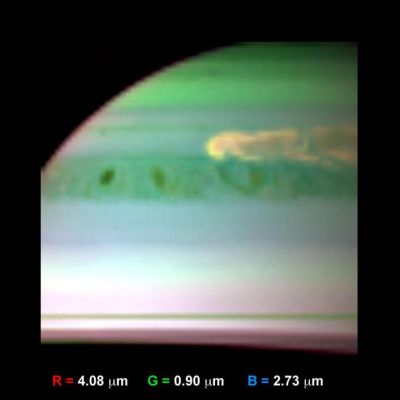
Large Ammonia Crystals in Saturn Storm (False Colors; credits: NASA/JPL-University of Arizona)
Caption NASA:"This false-color InfraRed image, obtained by NASA's Cassini Spacecraft, shows clouds of large Ammonia ice particles dredged up by a powerful storm in Saturn's Northern Hemisphere. Large updrafts dragged Ammonia gas upward more than 30 miles (approx. 50 Km) from below. The Ammonia then condensed into large crystals in the frigid Upper Atmosphere. This storm is the most violent ever observed at Saturn by an orbiting Spacecraft.

Cassini's Visual and InfraRed Mapping Spectrometer obtained these images on Feb. 24, 2011. Scientists colorized the image by assigning red to brightness detected from the 4.08-micron wavelength, green to brightness from the 0.90-micron wavelength, and blue to brightness from the 2.73-micron wavelength. Large particles (red) reflect Sunlight well at 4.08 microns. Particles at high altitude (green) reflect Sunlight well at 0.9 microns. Particles comprised of Ammonia -- especially large ones -- do not reflect 2.73-micron sunlight well, but instead absorb light at this wavelength. 
The storm here shows up as yellow, demonstrating that it has a large signal in both red and green colors. This indicates the cloud has large particles and extends upward to relatively high altitude. In addition, the lack of blue in the feature indicates that the storm cloud has a substantial component of Ammonia Crystals. The head of the storm is particularly rich in such particles, as created by powerful updrafts of Ammonia gas from depth in the throes of Saturn's thunderstorm".
Parole chiave: Saturn

Large Ammonia Crystals in Saturn Storm (False Colors; credits: NASA/JPL-University of Arizona)

Caption NASA:"This false-color InfraRed image, obtained by NASA's Cassini Spacecraft, shows clouds of large Ammonia ice particles dredged up by a powerful storm in Saturn's Northern Hemisphere. Large updrafts dragged Ammonia gas upward more than 30 miles (approx. 50 Km) from below. The Ammonia then condensed into large crystals in the frigid Upper Atmosphere. This storm is the most violent ever observed at Saturn by an orbiting Spacecraft.

Cassini's Visual and InfraRed Mapping Spectrometer obtained these images on Feb. 24, 2011. Scientists colorized the image by assigning red to brightness detected from the 4.08-micron wavelength, green to brightness from the 0.90-micron wavelength, and blue to brightness from the 2.73-micron wavelength. Large particles (red) reflect Sunlight well at 4.08 microns. Particles at high altitude (green) reflect Sunlight well at 0.9 microns. Particles comprised of Ammonia -- especially large ones -- do not reflect 2.73-micron sunlight well, but instead absorb light at this wavelength.
The storm here shows up as yellow, demonstrating that it has a large signal in both red and green colors. This indicates the cloud has large particles and extends upward to relatively high altitude. In addition, the lack of blue in the feature indicates that the storm cloud has a substantial component of Ammonia Crystals. The head of the storm is particularly rich in such particles, as created by powerful updrafts of Ammonia gas from depth in the throes of Saturn's thunderstorm".

Saturn-PIA12825.jpg Saturn-PIA12826.jpg Saturn-PIA14119.jpg Saturn-PIA08823~0.jpg Saturn-PIA08826.jpg
Informazioni sul file
Nome del file:Saturn-PIA14119.jpg
Nome album:MareKromium / Saturn: the "Ringed Beauty" and His Moons
Valutazione (1 voti):55555(Mostra dettagli)
Parole chiave:Saturn
Copyright:NASA/JPL/University of Arizona
Dimensione del file:24 KiB
Data di inserimento:Mag 20, 2011
Dimensioni:707 x 707 pixels
Visualizzato:67 volte
URL:https://www.lunexit.it/gallery/displayimage.php?pid=29040
Preferiti:Aggiungi ai preferiti


Powered by Coppermine Photo Gallery