Inizio Registrati Login

Elenco album Ultimi arrivi Ultimi commenti Più viste Più votate Preferiti Cerca

Inizio > DEEP SKY > Deep Sky Objects
Ritorna alla pagina delle miniature FILE 139/1036 Torna all'inizio Guarda foto precedente Guarda foto successiva Salta alla fine
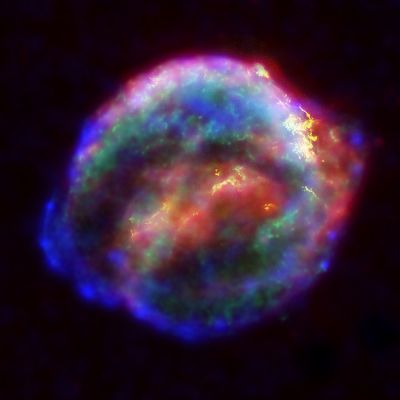
Supernova remnant SNR-1604
Light from the stellar explosion that created this energized cosmic cloud was first seen on planet Earth in October 1604. The supernova produced a bright new star in early 17th century skies within the constellation Ophiucus and it was studied by the Great astronomer Johannes Kepler and his contemporaries, without the benefit of a telescope! Armed with a modern understanding of stellar evolution, early 21st century astronomers continue to explore the expanding debris cloud, but can now use orbiting space telescopes to survey Kepler's supernova remnant (SNR) across the spectrum. In this tantalizing composite image, x-rays, visible light, and infrared radiation recorded by NASA's astrophysical observatories - Chandra X-Ray Observatory, HST and SST - are combined to give a more comprehensive view of the still enigmatic supernova remnant. About 13.000 LY away, SNR 1604 represents the most recent stellar explosion seen to occur within our Galaxy.
Parole chiave: Hubble Images - Spitzer Space Telescope - Chandra X-Ray Obs.

Supernova remnant SNR-1604

Light from the stellar explosion that created this energized cosmic cloud was first seen on planet Earth in October 1604. The supernova produced a bright new star in early 17th century skies within the constellation Ophiucus and it was studied by the Great astronomer Johannes Kepler and his contemporaries, without the benefit of a telescope! Armed with a modern understanding of stellar evolution, early 21st century astronomers continue to explore the expanding debris cloud, but can now use orbiting space telescopes to survey Kepler's supernova remnant (SNR) across the spectrum. In this tantalizing composite image, x-rays, visible light, and infrared radiation recorded by NASA's astrophysical observatories - Chandra X-Ray Observatory, HST and SST - are combined to give a more comprehensive view of the still enigmatic supernova remnant. About 13.000 LY away, SNR 1604 represents the most recent stellar explosion seen to occur within our Galaxy.

NGC-6822-PIA04222.jpg HD 107146 + AU Microscopii.jpg Supernova remnant - Kxo-HST-SST.jpg NGC-2237_and_NGC_2244-6.jpg Microquasars.jpg
Informazioni sul file
Nome del file:Supernova remnant - Kxo-HST-SST.jpg
Nome album:Deep Sky Objects
Valutazione (15 voti):55555(Mostra dettagli)
Parole chiave:Hubble / Images / - / Spitzer / Space / Telescope / - / Chandra / X-Ray / Obs.
Copyright:R. Sankrit and W. Blair (JHU) et al. - ESA - NASA
Dimensione del file:217 KiB
Data di inserimento:Ott 08, 2004
Dimensioni:750 x 750 pixels
Visualizzato:86 volte
URL:https://www.lunexit.it/gallery/displayimage.php?pid=2851
Preferiti:Aggiungi ai preferiti


Powered by Coppermine Photo Gallery