Inizio Registrati Login

Elenco album Ultimi arrivi Ultimi commenti Più viste Più votate Preferiti Cerca

Inizio > SOLAR SYSTEM > Titan: The "Foggy" Moon
Ritorna alla pagina delle miniature FILE 357/426 Torna all'inizio Guarda foto precedente Guarda foto successiva Salta alla fine
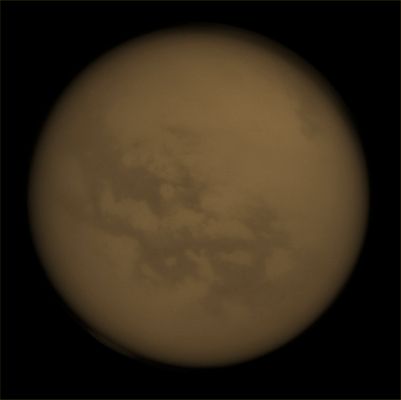
Fensal, Aztlan and Kraken Mare (Absolute Natural Colors; credits for the additional process. and color.: Dr Paolo C. Fienga/Lunar Explorer Italia/Italian Planetary Foundation)
Although it is almost completely hidden from human eyes, the NASA - Cassini Spacecraft can still spot a few dark Features on the Surface of Titan thanks to its special Near-InfraRed Filters. The Surface Features visible here, near the Equatorial Belt, have been dubbed "Fensal" and "Aztlan" by Planetary Scientists and they are believed to be vast (---> large and very long) Dunes made of Particles of Dust (mixed-up with, most likely, other Elements) that precipitated out of the Atmosphere of Titan (but some other possibilities about their origin and composition can also be well considered); on the other hand, near the North Pole of Titan, it is also well visible the largest body of liquids existing on this fascinating Saturnian moon, such as the Kraken Mare. 
Furthermore, just barely visible right on top of the South Pole, the huge Vortex that was spotted quite some time ago and that keeps Planetary Scientists busy trying to understand the actual reasons that caused its sudden formation, as well as and the amount of time during which it will still remain active (obviously assuming that such a Vortex is just a seasonal and not a - now - permanent phenomenon).

This view looks toward the Saturn-facing Hemisphere of Titan; North is up and rotated 32° to the right (Dx) and the image was taken with the NASA - Cassini Spacecraft Narrow-Angle Camera on April 13, 2013 using a Spectral Filter sensitive to Wavelengths of Near-InfraRed Light centered at 938 nanometers. The view was acquired at a distance of approximately 1,2 Million Miles (such as about 1,93 Million KiloMeters) from Titan and at a Sun-Titan-Cassini Spacecraft, or Phase, Angle of 4°. The image scale is roughly 7 miles (such as about 11,26 Km) per pixel.

This picture (which is an Original NASA - Cassini Spacecraft b/w frame published on the NASA - Planetary Photojournal and identified by the n. PIA 14663) has been additionally processed, magnified and then colorized, according to an educated guess carried out by Dr Paolo C. Fienga (LXTT-IPF), in Absolute Natural Colors (such as the colors that a human eye would actually perceive if someone were onboard the NASA - Cassini Spacecraft and then looked outside, towards the Saturnian moon Titan), by using an original technique created - and, in time, dramatically improved - by the Lunar Explorer Italia Team. Different colors, as well as different shades of the same color, mean, among others, the existence of different Elements present in the Atmosphere of Titan, each having a different Albedo (---> Reflectivity) and Chemical Composition. 

Note: it is possible (but we, as IPF, have no way to be one-hundred-percent sure of such a circumstance), that the actual luminosity of the Clouds and Hazes (as well as the luminosity of Titan itself) seen in this frame would appear, to an average human eye, way lower than it has been shown (or, better yet: interpreted) here.
Parole chiave: Titan

Fensal, Aztlan and Kraken Mare (Absolute Natural Colors; credits for the additional process. and color.: Dr Paolo C. Fienga/Lunar Explorer Italia/Italian Planetary Foundation)

Although it is almost completely hidden from human eyes, the NASA - Cassini Spacecraft can still spot a few dark Features on the Surface of Titan thanks to its special Near-InfraRed Filters. The Surface Features visible here, near the Equatorial Belt, have been dubbed "Fensal" and "Aztlan" by Planetary Scientists and they are believed to be vast (---> large and very long) Dunes made of Particles of Dust (mixed-up with, most likely, other Elements) that precipitated out of the Atmosphere of Titan (but some other possibilities about their origin and composition can also be well considered); on the other hand, near the North Pole of Titan, it is also well visible the largest body of liquids existing on this fascinating Saturnian moon, such as the Kraken Mare.
Furthermore, just barely visible right on top of the South Pole, the huge Vortex that was spotted quite some time ago and that keeps Planetary Scientists busy trying to understand the actual reasons that caused its sudden formation, as well as and the amount of time during which it will still remain active (obviously assuming that such a Vortex is just a seasonal and not a - now - permanent phenomenon).

This view looks toward the Saturn-facing Hemisphere of Titan; North is up and rotated 32° to the right (Dx) and the image was taken with the NASA - Cassini Spacecraft Narrow-Angle Camera on April 13, 2013 using a Spectral Filter sensitive to Wavelengths of Near-InfraRed Light centered at 938 nanometers. The view was acquired at a distance of approximately 1,2 Million Miles (such as about 1,93 Million KiloMeters) from Titan and at a Sun-Titan-Cassini Spacecraft, or Phase, Angle of 4°. The image scale is roughly 7 miles (such as about 11,26 Km) per pixel.

This picture (which is an Original NASA - Cassini Spacecraft b/w frame published on the NASA - Planetary Photojournal and identified by the n. PIA 14663) has been additionally processed, magnified and then colorized, according to an educated guess carried out by Dr Paolo C. Fienga (LXTT-IPF), in Absolute Natural Colors (such as the colors that a human eye would actually perceive if someone were onboard the NASA - Cassini Spacecraft and then looked outside, towards the Saturnian moon Titan), by using an original technique created - and, in time, dramatically improved - by the Lunar Explorer Italia Team. Different colors, as well as different shades of the same color, mean, among others, the existence of different Elements present in the Atmosphere of Titan, each having a different Albedo (---> Reflectivity) and Chemical Composition.

Note: it is possible (but we, as IPF, have no way to be one-hundred-percent sure of such a circumstance), that the actual luminosity of the Clouds and Hazes (as well as the luminosity of Titan itself) seen in this frame would appear, to an average human eye, way lower than it has been shown (or, better yet: interpreted) here.

Titan-PIA21624.jpg Titan-Fensal_and_Aztlan-PIA07732-PCF-LXTT-IPF-0.jpg Titan-PIA14663-PCF-LXTT-IPF.jpg Titan-Senkyo_Region-PIA14655-PCF-LXTT-IPF.jpg Titan-Lakes-South_Polar_Lake-01-PIA06241-PCF-LXTT-IPF-002.jpg
Informazioni sul file
Nome del file:Titan-PIA14663-PCF-LXTT-IPF.jpg
Nome album:MareKromium / Titan: The "Foggy" Moon
Valutazione (2 voti):55555(Mostra dettagli)
Parole chiave:Titan
Copyright:NASA/JPL/Space Science Institute and Dr Paolo C. Fienga - Lunar Explorer Italia per l'additional process. e la colorizzazione del frame
Dimensione del file:275 KiB
Data di inserimento:Giu 16, 2013
Dimensioni:2990 x 2982 pixels
Visualizzato:60 volte
URL:https://www.lunexit.it/gallery/displayimage.php?pid=31119
Preferiti:Aggiungi ai preferiti


Powered by Coppermine Photo Gallery