Inizio Registrati Login

Elenco album Ultimi arrivi Ultimi commenti Più viste Più votate Preferiti Cerca

Inizio > SOLAR SYSTEM > Titan: The "Foggy" Moon
Ritorna alla pagina delle miniature FILE 223/426 Torna all'inizio Guarda foto precedente Guarda foto successiva Salta alla fine
At the Edge of Titan's Dunes
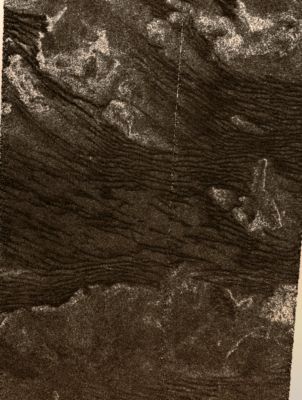
This is a portion of a Cassini Radar Mapper image obtained by the Cassini Spacecraft on its Dec. 21, 2008, flyby of Saturn's moon Titan. 
The area shown covers the southern boundary of an equatorial band where longitudinal dunes (dunes that form along the wind direction) are pervasive. 
Here the dunes are apparently created by winds locally coming from the West and North-West, and generally blowing toward the East. The dunes are interspersed with radar-bright features that are inferred to rise above the surrounding terrain. 

In the lower part of the image there are no dunes at all, and the texture is more typical of featureless plains observed in many other areas of Titan that lack dunes. 
In this Transition Zone, the sand-sized particles that make up the dunes might not be so plentiful. In this case, insufficient sand to replenish the dunes makes them gradually disappear. 
To compare the nature of these dunes to those seen at the Northern Boundary of the dune fields observed in radar images obtained during the T3 flyby on Feb. 15, 2005 see PIA07009. 

The image is centered near 19,2° South Lat. and 257,4° West Long. 
It covers an area of about 220 Km (approx. 137 miles) by about 170 Km (approx. 106 miles). North is approximately toward the top of the image, the radar illumination is from the right, and the Solar Incidence Angle is about 25° (meaning that the Sun was 65° above the Local Horizon). 
The vertical stripe across the image at its center is an artifact in this preliminary version.
Parole chiave: Titan

At the Edge of Titan's Dunes

This is a portion of a Cassini Radar Mapper image obtained by the Cassini Spacecraft on its Dec. 21, 2008, flyby of Saturn's moon Titan.
The area shown covers the southern boundary of an equatorial band where longitudinal dunes (dunes that form along the wind direction) are pervasive.
Here the dunes are apparently created by winds locally coming from the West and North-West, and generally blowing toward the East. The dunes are interspersed with radar-bright features that are inferred to rise above the surrounding terrain.

In the lower part of the image there are no dunes at all, and the texture is more typical of featureless plains observed in many other areas of Titan that lack dunes.
In this Transition Zone, the sand-sized particles that make up the dunes might not be so plentiful. In this case, insufficient sand to replenish the dunes makes them gradually disappear.
To compare the nature of these dunes to those seen at the Northern Boundary of the dune fields observed in radar images obtained during the T3 flyby on Feb. 15, 2005 see PIA07009.

The image is centered near 19,2° South Lat. and 257,4° West Long.
It covers an area of about 220 Km (approx. 137 miles) by about 170 Km (approx. 106 miles). North is approximately toward the top of the image, the radar illumination is from the right, and the Solar Incidence Angle is about 25° (meaning that the Sun was 65° above the Local Horizon).
The vertical stripe across the image at its center is an artifact in this preliminary version.

Titan-Regions-Hotei_Arcus_Region-PIA11839-1.jpg Titan-N00051470.gif Titan-Dunes-PIA11802.jpg Titan-Map-PIA11146.jpg Titan-Clouds-Cloud_System-GIFMovie-W00002371-W00002379.gif
Informazioni sul file
Nome del file:Titan-Dunes-PIA11802.jpg
Nome album:MareKromium / Titan: The "Foggy" Moon
Valutazione (4 voti):55555(Mostra dettagli)
Parole chiave:Titan
Copyright:NASA/JPL/Space Science Institute e Lunar Explorer Italia per l'additional process. e la colorizzazione
Dimensione del file:293 KiB
Data di inserimento:Feb 26, 2009
Dimensioni:1042 x 1378 pixels
Visualizzato:59 volte
URL:https://www.lunexit.it/gallery/displayimage.php?pid=23757
Preferiti:Aggiungi ai preferiti


Powered by Coppermine Photo Gallery