Inizio Registrati Login

Elenco album Ultimi arrivi Ultimi commenti Più viste Più votate Preferiti Cerca

Inizio > SOLAR SYSTEM > Jupiter: the "King" and His Moons
Ritorna alla pagina delle miniature FILE 14991/25353 Torna all'inizio Guarda foto precedente Guarda foto successiva Salta alla fine
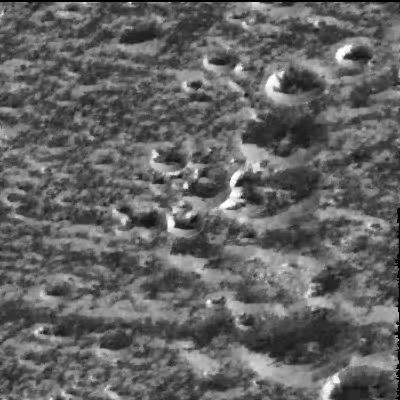
Frost on crater-tops of Ganymede
Scientists believe that water-ice frosts are the likely cause for the brightening seen around the circular rims of these craters located at a high northern latitude (57°) on Jupiter's moon Ganymede in this image taken by NASA's Galileo spacecraft on September 6, 1996. The image shows the same kind of bright, high-latitude surface areas as those first seen by the Voyager 1 spacecraft in 1979, but at higher resolution (this image spans about 18 Km - or 11 miles on a side). Even though the Sun is shining from the south, the north-facing walls of the ridges and craters are brighter than the walls facing the Sun. This is interpreted to mean that the very bright north-facing slopes are covered with surface water-ice frosts, and that these frosts preferentially accumulate in such high-latitude locations. 
Galileo scientists say that at the HR seen in Galileo images, the high-latitude brightness seen by Voyager 1 might be partly attributable to frosts forming on cooler, north-facing slopes. The right-hand side of the image is dominated by a north-south line of impact craters; the smallest ones at the top are about 2 kilometers (1.2 miles) in diameter and the large one at the bottom is about 5 kilometers (about 3 miles) in diameter. Ganymede is the largest moon in the solar system, larger than the planet Mercury and nearly the size of Mars.
Parole chiave: Jupiter Moons - Ganymede

Frost on crater-tops of Ganymede

Scientists believe that water-ice frosts are the likely cause for the brightening seen around the circular rims of these craters located at a high northern latitude (57°) on Jupiter's moon Ganymede in this image taken by NASA's Galileo spacecraft on September 6, 1996. The image shows the same kind of bright, high-latitude surface areas as those first seen by the Voyager 1 spacecraft in 1979, but at higher resolution (this image spans about 18 Km - or 11 miles on a side). Even though the Sun is shining from the south, the north-facing walls of the ridges and craters are brighter than the walls facing the Sun. This is interpreted to mean that the very bright north-facing slopes are covered with surface water-ice frosts, and that these frosts preferentially accumulate in such high-latitude locations.
Galileo scientists say that at the HR seen in Galileo images, the high-latitude brightness seen by Voyager 1 might be partly attributable to frosts forming on cooler, north-facing slopes. The right-hand side of the image is dominated by a north-south line of impact craters; the smallest ones at the top are about 2 kilometers (1.2 miles) in diameter and the large one at the bottom is about 5 kilometers (about 3 miles) in diameter. Ganymede is the largest moon in the solar system, larger than the planet Mercury and nearly the size of Mars.

Io-PIA00491.jpg Io-PIA00715.jpg Io-PIA02597.jpg Ganymede-PIA00496.jpg The Sun-W00011347.jpg
Informazioni sul file
Nome del file:Ganymede-PIA00496.jpg
Nome album:Jupiter: the "King" and His Moons
Valutazione (6 voti):55555(Mostra dettagli)
Parole chiave:Jupiter / Moons / - / Ganymede
Copyright:NASA - Galileo Project
Dimensione del file:30 KiB
Data di inserimento:Ott 20, 2005
Dimensioni:400 x 400 pixels
Visualizzato:60 volte
URL:https://www.lunexit.it/gallery/displayimage.php?pid=7910
Preferiti:Aggiungi ai preferiti


Powered by Coppermine Photo Gallery