Inizio Registrati Login

Elenco album Ultimi arrivi Ultimi commenti Più viste Più votate Preferiti Cerca

Inizio > SOLAR SYSTEM > Neptune and His Moons
Ritorna alla pagina delle miniature FILE 19651/25353 Torna all'inizio Guarda foto precedente Guarda foto successiva Salta alla fine
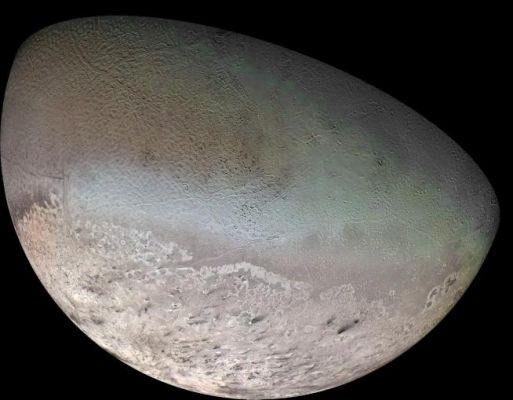
Triton (False Colors; credits: NASA/JPL/USGS)
Caption NASA originale:"The color was synthesized by combining HR images taken through orange, violet and ultraviolet filters; these images were displayed as red, green and blue images and combined to create this color version. With a radius of 1.350 Km, about 22% smaller than Earth's Moon, Triton is by far the largest satellite of Neptune. It is 1 of only 3 objects in the Solar System known to have a nitrogen-dominated atmosphere (the others are Earth and Saturn's giant moon, Titan). Triton has the coldest surface known anywhere in the Solar System (38 K, about -391 degrees F); it is so cold that most of Triton's nitrogen is condensed as frost, making it the only satellite in the Solar System known to have a surface made mainly of nitrogen ice. The pinkish deposits constitute a vast south polar cap believed to contain methane ice, which would have reacted under sunlight to form pink or red compounds. The dark streaks overlying these pink ices are believed to be an icy and perhaps carbonaceous dust deposited from huge geyser-like plumes, some of which were found to be active during the Voyager 2 flyby. The bluish-green band visible in this image extends all the way around Triton near the equator; it may consist of relatively fresh nitrogen frost deposits. The greenish areas includes what is called the cantaloupe terrain, whose origin is unknown, and a set of "cryovolcanic" landscapes apparently produced by icy-cold liquids (now frozen) erupted from Triton's interior".
Parole chiave: Neptune's Moons - Triton

Triton (False Colors; credits: NASA/JPL/USGS)

Caption NASA originale:"The color was synthesized by combining HR images taken through orange, violet and ultraviolet filters; these images were displayed as red, green and blue images and combined to create this color version. With a radius of 1.350 Km, about 22% smaller than Earth's Moon, Triton is by far the largest satellite of Neptune. It is 1 of only 3 objects in the Solar System known to have a nitrogen-dominated atmosphere (the others are Earth and Saturn's giant moon, Titan). Triton has the coldest surface known anywhere in the Solar System (38 K, about -391 degrees F); it is so cold that most of Triton's nitrogen is condensed as frost, making it the only satellite in the Solar System known to have a surface made mainly of nitrogen ice. The pinkish deposits constitute a vast south polar cap believed to contain methane ice, which would have reacted under sunlight to form pink or red compounds. The dark streaks overlying these pink ices are believed to be an icy and perhaps carbonaceous dust deposited from huge geyser-like plumes, some of which were found to be active during the Voyager 2 flyby. The bluish-green band visible in this image extends all the way around Triton near the equator; it may consist of relatively fresh nitrogen frost deposits. The greenish areas includes what is called the cantaloupe terrain, whose origin is unknown, and a set of "cryovolcanic" landscapes apparently produced by icy-cold liquids (now frozen) erupted from Triton's interior".

SOL358-2N158150172EFFA273P0645R0M1.jpg SOL363-2N158593457EFFA2B3P0665L0M1.jpg SOL363-2N158593493EFFA2B3P0665R0M1.jpg Triton-PIA00056_modest.jpg SOL366-2N158863773EFFA2F3P0645L0M1.jpg
Informazioni sul file
Nome del file:Triton-PIA00317_modest.jpg
Nome album:Neptune and His Moons
Valutazione (3 voti):55555(Mostra dettagli)
Parole chiave:Neptune's / Moons / - / Triton
Copyright:NASA - Voyager 2 Project
Dimensione del file:45 KiB
Data di inserimento:Gen 13, 2005
Dimensioni:654 x 509 pixels
Visualizzato:56 volte
URL:https://www.lunexit.it/gallery/displayimage.php?pid=3944
Preferiti:Aggiungi ai preferiti


Powered by Coppermine Photo Gallery