Inizio Registrati Login

Elenco album Ultimi arrivi Ultimi commenti Più viste Più votate Preferiti Cerca

Inizio > SOLAR SYSTEM > Pluto and Charon: The "Double Planet"
Ritorna alla pagina delle miniature FILE 22887/25353 Torna all'inizio Guarda foto precedente Guarda foto successiva Salta alla fine
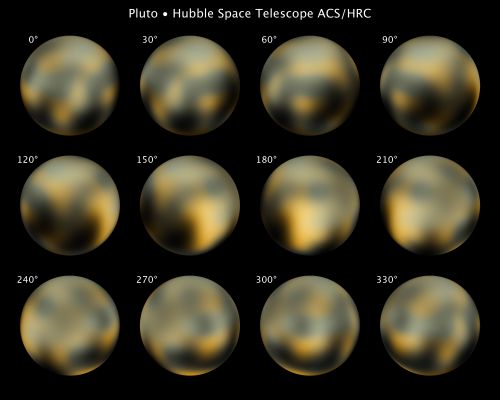
Surface Color-Variations on Pluto
Since its discovery in 1930, Pluto has been a speck of light in the largest ground-based telescopes. But NASA's Hubble Space Telescope has now mapped the Dwarf Planet in never-before-seen detail. The new map is so good, astronomers have even been able to detect changes on the Dwarf Planet's Surface by comparing Hubble images taken in 1994 with the newer images taken in 2002-2003. The task is as challenging as trying to see the markings on a soccer ball 40 miles away.

Hubble's view isn't sharp enough to see craters or mountains, if they exist on the surface, but Hubble reveals a complex-looking and variegated world with white, dark-orange, and charcoal-black terrain. The overall color is believed to be a result of UltraViolet radiation from the distant Sun breaking up Methane that is present on Pluto's Surface, leaving behind a dark, molasses-colored, carbon-rich residue. 
Astronomers were very surprised to see that Pluto's brightness has changed — the Northern Pole is brighter and the Southern Hemisphere is darker and redder. Summer is approaching Pluto's North Pole, and this may cause surface ices to melt and refreeze in the colder shadowed portion of the Planet. The Hubble pictures underscore that Pluto is not simply a ball of ice and rock but a dynamic world that undergoes dramatic atmospheric changes.
Parole chiave: Pluto

Surface Color-Variations on Pluto

Since its discovery in 1930, Pluto has been a speck of light in the largest ground-based telescopes. But NASA's Hubble Space Telescope has now mapped the Dwarf Planet in never-before-seen detail. The new map is so good, astronomers have even been able to detect changes on the Dwarf Planet's Surface by comparing Hubble images taken in 1994 with the newer images taken in 2002-2003. The task is as challenging as trying to see the markings on a soccer ball 40 miles away.

Hubble's view isn't sharp enough to see craters or mountains, if they exist on the surface, but Hubble reveals a complex-looking and variegated world with white, dark-orange, and charcoal-black terrain. The overall color is believed to be a result of UltraViolet radiation from the distant Sun breaking up Methane that is present on Pluto's Surface, leaving behind a dark, molasses-colored, carbon-rich residue.
Astronomers were very surprised to see that Pluto's brightness has changed — the Northern Pole is brighter and the Southern Hemisphere is darker and redder. Summer is approaching Pluto's North Pole, and this may cause surface ices to melt and refreeze in the colder shadowed portion of the Planet. The Hubble pictures underscore that Pluto is not simply a ball of ice and rock but a dynamic world that undergoes dramatic atmospheric changes.

Prometheus-4311527645_dc29b5404a_o.jpg OPP-SOL2137-Pancam.jpg Dione-EB-4311210639_db673f3300_b.jpg SOL2163-PANCAM-MF-LXXT1.jpg PSP_001503_1645_RED_abrowse-00.jpg
Informazioni sul file
Nome del file:Pluto-421596main_s1006ay-1.jpg
Nome album:MareKromium / Pluto and Charon: The "Double Planet"
Valutazione (4 voti):55555(Mostra dettagli)
Parole chiave:Pluto
Copyright:NASA, ESA, and M. Buie (Southwest Research Institute)
Dimensione del file:624 KiB
Data di inserimento:Feb 05, 2010
Dimensioni:3000 x 2400 pixels
Visualizzato:55 volte
URL:https://www.lunexit.it/gallery/displayimage.php?pid=26240
Preferiti:Aggiungi ai preferiti


Powered by Coppermine Photo Gallery