Inizio Registrati Login

Elenco album Ultimi arrivi Ultimi commenti Più viste Più votate Preferiti Cerca

Inizio > MARS > Mars Reconnaissance Orbiter (MRO)
Ritorna alla pagina delle miniature FILE 19935/25353 Torna all'inizio Guarda foto precedente Guarda foto successiva Salta alla fine
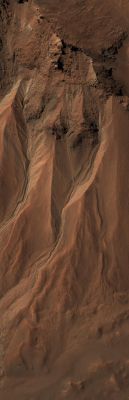
Gullies at the Edge of Hale Crater (Natural Colors; credits: NASA/JPL/Univ. of Arizona)
This image from the High Resolution Imaging Science Experiment (HiRISE) camera on NASA's Mars Reconnaissance Orbiter shows Gullies near the edge of Hale Crater on Southern Mars. The view covers an area about 1 Km (0,6 miles) across and was taken on Aug. 3, 2009. 
Martian Gullies carved into hill slopes and the walls of impact craters were discovered several years ago. Scientists are excited to study these features because, on Earth, they usually form through the action of liquid water -- long thought to be absent on the Martian Surface. Whether liquid water carves gullies under today's cold and dry conditions on Mars is a major question that planetary scientists are trying to answer. 

The Gullies pictured here are examples of what a typical Martian Gully looks like. You can see wide V-shaped channels running downhill (from top to bottom) where the material that carved the gully flowed. At the bottom of the channel this material empties out onto a fan-shaped mound. The fans from each gully overlap one other in complicated ways. At the tops of the channels, large amphitheater-shaped alcoves are carved in the rock. The material removed from these alcoves likely flowed downhill to the aprons through the Gullies. 
The terrain in this image is at 36,5° South Latitude and 322,7° East Longitude. 

Gullies at this site are especially interesting because scientists recently discovered actively changing examples at similar locations. Images separated by several years showed changes in the appearance of some of these Gullies. Today, planetary scientists are using the HiRISE camera to examine Gullies such as the one in this image for change that might provide a clue about whether liquid water occurs on the Surface of Mars. 

Full-frame images, catalogued as ESP_014153_1430, are at http://hirise.lpl.arizona.edu/ESP_014153_1430. 
The image was taken at 2:21 p.m. Local Mars Time, with the sun 54° above the horizon (S.I.A. = 36°). 
The season was Summer in the Southern Hemisphere of Mars.
Parole chiave: Mars from orbit - Craters - Hale Crater

Gullies at the Edge of Hale Crater (Natural Colors; credits: NASA/JPL/Univ. of Arizona)

This image from the High Resolution Imaging Science Experiment (HiRISE) camera on NASA's Mars Reconnaissance Orbiter shows Gullies near the edge of Hale Crater on Southern Mars. The view covers an area about 1 Km (0,6 miles) across and was taken on Aug. 3, 2009.
Martian Gullies carved into hill slopes and the walls of impact craters were discovered several years ago. Scientists are excited to study these features because, on Earth, they usually form through the action of liquid water -- long thought to be absent on the Martian Surface. Whether liquid water carves gullies under today's cold and dry conditions on Mars is a major question that planetary scientists are trying to answer.

The Gullies pictured here are examples of what a typical Martian Gully looks like. You can see wide V-shaped channels running downhill (from top to bottom) where the material that carved the gully flowed. At the bottom of the channel this material empties out onto a fan-shaped mound. The fans from each gully overlap one other in complicated ways. At the tops of the channels, large amphitheater-shaped alcoves are carved in the rock. The material removed from these alcoves likely flowed downhill to the aprons through the Gullies.
The terrain in this image is at 36,5° South Latitude and 322,7° East Longitude.

Gullies at this site are especially interesting because scientists recently discovered actively changing examples at similar locations. Images separated by several years showed changes in the appearance of some of these Gullies. Today, planetary scientists are using the HiRISE camera to examine Gullies such as the one in this image for change that might provide a clue about whether liquid water occurs on the Surface of Mars.

Full-frame images, catalogued as ESP_014153_1430, are at http://hirise.lpl.arizona.edu/ESP_014153_1430.
The image was taken at 2:21 p.m. Local Mars Time, with the sun 54° above the horizon (S.I.A. = 36°).
The season was Summer in the Southern Hemisphere of Mars.

OPP-SOL1950-MF.jpg OPP-SOL1957-1_copia2.jpg SOL2016-GB2.jpg OPP-SOL1950-GB-LXT-3.jpg Tethys-PIA11572.jpg
Informazioni sul file
Nome del file:PIA12194.jpg
Nome album:MareKromium / Mars Reconnaissance Orbiter (MRO)
Valutazione (4 voti):55555(Mostra dettagli)
Parole chiave:Mars / from / orbit / - / Craters / - / Hale / Crater
Copyright:NASA/JPL/Univ. of Arizona
Dimensione del file:660 KiB
Data di inserimento:Set 05, 2009
Dimensioni:1347 x 4170 pixels
Visualizzato:57 volte
URL:https://www.lunexit.it/gallery/displayimage.php?pid=25244
Preferiti:Aggiungi ai preferiti

Commento 1 a 2 di 2
Pagina: 1

walthari   [Set 05, 2009 at 02:11 PM]
splendido esempio di erosione e trasporto da corsi d'acqua,peccato che in quest'immagine non si veda il caratteristico alluvional-fan alla base del rilievo
MareKromium   [Set 06, 2009 at 12:54 PM]
Ciao Walt Ho pubblicato oggi il ctx frame. Aspetto tue note & commenti, as usual. Un abbraccio e Buona Domenica! paolo

Commento 1 a 2 di 2
Pagina: 1


Powered by Coppermine Photo Gallery