|
|
Impact on Jupiter! (from Hubble Space Telescope - ctx frame)
|
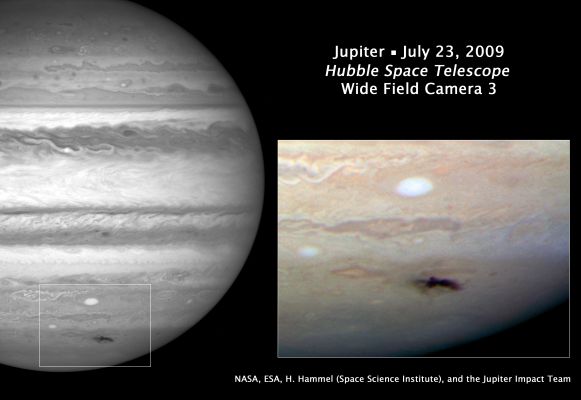
NASA scientists have interrupted the checkout and calibration of the Hubble Space Telescope to aim the recently refurbished observatory at a new expanding spot on the giant planet Jupiter. The spot, caused by the impact of a comet or an asteroid, is changing day to day in the Planet's cloud tops.
For the past several days the world's largest telescopes have been trained on Jupiter. Not to miss the potentially new science in the unfolding drama 360 MMs away, Space Telescope Science Institute director Matt Mountain allocated discretionary time to a team of astronomers led by Heidi Hammel of the Space Science Institute in Boulder, Colo.
The Hubble picture, taken on July 23, 2009, is the sharpest visible-light picture taken of the impact feature. The observations were made with Hubble's new camera, the Wide Field Camera 3 (WFC3).
"This image of the impact on Jupiter is fantastic" said U.S. Senator Barbara A. Mikulski, D-Md., chairwoman of the Commerce, Justice and Science Appropriations Subcommittee. "It tells us that our astronauts and ground crew at the Goddard Space Flight Center successfully repaired the Hubble telescope".
"This is just one example of what Hubble's new, state-of-the-art camera can do, thanks to the STS-125 astronauts and the entire Hubble team," said Ed Weiler, associate administrator of NASA's Science Mission Directorate. "However, the best is yet to come!".
"Hubble's truly exquisite imaging capability has revealed an astonishing wealth of detail in the 2009 impact site" said Hammel. "By combining these images with our ground-based data at other wavelengths, our Hubble data will allow a comprehensive understanding of exactly what is happening to the impact debris. My sincerest congratulations and thanks to the team who created Wide Field Camera 3 and to the astronauts who installed it!".
Co-investigator Imke de Pater of the University of California at Berkeley said: "The combination of the Hubble data with mid-infrared images from the Gemini telescope will give us an insight into changes of the vertical structure of the atmosphere due to the impact".
|
|