|
|
Raditladi Basin
|
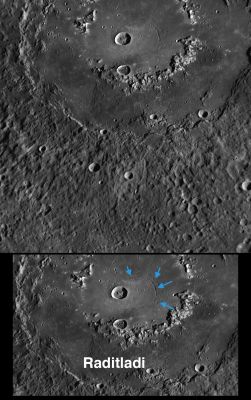
Raditladi Basin, imaged during MESSENGER's first Mercury flyby and named in April 2008 (PIA10611), is intriguing for several reasons. Shown extending across the top of this high-resolution NAC image, Raditladi Basin is relatively young, with only a few small impact craters on its floor and with well-preserved walls and peak-ring structure.
Visible on the floor of Raditladi are concentric troughs (blue arrows), formed by extension (pulling apart) of the surface. However, extensional troughs on Mercury are quite rare, having been seen to date only in two other locations on the Planet: as part of Pantheon Fossae and other troughs in Caloris Basin and on the floor of Rembrandt, the large basin discovered during MESSENGER's second Mercury flyby (see PIA11769).
Understanding how these troughs formed in the young Raditladi Basin could provide an important indicator of processes that acted relatively recently in Mercury’s geologic history.
Raditladi Basin was the topic of one of 25 presentations made by MESSENGER team members at the 40th Lunar and Planetary Science Conference held last week (April 2009).
Date Acquired: January 14, 2008
Image Mission Elapsed Time (MET): 108826792
Instrument: Narrow Angle Camera (NAC) of the Mercury Dual Imaging System (MDIS)
Resolution: 250 meters/pixel (0,16 miles/pixel)
Scale: Raditladi basin has a diameter of approx. 257 Km (about 160 miles)
Spacecraft Altitude: approx. 10.000 Km (about 6200 miles)
|
|