|
|
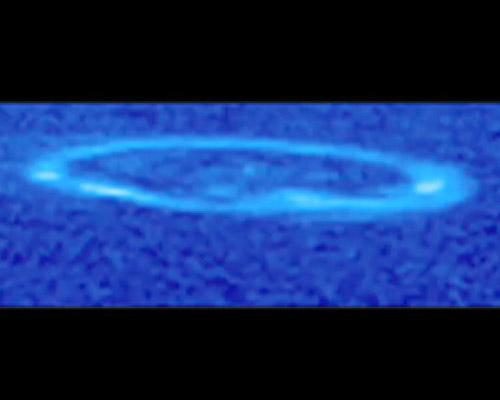
Saturnian Aurora
|
Caption NASA:"Glowing like a neon lasso, Saturn’s Aurora is seen spinning above Saturn’s North Pole over the course of most of a Saturn day in this image taken by the ultraviolet imaging spectrograph on NASA’s Cassini Spacecraft.
Saturn’s auroral lights are the result of a rain of electrically charged particles from the magnetic bubble, called the Magnetosphere, that surrounds the Planet.
When the particles strike gaseous Hydrogen in Saturn’s Atmosphere, the Hydrogen becomes excited and glows, creating Aurorae. Neon signs work in a similar way: electricity is used to excite a gas, usually Neon or Argon, in a tube.
Changes that occur in Saturn’s Magnetosphere can cause fluctuations in the Aurora. Undulations in the Aurora may be caused by waves moving along magnetic field lines.
A surge in auroral brightness is the result of a sudden injection of particles into the Magnetosphere. These charged particles come from a variety of sources, including the Sun, Saturn’s Rings, and the water ice plume of Saturn’s moon Enceladus.
This image was taken on May, 25th, 2007.
Saturn's Aurorae were discovered by NASA’s Pioneer 11 Spacecraft in 1979 and observed in the Saturn flybys by the NASA Voyager 1 and 2 Spacecrafts in the early '80s. NASA’s Hubble Space Telescope first obtained images of an Aurora in 1994. From Cassini’s always-changing orbit around Saturn, fresh observations in UltraViolet and InfraRed wavelengths are being combined with other data to help characterize similarities and differences among the Aurorae of Saturn, Jupiter and Earth".
|
|