Inizio Registrati Login

Elenco album Ultimi arrivi Ultimi commenti Più viste Più votate Preferiti Cerca

Inizio > SOLAR SYSTEM > Mercury
Ritorna alla pagina delle miniature FILE 21082/25353 Torna all'inizio Guarda foto precedente Guarda foto successiva Salta alla fine
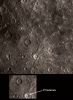
Various Mercurian Surface Features (natural colors; credits: Lunar Explorer Italia)
This NAC image displays a number of interesting geologic features characteristic of Mercury’s Surface. 
The Crater indicated by the yellow arrow has unusual bright material on its floor, likely due to rocks of a different chemical composition. Bright material also has been seen in the craters Sander and Kertész. 
The pink arrows point to a pair of larger and older craters that have been flooded with now solidified volcanic lava, similar to flooding seen at the impact basin Raphael. In the lower right-hand corner of the image is a large peak-ring Basin, about 210 Km (approx. 130 miles) in diameter, which also appears to have been flooded with lava. There is also a small Scarp (or "Cliff") within that Basin that cuts through a smaller crater at the edge of the Basin's inner ring, at the point indicated by the blue arrow. 
Scarps on Mercury are often seen intersecting Impact Craters, such as this dramatic, previously released image from the mission's second Mercury flyby (see, for example, PIA11358). 
The green arrows on the left side of the image indicate a series of Secondary Crater Chains. Chains of small craters such as these are formed when ejecta are expelled from a Primary Crater after the initial impact. Secondaries are widespread across Mercury's Surface, as was also discussed in the caption to this previously released image (see PIA10178). 
Unraveling Mercury's Geologic History requires investigating the complex and overlapping relationships of Volcanic Plains, Impacts and Scarps seen on the Planet's Surface. 

Date Acquired: October 6, 2008
Image Mission Elapsed Time (MET): 131774026
Instrument: Narrow Angle Camera (NAC) of the Mercury Dual Imaging System (MDIS)
Resolution: 540 meters/pixel (0,33 miles/pixel)
Scale: This image is about 550 Km (approx. 340 miles) across
Spacecraft Altitude: about 21.000 Km (approx. 13.000 miles)
Parole chiave: Mercury's Fly-by

Various Mercurian Surface Features (natural colors; credits: Lunar Explorer Italia)

This NAC image displays a number of interesting geologic features characteristic of Mercury’s Surface.
The Crater indicated by the yellow arrow has unusual bright material on its floor, likely due to rocks of a different chemical composition. Bright material also has been seen in the craters Sander and Kertész.
The pink arrows point to a pair of larger and older craters that have been flooded with now solidified volcanic lava, similar to flooding seen at the impact basin Raphael. In the lower right-hand corner of the image is a large peak-ring Basin, about 210 Km (approx. 130 miles) in diameter, which also appears to have been flooded with lava. There is also a small Scarp (or "Cliff") within that Basin that cuts through a smaller crater at the edge of the Basin's inner ring, at the point indicated by the blue arrow.
Scarps on Mercury are often seen intersecting Impact Craters, such as this dramatic, previously released image from the mission's second Mercury flyby (see, for example, PIA11358).
The green arrows on the left side of the image indicate a series of Secondary Crater Chains. Chains of small craters such as these are formed when ejecta are expelled from a Primary Crater after the initial impact. Secondaries are widespread across Mercury's Surface, as was also discussed in the caption to this previously released image (see PIA10178).
Unraveling Mercury's Geologic History requires investigating the complex and overlapping relationships of Volcanic Plains, Impacts and Scarps seen on the Planet's Surface.

Date Acquired: October 6, 2008
Image Mission Elapsed Time (MET): 131774026
Instrument: Narrow Angle Camera (NAC) of the Mercury Dual Imaging System (MDIS)
Resolution: 540 meters/pixel (0,33 miles/pixel)
Scale: This image is about 550 Km (approx. 340 miles) across
Spacecraft Altitude: about 21.000 Km (approx. 13.000 miles)

Craters-Unnamed_Crater_with_Gullies-PCF-LXTT.jpg PSP_001521_2025_RED_abrowse-00.jpg SOL429-GB.jpg ZZ-Mercury-Craters-Enwonwu_Crater-PIA11784-1.jpg SOL477-2P168726853EDNAAACP2618L2M1.jpg
Informazioni sul file
Nome del file:ZZ-Mercury-Global_View_of_the_Surface-PIA11795_fig1.jpg
Nome album:MareKromium / Mercury
Valutazione (3 voti):55555(Mostra dettagli)
Parole chiave:Mercury's / Fly-by
Copyright:NASA/Johns Hopkins University Applied Physics Laboratory/Carnegie Institution of Washington e Lunar Explorer Italia per l'additional processing e la colorizzazione
Dimensione del file:386 KiB
Data di inserimento:Feb 11, 2009
Dimensioni:1499 x 1500 pixels
Visualizzato:56 volte
URL:https://www.lunexit.it/gallery/displayimage.php?pid=23563
Preferiti:Aggiungi ai preferiti


Powered by Coppermine Photo Gallery