Inizio Registrati Login

Elenco album Ultimi arrivi Ultimi commenti Più viste Più votate Preferiti Cerca

Inizio > SOLAR SYSTEM > Mercury
Ritorna alla pagina delle miniature FILE 18607/25353 Torna all'inizio Guarda foto precedente Guarda foto successiva Salta alla fine
Faults in Caloris Basin
As the youngest large impact basin known on Mercury, the Caloris Basin has landforms that are better preserved than in older basins, which have been more modified by impact cratering. 
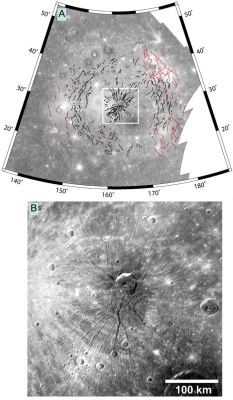
This figure, recently published in Science magazine, shows a map of many linear features within Caloris Basin that formed when the near-surface rocks were subjected to large horizontal forces. The Caloris Basin contains hundreds of extensional troughs, mapped as black lines, where the surface has been pulled apart and faulted. 
Pantheon Fossae (located inside the white box of the top map and shown in detail in the bottom image) has over 200 such troughs in a radiating pattern, but near the outer edges of the basin interior troughs are seen in patterns broadly concentric to Caloris Basin. The Caloris Basin interior also has been deformed by many wrinkle ridges, mapped as red lines, formed when the surface was compressed or shortened horizontally. Relationships between the extensional troughs and contractional wrinkle ridges provide information about the evolution of the Caloris basin and Mercury's interior. 

Date Acquired: January 14, 2008
Instrument: Narrow Angle Camera (NAC) of the Mercury Dual Imaging System (MDIS) 
Scale: Caloris Basin is about 1550 Km (approx. 960 miles) in diameter. The crater Apollodorus near the center of Pantheon Fossae is about 41 Km (approx. 25 miles) in diameter. 
Parole chiave: Mercury

Faults in Caloris Basin

As the youngest large impact basin known on Mercury, the Caloris Basin has landforms that are better preserved than in older basins, which have been more modified by impact cratering.
This figure, recently published in Science magazine, shows a map of many linear features within Caloris Basin that formed when the near-surface rocks were subjected to large horizontal forces. The Caloris Basin contains hundreds of extensional troughs, mapped as black lines, where the surface has been pulled apart and faulted.
Pantheon Fossae (located inside the white box of the top map and shown in detail in the bottom image) has over 200 such troughs in a radiating pattern, but near the outer edges of the basin interior troughs are seen in patterns broadly concentric to Caloris Basin. The Caloris Basin interior also has been deformed by many wrinkle ridges, mapped as red lines, formed when the surface was compressed or shortened horizontally. Relationships between the extensional troughs and contractional wrinkle ridges provide information about the evolution of the Caloris basin and Mercury's interior.

Date Acquired: January 14, 2008
Instrument: Narrow Angle Camera (NAC) of the Mercury Dual Imaging System (MDIS)
Scale: Caloris Basin is about 1550 Km (approx. 960 miles) in diameter. The crater Apollodorus near the center of Pantheon Fossae is about 41 Km (approx. 25 miles) in diameter.

PHOE-SOL108-lg31337-31338-31339-2.jpg Mimas-PIA10469.jpg PHOE-SOL108-lg_31544-lg_31569.gif SOL1559-1~0.jpg The_Rings-PIA10470.jpg
Informazioni sul file
Nome del file:ZS-Mercury-PIA11077.jpg
Nome album:MareKromium / Mercury
Valutazione (3 voti):55555(Mostra dettagli)
Parole chiave:Mercury
Copyright:NASA/Johns Hopkins University Applied Physics Laboratory/Arizona State University/Carnegie Institution of Washington
Dimensione del file:137 KiB
Data di inserimento:Set 16, 2008
Dimensioni:692 x 1185 pixels
Visualizzato:57 volte
URL:https://www.lunexit.it/gallery/displayimage.php?pid=21898
Preferiti:Aggiungi ai preferiti


Powered by Coppermine Photo Gallery