Inizio Registrati Login

Elenco album Ultimi arrivi Ultimi commenti Più viste Più votate Preferiti Cerca

Inizio > SOLAR SYSTEM > Jupiter: the "King" and His Moons
Ritorna alla pagina delle miniature FILE 15771/25353 Torna all'inizio Guarda foto precedente Guarda foto successiva Salta alla fine
Zal Region on Io
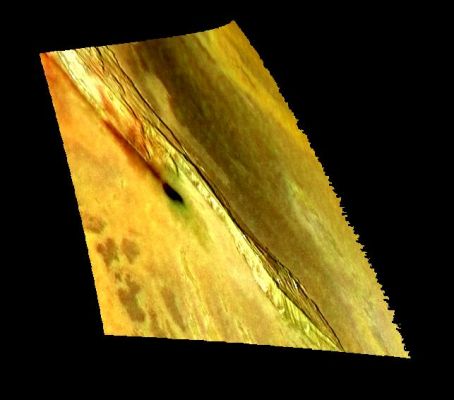
This image shows one of many intriguing mountains on Jupiter's moon Io. The image was made by combining a recent high-resolution, black and white image with earlier low-resolution color data to provide a high-resolution, color view. NASA's Galileo spacecraft took both images.

The 240-kilometer (150-mile) long mountain in the image is south of the volcanic hot spot named Zal. The black and white version of this image was useful for showing the shape of the mountain and the small fans of debris piled against the base of its tall, steep cliffs. However, when colorized the relationship between different types of materials becomes apparent. For example, the bright, red material is believed to contain a compound of sulfur that forms when sulfur is boiled at a high temperature. Active eruptions of molten rock (lava) are the most likely source for the heat. Thus we see red sulfur where lava reaches the surface. Other sulfur compounds cover the yellow areas, and the black areas are fresh silicate lava that has not yet been coated by the yellow sulfurous materials. The green patches are still somewhat mysterious; they appear to form when red sulfur lands on warm lava and the two react in a manner that is still unknown.

In this image, it is clear that the red material has blown out of a long crack along the western side of the mountain. Lava has flowed from this crack and filled a depression (caldera). Some of the red sulfur close to the dark caldera appears to have been converted into green material. The fact that lava comes up along the faults that define the sides of the mountains provides important clues to how the mountains form and the state of the interior of Io. Scientists at the University of Arizona speculate that the formation of the mountains on Io may be related to plumes of hot material rising inside the fiery body of Io.

North is to the top and the setting sun is shining from the west. The image is centered at about 33 degrees north, 72 degrees west. The high-resolution image was taken on February 22, 2000 by NASA's Galileo spacecraft. The image was taken by the Galileo's onboard camera from a range of 33,500 kilometers (20,800 miles) and has a resolution of 335 meters (1,100 feet) per picture element. The color images were taken on July 3, 1999. They have resolutions of 1.3 kilometers (0.81 miles) per picture element and are illuminated from almost directly behind the spacecraft. They were taken at a distance of about 130,000 kilometers(81,000 miles) from Io.


Parole chiave: Jupiter's moons - Io

Zal Region on Io

This image shows one of many intriguing mountains on Jupiter's moon Io. The image was made by combining a recent high-resolution, black and white image with earlier low-resolution color data to provide a high-resolution, color view. NASA's Galileo spacecraft took both images.

The 240-kilometer (150-mile) long mountain in the image is south of the volcanic hot spot named Zal. The black and white version of this image was useful for showing the shape of the mountain and the small fans of debris piled against the base of its tall, steep cliffs. However, when colorized the relationship between different types of materials becomes apparent. For example, the bright, red material is believed to contain a compound of sulfur that forms when sulfur is boiled at a high temperature. Active eruptions of molten rock (lava) are the most likely source for the heat. Thus we see red sulfur where lava reaches the surface. Other sulfur compounds cover the yellow areas, and the black areas are fresh silicate lava that has not yet been coated by the yellow sulfurous materials. The green patches are still somewhat mysterious; they appear to form when red sulfur lands on warm lava and the two react in a manner that is still unknown.

In this image, it is clear that the red material has blown out of a long crack along the western side of the mountain. Lava has flowed from this crack and filled a depression (caldera). Some of the red sulfur close to the dark caldera appears to have been converted into green material. The fact that lava comes up along the faults that define the sides of the mountains provides important clues to how the mountains form and the state of the interior of Io. Scientists at the University of Arizona speculate that the formation of the mountains on Io may be related to plumes of hot material rising inside the fiery body of Io.

North is to the top and the setting sun is shining from the west. The image is centered at about 33 degrees north, 72 degrees west. The high-resolution image was taken on February 22, 2000 by NASA's Galileo spacecraft. The image was taken by the Galileo's onboard camera from a range of 33,500 kilometers (20,800 miles) and has a resolution of 335 meters (1,100 feet) per picture element. The color images were taken on July 3, 1999. They have resolutions of 1.3 kilometers (0.81 miles) per picture element and are illuminated from almost directly behind the spacecraft. They were taken at a distance of about 130,000 kilometers(81,000 miles) from Io.

Saturn-N00014879.jpg OPP-SOL207-1N146561132EFF35B8P0643L0M1.jpg SOL229-2N146694188EFF8600P1805L0M1.jpg Io-Volcanic Plumes and Flares-PIA00703.jpg Ganymede-PIA01515.jpg
Informazioni sul file
Nome del file:Io-Zal Region-PIA02554.jpg
Nome album:Jupiter: the "King" and His Moons
Valutazione (10 voti):55555(Mostra dettagli)
Parole chiave:Jupiter's / moons / - / Io
Copyright:NASA - Galileo Project
Dimensione del file:38 KiB
Data di inserimento:Ago 26, 2004
Dimensioni:643 x 566 pixels
Visualizzato:58 volte
URL:https://www.lunexit.it/gallery/displayimage.php?pid=2139
Preferiti:Aggiungi ai preferiti


Powered by Coppermine Photo Gallery