Inizio Registrati Login

Elenco album Ultimi arrivi Ultimi commenti Più viste Più votate Preferiti Cerca

Inizio > SOLAR SYSTEM > Jupiter: the "King" and His Moons
Ritorna alla pagina delle miniature FILE 14213/25353 Torna all'inizio Guarda foto precedente Guarda foto successiva Salta alla fine
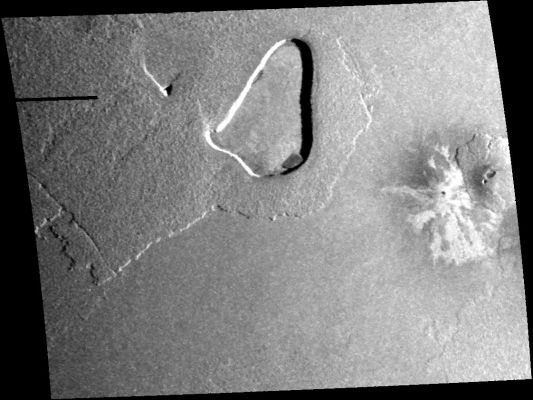
Volcanic Depression near the Equator (Original NASA/Galileo b/w Frame)
This image taken by NASA's Galileo spacecraft on Oct. 16, 2001, near the equator of Jupiter's moon Io shows the contrast in volcanism styles found on Io.

The central feature is a large patera, or volcanic depression, almost 100 kilometers (60 miles) long. It may have formed after eruptions of lava emptied a subsurface magma chamber and left an empty space into which the crust collapsed. Evidence of lava flows associated with this patera, however, is difficult to find. Either the flows have been buried, or perhaps they never erupted and simply drained back deep into the crust.

On the right of the image is a small shield volcano, similar to volcanoes in Hawaii. It is rare for lavas on Io to be thick enough to pile up into shields around vents. They usually run out in thin, long flows instead. This shield abuts some very pale lava flows that emerged from a small vent to the west. These flows could be made of sulfur, like flows at Io's Emakong Patera. The vent is also surrounded by dark, diffuse material, which may be the result of lava erupted in an explosive, gas-rich eruption, similar to the 1980 eruption of Mount Saint Helens in Washington.

North is to the top of the image and the illumination is from the right. The image has a resolution of 330 meters (1,080 feet) per picture element and is 340 (211 miles) kilometers across.


Parole chiave: Jupiter's moons - Io

Volcanic Depression near the Equator (Original NASA/Galileo b/w Frame)

This image taken by NASA's Galileo spacecraft on Oct. 16, 2001, near the equator of Jupiter's moon Io shows the contrast in volcanism styles found on Io.

The central feature is a large patera, or volcanic depression, almost 100 kilometers (60 miles) long. It may have formed after eruptions of lava emptied a subsurface magma chamber and left an empty space into which the crust collapsed. Evidence of lava flows associated with this patera, however, is difficult to find. Either the flows have been buried, or perhaps they never erupted and simply drained back deep into the crust.

On the right of the image is a small shield volcano, similar to volcanoes in Hawaii. It is rare for lavas on Io to be thick enough to pile up into shields around vents. They usually run out in thin, long flows instead. This shield abuts some very pale lava flows that emerged from a small vent to the west. These flows could be made of sulfur, like flows at Io's Emakong Patera. The vent is also surrounded by dark, diffuse material, which may be the result of lava erupted in an explosive, gas-rich eruption, similar to the 1980 eruption of Mount Saint Helens in Washington.

North is to the top of the image and the illumination is from the right. The image has a resolution of 330 meters (1,080 feet) per picture element and is 340 (211 miles) kilometers across.

Saturn from approx. 9.000.000 Km (2).jpg SA-Night On Saturn.jpg Saturn from 8.200.000 Km.jpg Io-Telegonus Mensa-PIA03528_modest.jpg Io-Chain of Craters-PIA02566.jpg
Informazioni sul file
Nome del file:Io-Volcanic_Depression-PIA03532_modest1.jpg
Nome album:Jupiter: the "King" and His Moons
Valutazione (13 voti):55555(Mostra dettagli)
Parole chiave:Jupiter's / moons / - / Io
Copyright:NASA - Galileo Project
Dimensione del file:139 KiB
Data di inserimento:Ago 25, 2004
Dimensioni:1122 x 842 pixels
Visualizzato:60 volte
URL:https://www.lunexit.it/gallery/displayimage.php?pid=2122
Preferiti:Aggiungi ai preferiti


Powered by Coppermine Photo Gallery