|
|
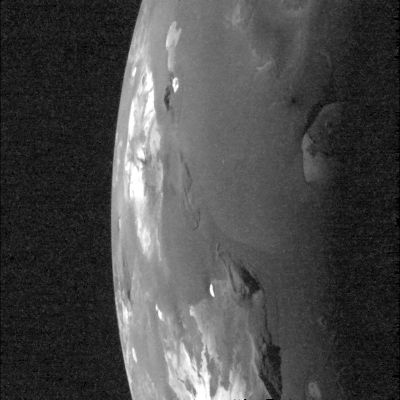
Io: the Loki Volcano from Galileo (RAW-HR and b/w Original NASA-Galileo Spacecraft Frame)
|
Caption NASA:"Light from the setting Sun falls across the Loki Volcanic Region on Jupiter's moon Io in this image taken by NASA's Galileo Spacecraft taken on October, 16, 2001.
The image was taken to examine the relative depths and heights of the major Surface Features existing in the Region. The Sun illuminates the surface from the right. Galileo's camera caught the large Volcanic Crater, or "Patera" of Loki near the Terminator (such as the boundary line between night and day). The image also shows several smaller craters plus shadows cast by the high peaks of several mountains.
Shadows cast by the low Sun should reveal any topography associated with Loki, such as a plateau in the center of the Patera or high Patera Walls. The near absence of shadows in this Region surprised Galileo scientists, as they had expected much more pronounced topography near Loki.
Another surprising aspect of this image is that features that have been black in previous Voyager and Galileo images of Loki, such as the dark Lava Flows visible inside the Patera, are here brighter than their surroundings. The best explanation is that the shiny, glassy surfaces of chilled Lava Flows look extremely dark when the Sun is directly overhead, but they reflect the Sun's light comparatively well when it shines at a low angle, in a similar manner to the reflective surfaces of bodies of water.
Other Volcanic Paterae in this image show the same unusual reflectance as seen at Loki. Some of them are being viewed at such an angle that these reflections from Lava Flows are the brightest features in the image. This image tells us that Lava Flows on Io chill quickly and form glassy surfaces, not unlike recently cooled lava flows in Hawaii.
The image has a resolution of about 1,1 Km (approx. 0,7 miles) per picture element. North is to the top of the picture".
|
|