Inizio Registrati Login

Elenco album Ultimi arrivi Ultimi commenti Più viste Più votate Preferiti Cerca

Inizio > MARS > Mars Reconnaissance Orbiter (MRO)
Ritorna alla pagina delle miniature FILE 18980/25353 Torna all'inizio Guarda foto precedente Guarda foto successiva Salta alla fine
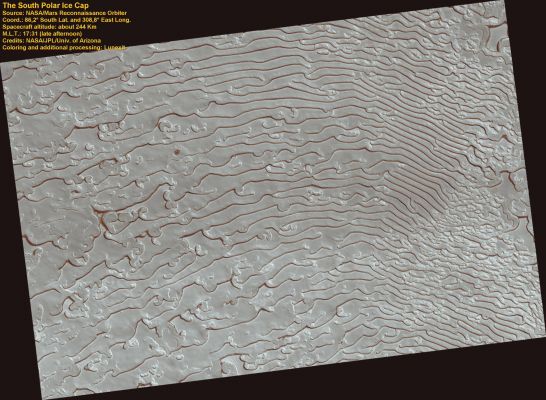
Fingerprint Terrain with Sawtooth Patterns in the South Polar Ice Cap (Natural Colors; credits for the additional process. and color.: Dr Paolo C. Fienga - Lunexit Team)
This image shows a portion of the South Polar Ice Cap. The ice you see here is frozen CO2 rather than the frozen water you are used to here on Earth. 
Even on Mars, where the temperatures are much lower than on Earth, CO2 ice is a volatile substance. As it is so unstable, large amounts can sublimate very quickly when heated. In this ice cap we can see icy features shrink in size by several meters per year as the ice that makes them up is removed by solar heating. Usually these icy features are almost circular as you get equal amounts of Sunlight from every direction when you are at the Pole.
However, in this location something strange has happened. Instead of the usual circular features we see features that are decidedly linear in shape. These sets of linear features have been dubbed "fingerprint terrain" by Planetary Scientists. They are seen in several locations in this ice cap and usually have a wavelength close to 90 mt (295 feet). It's hard to understand why linear features would form in this sort of environment by sublimation of ice alone. 
It is possible that these features are formed instead by atmospheric processes. Either the features are sand dunes covered by a thin covering of frost or they might be made up of loose ice crystals that saltate like sand grains and have collected into ripples.
It would be a huge surprise to find sand dunes in this location, just as you wouldn't expect to see sand dunes on top of the Greenland ice sheet on Earth. To confirm that they are made of CO2 ice, HiRISE will image this location again at the end of the year and compare it to this image to look for changes. 
Icy features should show large changes, but sand dunes move much more slowly. 
Parole chiave: Mars from orbit - South Polar Cap

Fingerprint Terrain with Sawtooth Patterns in the South Polar Ice Cap (Natural Colors; credits for the additional process. and color.: Dr Paolo C. Fienga - Lunexit Team)

This image shows a portion of the South Polar Ice Cap. The ice you see here is frozen CO2 rather than the frozen water you are used to here on Earth.
Even on Mars, where the temperatures are much lower than on Earth, CO2 ice is a volatile substance. As it is so unstable, large amounts can sublimate very quickly when heated. In this ice cap we can see icy features shrink in size by several meters per year as the ice that makes them up is removed by solar heating. Usually these icy features are almost circular as you get equal amounts of Sunlight from every direction when you are at the Pole.
However, in this location something strange has happened. Instead of the usual circular features we see features that are decidedly linear in shape. These sets of linear features have been dubbed "fingerprint terrain" by Planetary Scientists. They are seen in several locations in this ice cap and usually have a wavelength close to 90 mt (295 feet). It's hard to understand why linear features would form in this sort of environment by sublimation of ice alone.
It is possible that these features are formed instead by atmospheric processes. Either the features are sand dunes covered by a thin covering of frost or they might be made up of loose ice crystals that saltate like sand grains and have collected into ripples.
It would be a huge surprise to find sand dunes in this location, just as you wouldn't expect to see sand dunes on top of the Greenland ice sheet on Earth. To confirm that they are made of CO2 ice, HiRISE will image this location again at the end of the year and compare it to this image to look for changes.
Icy features should show large changes, but sand dunes move much more slowly.

as16-106-17278.jpg as16-120-19279.jpg as16-119-19171.jpg as16-119-19096.jpg Craters-Unnamed_Crater_with_possible_Oil_Lake-V07738009-PCF-LXTT-02.jpg
Informazioni sul file
Nome del file:PSP_004820_0940_RED_browse.jpg
Nome album:MareKromium / Mars Reconnaissance Orbiter (MRO)
Valutazione (4 voti):55555(Mostra dettagli)
Parole chiave:Mars / from / orbit / - / South / Polar / Cap
Copyright:NASA/JPL/University of Arizona e Lunar Explorer Italia per l'ingrandimento, la pulizia digitale e la colorizzazione del frame
Dimensione del file:1163 KiB
Data di inserimento:Ago 23, 2007
Dimensioni:3484 x 2550 pixels
Visualizzato:57 volte
URL:https://www.lunexit.it/gallery/displayimage.php?pid=17915
Preferiti:Aggiungi ai preferiti


Powered by Coppermine Photo Gallery