|
|
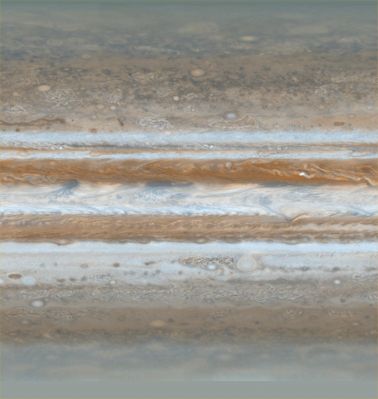
Super-detailed Jupiter's Map (2)
|
The map shows a variety of colorful cloud features, including parallel reddish-brown and white bands, the Great Red Spot - frame 1), multi-lobed chaotic regions, white ovals and many small vortices. Many clouds appear in streaks and waves due to continual stretching and folding by Jupiter's winds and turbulence. The bluish-gray features along the north edge of the central bright band are equatorial "hot spots" meteorological systems such as the one entered by NASA's Galileo probe. Small bright spots within the orange band north of the Equator are lightning-bearing thunderstorms. The Polar Regions are less clearly visible because Cassini viewed them at an angle and through thicker atmospheric haze.
Pixels in the rectangular map cover equal increments of planetocentric latitude (which is measured relative to the center of the Planet) and longitude, extending to 180° of latitude and 360° of longitude.
|
|